
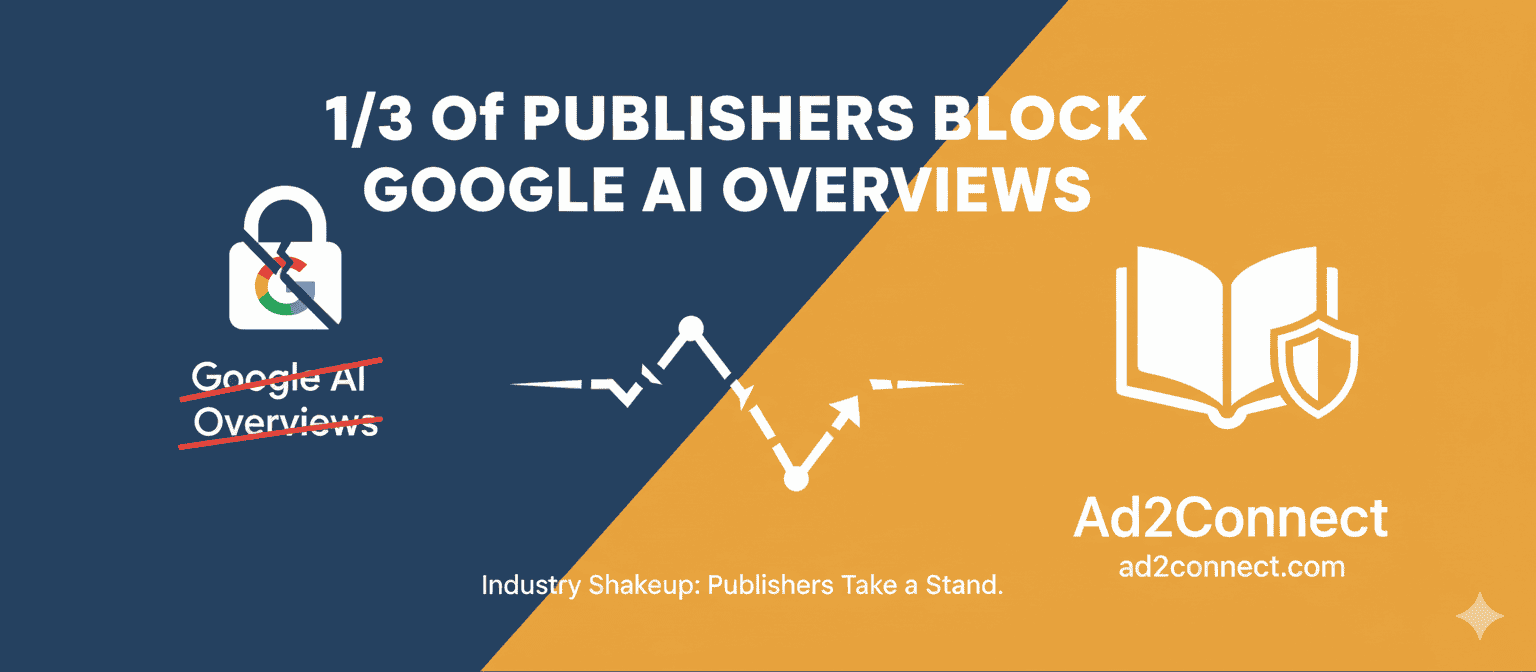
1/3 of Publishers Say They Will Block Google AI Overviews
Google’s search results are undergoing one of the biggest transformations since the rise of mobile. With the launch of AI Overviews, users can now receive instant, AI-generated answers at the top of search results instead of clicking through multiple websites.
But this convenience comes at a cost.
For publishers in the United States, Europe, and other major digital markets, this is not just a technical choice. It is a strategic decision that could redefine how content is created, discovered, and monetized in the AI-powered web.
What Are Google AI Overviews?
Google AI Overviews are part of its evolving Search Generative Experience. These AI-driven summaries appear above traditional organic listings and provide users with synthesized answers pulled from multiple web sources.
Instead of showing ten blue links, Google now often delivers a full explanation directly on the results page.
This shift changes how users consume information, how publishers earn revenue, and how SEO performance is measured. For searchers, AI Overviews mean faster answers. For publishers, they can mean fewer visits and reduced visibility.
Why Publishers Are Blocking Google AI Overviews
The movement toward publishers blocking Google AI Overviews is driven by several converging pressures.
First, traffic decline is a major concern. When users get complete answers directly in search results, there is little incentive to click through to the source website. This weakens the traditional exchange of value between Google and publishers.
Second, monetization is threatened. Fewer page views translate into fewer ad impressions, lower affiliate conversions, and shrinking subscription opportunities.
Third, content ownership remains unresolved. Many publishers feel their work is being repurposed without explicit licensing or compensation. Their journalism, research, and original reporting are becoming training and output material for AI systems without clear attribution or financial return.
Finally, brand visibility is diluted. While AI Overviews may cite sources, users often remember the answer rather than the publication that produced it.
How Publishers Are Restricting AI Access
Publishers are exploring several technical and policy-based methods to control how their content is used.
They are updating robots.txt files to restrict AI crawlers, implementing noai and nosnippet directives, strengthening paywalls, and negotiating licensing frameworks with AI companies.
Some publishers are choosing a hybrid approach: allowing indexing for traditional search while restricting generative reuse. This allows them to remain discoverable while protecting proprietary content from being summarized into zero-click answers.
SEO Impact and Behavioral Changes
AI Overviews are reshaping user behavior in measurable ways.
Searchers now spend more time scanning summaries and less time browsing multiple websites. This affects key behavioral SEO signals such as click-through rate, dwell time, and bounce rate.
Publishers must adapt by structuring content clearly with semantic headings, writing concise answers followed by in-depth explanations, adding unique insights that AI summaries cannot replicate, and strengthening internal linking to guide deeper exploration.
This shift favors authority-based SEO rather than purely keyword-driven strategies.
GEO and Market-Level Implications
In the U.S. and EU, where regulatory pressure around copyright and data usage is rising, publishers are more likely to resist AI reuse of their content.
European publishers, in particular, are exploring stronger content protection due to data governance laws and intellectual property frameworks. Meanwhile, U.S. media companies are testing legal and licensing pathways.
Emerging markets face a different challenge: reduced organic visibility could further concentrate power among large platforms, limiting growth opportunities for independent publishers.
Strategic Opportunities for Publishers
Blocking AI Overviews is not the only option. Many publishers are choosing to evolve instead of withdraw.
They are investing in original research and proprietary data, opinion and expert-led analysis, community-driven content, and brand-first storytelling.
Monetization strategies are also shifting toward memberships, newsletters, premium content hubs, and direct partnerships. This diversification reduces dependency on organic traffic alone.
Behavioral SEO and Engagement Optimization
To counteract declining clicks, publishers must design for interaction.
High-performing pages now include expandable FAQ sections, scroll-friendly layouts, embedded checklists, interactive elements such as polls or calculators, and strong internal linking paths.
These elements increase dwell time, improve scroll depth, and encourage repeat visits—signals that help maintain visibility even as SERPs change.
AI, Search, and the Future of Publishing
The debate over publishers blocking Google AI Overviews highlights a broader transformation.
Search is moving from link discovery to answer delivery, keyword matching to entity understanding, and traffic volume to trust signals.
Publishers who adapt by becoming trusted information hubs will outperform those relying solely on legacy SEO tactics.
Conclusion
The finding that one-third of publishers may block Google AI Overviews marks a critical moment in digital publishing history.
This is not simply a rejection of AI. It is a call for fair compensation, clear attribution, and sustainable content ecosystems.