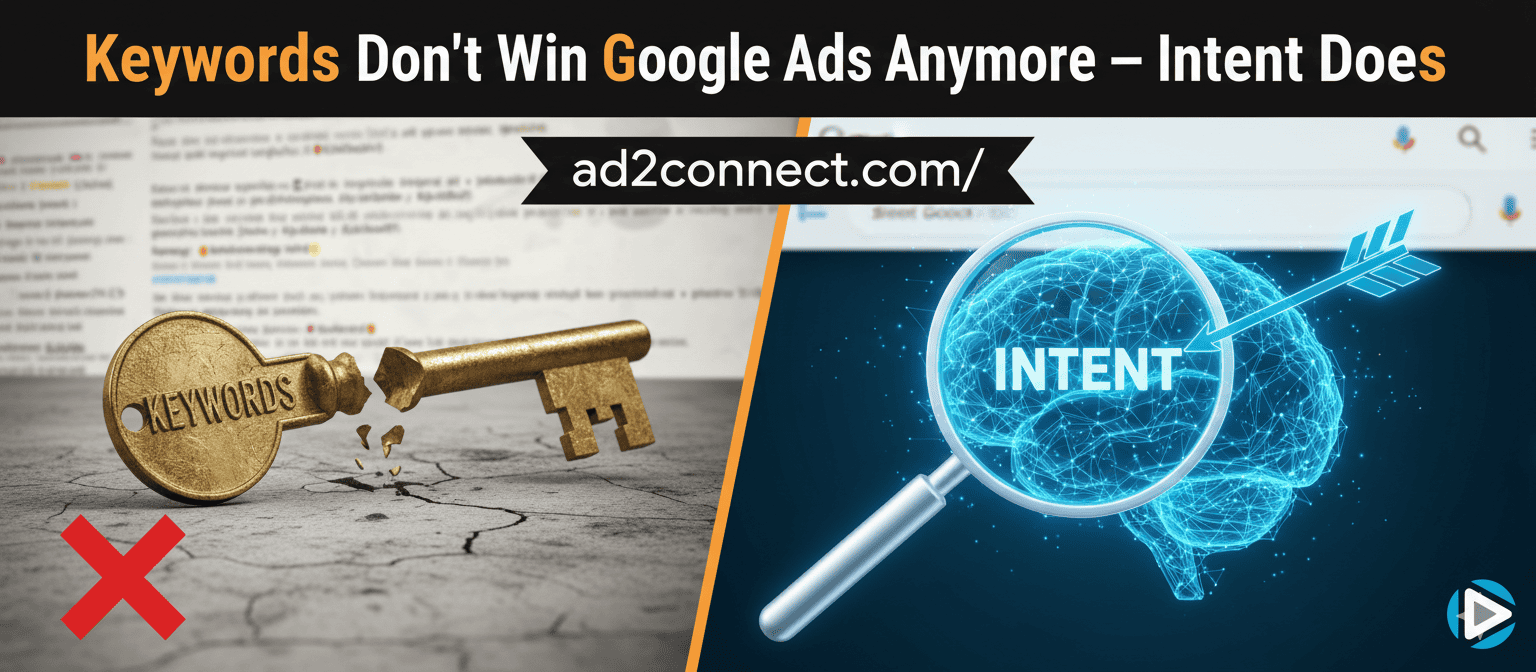
Keywords Don’t Win Google Ads Anymore—Intent Does
The Real Shift: From Search Terms to Search Meaning
Answer first: Google Ads now prioritizes user intent, not literal keywords.
When someone searches, Google evaluates:
- The meaning behind the query
- The user’s recent behavior
- Location and real-world context
- Device, time, and engagement patterns
A user searching “best digital marketing agency” from Lower Parel during office hours signals high commercial intent—even if your exact keyword isn’t present.
Keywords are no longer instructions. They’re hints.
Why the Keyword-First Model Stopped Working
The old system was rigid. The new system is predictive.
Then: Keyword-Controlled Ads
- Exact or close-match triggering
- Manual bidding
- Limited context
- Keyword-heavy structures
Now: Intent-Led Advertising
- AI predicts likelihood to convert
- Hundreds of real-time signals
- Automated bidding strategies
- Audience and behavior modeling
What “Intent” Actually Means in Google Ads
Intent is a probability score built from data.
- Semantic understanding of queries
- User context (location, device, time)
- Account signals (conversion history, first-party data)
- Landing page relevance and UX quality
A Mumbai user searching “CRM software pricing” shows stronger buying intent than someone searching “what is CRM.” Google reacts instantly.
Best Practices to Win in an Intent-Driven Google Ads World
- Optimize for outcomes: Track calls, forms, chats, and WhatsApp leads using enhanced conversions.
- Design landing pages for intent: clear messaging, Mumbai-focused content, and fast mobile UX.
- Use automation wisely: broad match + smart bidding with monitoring.
- Strengthen local signals: Area-based copy, extensions, and local relevance.
Authoritative References
- Google Ads Help Center—Smart Bidding & Broad Match
- Google Search Central—AI-powered search updates
- Search Engine Land—Intent-based Google Ads analysis
Conclusion—The Faster You Adapt, the Cheaper You Scale
Google Ads isn’t broken. It’s just no longer manual.
Winning today means feeding Google better intent signals, designing for users, and letting AI optimize what humans can’t.
Advertisers who adapt early pay less and convert more.
Ready to align your Google Ads with real user intent?
Audit and future-proof your campaigns today.