
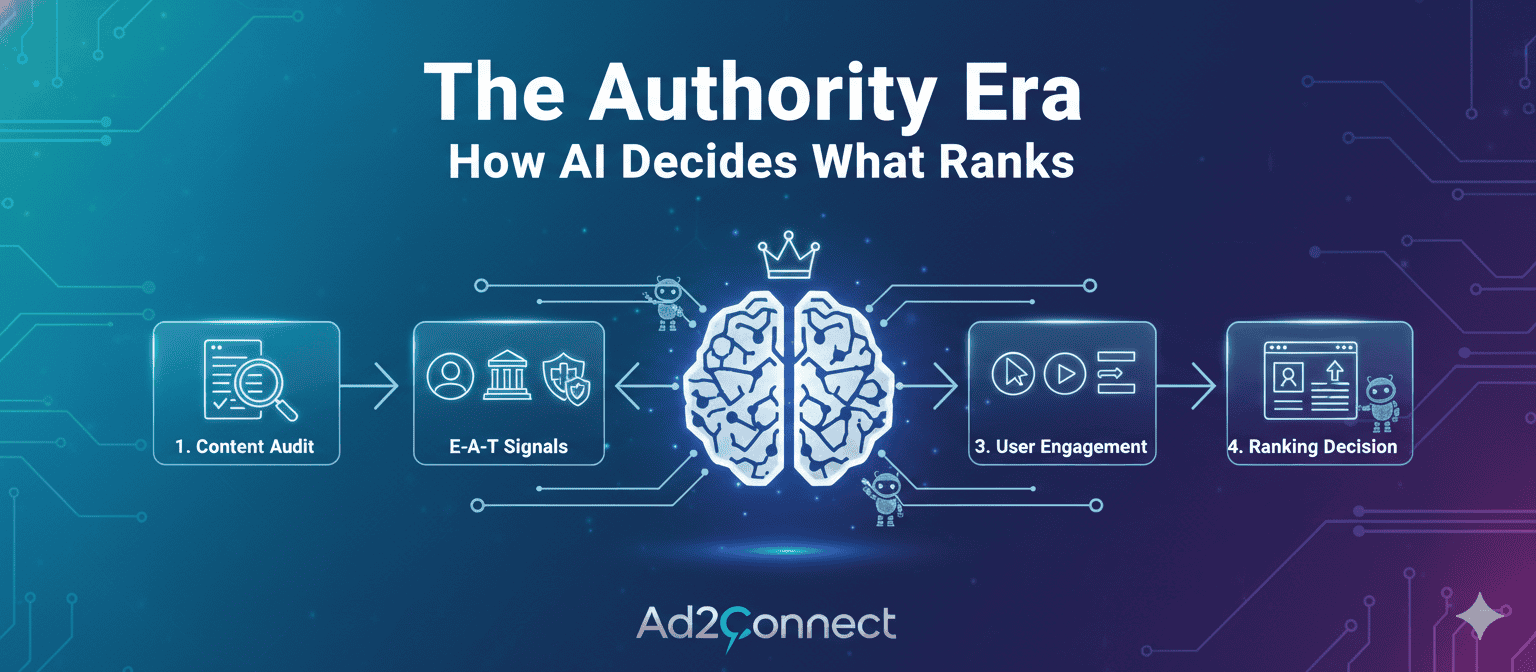
The Authority Era: How AI Decides What Ranks
Search is no longer a simple contest of who uses the right keywords. Artificial intelligence now plays a central role in deciding which content deserves to rank. This shift has ushered in the authority era of search, where credibility, topical depth, and user trust matter more than mechanical optimization.
AI-powered systems understand language, evaluate context, and connect ideas across millions of pages. Instead of treating each page as an isolated document, search engines evaluate who is publishing, how consistently they cover a topic, and whether users find their content useful.
For businesses and publishers, this means ranking is no longer about matching a query. It is about proving you are a reliable source of knowledge. Understanding how AI decides what ranks is essential for long-term visibility.
What the Authority Era Means in AI Search
The authority era refers to a ranking model shaped by machine learning and semantic understanding. AI evaluates multiple signals at once, including:
- Content quality and originality
- Topic coverage across your site
- Relationships between entities such as brands and concepts
- User behavior and trust signals
Instead of asking whether a page contains a keyword, AI systems ask whether a site is knowledgeable about the topic, whether the content aligns with user expectations, and whether the source is trusted over time.
This shift connects to modern optimization approaches such as AI Optimization, Topical Entity Optimization, Visibility Engine Optimization, Conversion Rate Optimization, Local Entity Optimization, and Content Intelligence Optimization.
How AI Determines Authority in Search Results
Entity Understanding Over Keywords
AI-driven search works with entities rather than isolated phrases. An entity can be a product, a company, a concept, or a person. Instead of focusing on one term like “AI search,” systems analyze related ideas such as machine learning, ranking systems, and information retrieval.
Your content should explain relationships between concepts, reference relevant tools and platforms, and use natural language instead of keyword repetition. Entity-based optimization helps AI classify what your site is truly about.
Topical Depth and Consistency
Authority grows when a site demonstrates consistent coverage of a subject. AI favors comprehensive explanations, supporting subtopics, and logical structure. Publishing a single article is no longer enough.
Search engines look for clusters of content that explain what something is, how it works, why it matters, and how to apply it. Content Intelligence Optimization helps identify gaps and expansion opportunities.
Behavioral and Trust Signals
AI also observes how users behave. It looks at time spent reading, scroll depth, repeat visits, and brand searches. When users engage and return, these interactions signal credibility and help build algorithmic trust.
Practical Ways to Build Authority in the AI Era
Create Topic Clusters Instead of Standalone Posts
Authority grows faster when content is connected. A strong cluster includes a main guide explaining the concept, supporting articles exploring details, practical examples, and updates on trends.
This structure helps AI recognize that your site owns a topic instead of touching it briefly.
Optimize for Entities, Not Just Phrases
When writing, mention related tools, concepts, and technologies. Explain how they connect and avoid keyword stuffing. For example, when discussing AI-driven search, reference analytics platforms, search infrastructure, and ranking systems naturally.
This improves semantic clarity and supports Topical Entity Optimization.
Demonstrate Real Expertise
Authority is reinforced by first-hand experience, clear authorship, unique insights, and concrete examples. Avoid thin summaries, automated rewrites, and copying competitors. Search engines reward content that adds value to the ecosystem.
GEO Targeting and Local Authority
Authority is not only global. AI also evaluates regional relevance. Businesses in the US or UK can strengthen authority by publishing location-specific guides, optimizing service pages for local intent, and building strong review and citation profiles.
This improves Local Entity Optimization and helps visibility in geographically influenced results.
Behavioral SEO Optimization
- Write compelling meta titles to improve click-through rate
- Add summaries near the top for fast answers
- Use internal links to encourage deeper reading
- Include visuals to reduce bounce rate
Conclusion
AI has reshaped search into a credibility-driven system. Rankings now depend on who demonstrates real understanding, who earns user trust, and who consistently delivers value.
Key takeaways include building topic depth, optimizing for entities, strengthening UX and accessibility, and reinforcing local relevance.