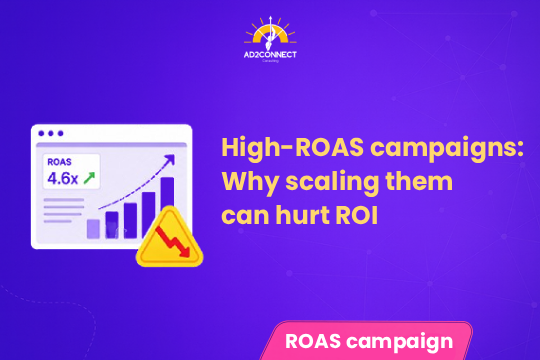
High-ROAS Campaigns: Why Scaling Them Can Hurt ROI
Your campaign is delivering amazing ROAS… so you increase the budget.
And suddenly—your cost per lead shoots up, conversions slow down, and ROI drops.
This is one of the most common (and expensive) mistakes business owners make—especially when running ads without a clear scaling strategy.
What you actually want isn’t just high ROAS. You want consistent leads, predictable growth, and scalable profit. This guide explains why high-ROAS campaigns fail when scaled—and how to grow without hurting ROI.
High-ROAS Campaigns
High-ROAS campaigns don’t always deserve more budget because they operate within limited, high-efficiency audiences. Increasing spend forces platforms to expand targeting, which raises costs and reduces conversion rates. Instead of scaling vertically, businesses should focus on audience expansion, creative testing, and overall ROI.
Summary
- High-ROAS campaigns rely on small, high-intent audiences
- Increasing budget leads to higher CPC and lower conversion rates
- Diminishing returns reduce profitability
- Scaling requires new audiences, creatives, and funnel stages
- Focus on blended ROI, not just campaign-level ROAS
Why High-ROAS Campaigns Break When You Scale
1. Limited Audience Size
Most high-ROAS campaigns target remarketing users, branded searches, or high-intent audiences. These segments are limited. Once exhausted, performance declines.
2. Diminishing Returns
At low budgets, you reach the best prospects. As spend increases, you start paying more for less qualified leads.
3. Platform Expansion
Ad platforms expand targeting when budgets increase, often reaching less relevant users and reducing efficiency.
4. ROAS Can Be Misleading
ROAS does not account for lead quality, sales cycle, or long-term customer value. It can create a false sense of success.
Common Mistakes
- Scaling only high-performing campaigns
- Ignoring audience saturation
- Not refreshing creatives
- Focusing only on ROAS instead of revenue
- Skipping funnel strategy
How to Scale Without Hurting ROI
1. Measure Marginal ROAS
Instead of average ROAS, evaluate how additional spend impacts returns.
2. Expand Audiences
- Test new segments
- Use lookalike audiences
- Explore new geographies
3. Refresh Creatives
New creatives improve engagement and prevent performance drop.
4. Build Full-Funnel Campaigns
Include awareness, consideration, and retargeting campaigns for better scalability.
5. Track Blended Performance
Measure overall leads, cost per lead, and revenue—not just individual campaign performance.
Case Study
Initial Campaign:
- Budget: ?60,000
- Leads: 50
- Cost per lead: ?1,200
- ROAS: 5.2x
After Scaling Budget:
- Budget: ?1,80,000
- Leads: 70
- Cost per lead: ?2,570
- ROAS: 2.3x
After Strategy Optimization:
- Budget: ?1,80,000
- Leads: 165
- Cost per lead: ?1,090
- Blended ROAS: 4.5x
Insight: Growth came from strategy changes, not just budget increase.
Expert Insights
- High ROAS indicates efficiency, not scalability
- Mid-performing campaigns often scale better
- Creative testing is more impactful than budget increase
- Full-funnel strategies improve long-term ROI
Actionable Checklist
- Check audience size
- Monitor frequency
- Prepare new creatives
- Evaluate marginal ROAS
- Build funnel stages
- Verify tracking accuracy
- Analyze lead quality
Conclusion
High-ROAS campaigns can look like your best performers—but they often have hidden limitations.
Scaling them blindly leads to higher costs and lower efficiency.
The smarter approach is to scale your system—not just your budget.