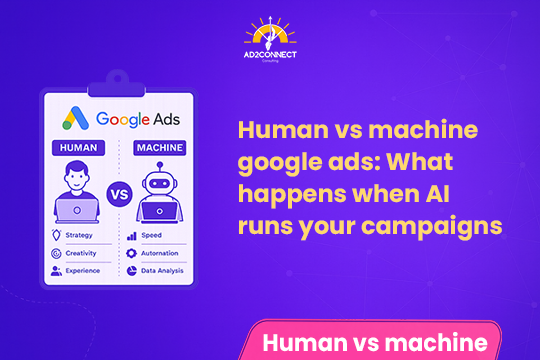
Human vs Machine Google Ads: What Happens When AI Runs Your Campaigns
A Practical guide to Human vs AI in digital marketing for better ROI
Table of Contents
- Introduction
- Human vs machine Google Ads
- Summary
- Why This Problem Happens
- Human vs Machine: What Actually Changes
- Common Mistakes Businesses Make
- Step-by-Step Solution
- Case Study
- Expert Insights
- Actionable Checklist
- Conclusion
Introduction
What if your Google Ads campaigns could optimize themselves — but still fail to generate quality leads?
That’s the reality many business owners in Mumbai are facing right now.
You’re spending ?30,000–?1,00,000 per month on ads, but leads are inconsistent, costs keep rising, and agencies provide unclear reports.
At the same time, AI tools are becoming more common in digital marketing.
Should you trust machines to run your Google Ads, or do you still need human expertise?
If your goal is more leads, lower cost per lead, and predictable ROI, this guide will help you understand what actually works.
Human vs machine Google Ads
Human vs machine Google Ads is not about replacement, it is about roles.
- Machines handle execution such as bidding, budget allocation, and keyword adjustments
- Humans handle strategy such as audience targeting and messaging
- The best results come from combining both approaches
Businesses relying only on automation often waste budget, while a hybrid approach delivers better ROI.
Quick Summary
- AI improves speed, scale, and optimization
- Humans bring strategy and creativity
- Automation alone often lacks intent clarity
- Hybrid campaigns deliver better results
Why This Problem Happens
Over-Reliance on Automation
Automation works best when tracking is accurate and sufficient data is available. Most small businesses do not meet these conditions.
Lack of Strategic Direction
AI cannot understand business goals, margins, or customer intent. It optimizes for data signals, not long-term growth.
Poor Campaign Structure
Many accounts suffer from broad targeting, lack of negative keywords, and mixed user intent, which reduces effectiveness.
Human vs Machine: What Actually Changes
What Machines Do Better
- Real-time bid adjustments
- Budget allocation
- Data analysis
- Continuous optimization
What Humans Do Better
- Understanding buyer intent
- Creating high-converting ad copy
- Designing conversion-focused landing pages
- Evaluating lead quality
Common Mistakes Businesses Make
- Running automated campaigns without monitoring
- Focusing only on lead volume, not quality
- Using generic landing pages
- Choosing low-cost agencies without strategy
Step-by-Step Solution
Step 1: Define Clear Goals
Set measurable targets such as cost per acquisition and return on investment.
Step 2: Structure Campaigns by Intent
Create separate campaigns for high-intent, research, and branded searches.
Step 3: Use AI for Execution
Allow AI to manage bids and budgets, but control targeting and messaging manually.
Step 4: Improve Landing Pages
Ensure your landing pages are aligned with your ads and optimized for conversions.
Step 5: Continuous Optimization
Regularly update keywords, refine targeting, and analyze performance.
Case Study
Client: Local service business in Mumbai
Budget: ?60,000 per month
Before Optimization
- Leads: 95 per month
- Cost per lead: ?630
- Conversion rate: 4%
After Optimization
- Leads: 140 per month
- Cost per lead: ?390
- Conversion rate: 9%
- ROI increased significantly
Expert Insights
- AI is only effective if tracking data is accurate
- Small businesses often lack enough data for full automation
- Creative messaging remains a major differentiator
- Combining SEO and paid ads improves overall performance
Actionable Checklist
- Define cost per acquisition targets
- Separate campaigns by intent
- Use AI for bidding, not strategy
- Add negative keywords regularly
- Track lead quality
- Optimize landing pages
- Review campaigns weekly
Conclusion
The debate between human vs machine Google Ads is not about choosing one over the other.
Machines provide efficiency, while humans provide direction.
The most successful campaigns combine both to achieve consistent and profitable results.