Social Topical Map: Why Every SEO Team Needs One Now
Your YouTube channel is probably already showing up in Google Search, and you likely have no idea how often. Here’s what the new Search Console data reveals, and how to actually act on it.
By Snehal Singh | Published: August 3, 2026
AI Overview Summary
Google Search Console now offers platform properties, letting brands connect YouTube, Instagram, and TikTok accounts to see which Google Search queries their video and social content already appears for. Early adopters have found large volumes of impressions their content was already eligible for, with very few clicks, meaning the content ranks but isn’t packaged to convert that visibility. A social topical map applies the topic-clustering approach SEO teams already use for website content to social and video content instead: group platform query data into topic clusters, decide whether to optimize, embed, or produce new content for each cluster, and match content format to search intent. The goal is holding multiple placements, a webpage, a video, and a social post, on the same results page for the same topic, which matters more now that AI Mode reads and cites video and image content directly.
Table of Contents
What Launched, and Why It’s Bigger Than a Reporting Feature
Google Search Console added a new property type this July: platform properties. Connect a YouTube channel, Instagram profile, or TikTok account, and Search Console shows the Google Search queries where that content already appears, along with impressions, clicks, and average position.
On its own, that’s just a new report. What makes it matter is timing.
AI Mode is becoming more multimodal. It reads images and video directly, generates related queries from them, and pulls answers from multiple content formats as equal results, not as extras beneath the standard links. A single search can now surface a webpage, a video, an image, and a social post all at once. A brand that only publishes text is competing for one of those slots. A brand present across formats can hold several.
Early adopters connecting their channels have found a familiar pattern: strong impression volume for queries nobody ever briefed the content to rank for, paired with very few clicks. That gap, eligible but unpackaged, is the signal this data exists to surface.
What a Social Topical Map Actually Is
SEO teams have used topical maps for years to plan website content. The idea is simple:
- Map every subtopic and question a subject contains.
- Cover the map completely.
- Search engines start treating the site as an authority on the whole topic, not just isolated keywords.
Social and video teams have never worked from the same evidence base. Content calendars get built by platform, not by topic, and search performance sits in a different workstream entirely.
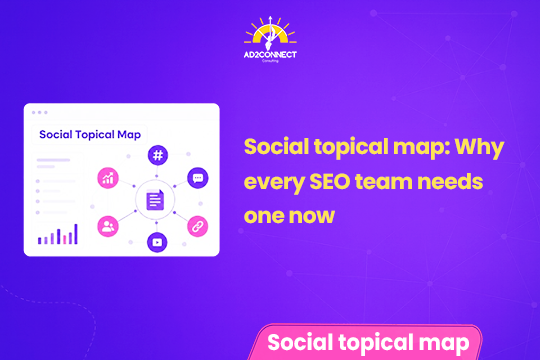
A social topical map closes that gap. It’s the same clustering and coverage logic SEO teams already use, applied to social and video content, and built from the platform query data Search Console now provides. One map drives content decisions across YouTube, Instagram, TikTok, and any other connected platform, instead of five channels planning in isolation.
The 6-Step Framework
1. Connect Platform Properties
Add each platform account as a property in Search Console and verify it. This is the only setup step, and it’s a one-time action per account.
2. Audit What Google Already Surfaces
Export the query data after a few weeks of collection. Group similar phrasings into clusters before judging anything individually; a single phrasing can look negligible while the full cluster represents real demand.
Then sort each cluster into one of three actions:
- Optimize: Content ranking in the middle of page one or on page two, with real impressions. The content itself works. The title or thumbnail is losing the click.
- Embed: A video or post already answers a query well. Place it directly on the matching website page so both assets reinforce the same query together.
- Produce: Real search demand with a weak or missing position. This is a brief for new content, ideally with a different angle than whatever’s already ranking.
3. Build the Map
Combine three inputs: the platform query data from Step 2, standard keyword research, and trend data for directional signal.
Organize everything by topic cluster, not by platform. Each cluster should carry its own demand evidence, dominant search intent, and the content formats that fit it best.
4. Produce Format-Matched Content
Match format to intent inside each cluster:
- Comparison and evaluation queries suit long-form video.
- Quick how-to queries suit short-form video.
- Data-heavy topics suit carousels or written breakdowns.
One well-researched cluster can produce a blog pillar, a long-form video on a specific facet, and a short-form clip on a narrower sub-facet, all reinforcing the same underlying demand instead of separate teams guessing independently.
5. Embed on Matching Site Pages
Place the video or social content on the website page targeting the same topic cluster. The page and the video now reinforce each other for the same queries, building the kind of multi-format presence AI Mode increasingly rewards.
6. Repeat and Compound
Every new placement generates new query data inside the platform property. Feed that back into Step 2 and repeat the cycle. Coverage compounds the same way topical authority does on a website.
Two Scoreboards: The Platform Algorithm vs. the SERP
Social platforms and search engines reward different things, and teams that only optimize for one miss the other entirely.
Platform algorithms reward packaging, consistency, and breadth. A strong title, a compelling thumbnail, and a steady upload schedule can produce fast, visible growth in views and subscribers. That payout arrives quickly and fades quickly too, since a platform’s feed favors what’s recent.
Search results reward something different: matching a query well and staying relevant to it over time. Older, less polished videos often keep earning search impressions and clicks years after a platform’s own algorithm has stopped promoting them, simply because they still answer the question someone typed.
Neither scoreboard is more important than the other. A social topical map is what lets a team play both intentionally, instead of defaulting to whichever one is easier to measure.
Honest Caveats Before You Start
- Give it real time. Early data is thin and often looks like noise. Clusters typically don’t become visible for at least a few weeks.
- Platforms vary. YouTube data tends to be the richest. Instagram and TikTok footprints are often smaller and skew toward navigational searches.
- Impressions aren’t traffic. An impression with no click is an eligibility signal and a packaging problem, not a success metric on its own.
- Rollout isn’t universal yet. Some accounts may not be able to connect properties immediately, since the feature rolled out gradually.
Mistakes That Look Like Strategy
- Treating platform property data as a vanity metric instead of a content brief.
- Judging individual query phrasings instead of grouping them into clusters first.
- Producing new content for a cluster that already has strong assets simply needing better packaging.
- Optimizing only for the platform’s own algorithm and ignoring the separate, slower-moving search scoreboard.
- Abandoning the audit after one week because the data looks sparse or unclear.
How Ad2Connect Approaches Multi-Format SEO
At Ad2Connect, content strategy has never lived in a single channel, and this shift makes that approach more measurable, not less necessary. When a client has an active YouTube channel or social presence, we treat it as a search asset from the start, not a separate workstream disconnected from the website.
This same principle runs through our other frameworks: match the right fix, format, or channel to the actual evidence, rather than defaulting to whatever’s easiest to produce. It’s the same thinking behind our guide on technical SEO debt, where we triage by impact rather than by what looks urgent, and it connects directly to our coverage of AI Mode ads reaching 30% of queries, since multimodal search is the reason a social topical map matters now rather than later. It also pairs naturally with a broader SEO and performance marketing strategy built around every surface a brand can be found on, not just its website.
If your team has an active YouTube, Instagram, or TikTok presence and has never connected it to Search Console, that’s the first gap worth closing before planning anything else.
Key Takeaways
- Search Console’s platform properties reveal search visibility your social content already has, often with strong impressions and very few clicks.
- A social topical map applies website topic-clustering logic to social and video content, turning scattered platform data into a coordinated content plan.
- The 6-step framework runs from connecting properties to auditing, mapping, producing, embedding, and repeating.
- Platforms and search results reward different things. Plan for both instead of optimizing for just one.
- Give the data time. Meaningful clusters typically take a few weeks to emerge.
Ad2Connect is a digital marketing agency helping SaaS, eCommerce, D2C, and local businesses grow through data-driven SEO, performance marketing, and content strategy. If your video and social content isn’t connected to your SEO strategy yet, talk to our content team about building a social topical map.