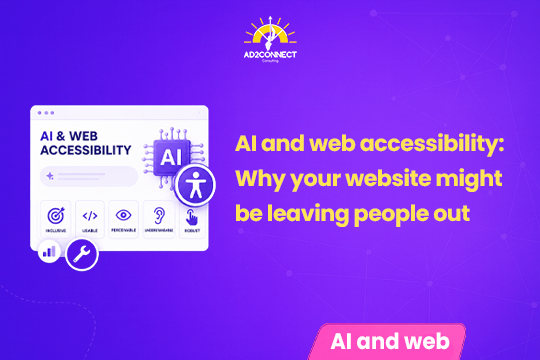
AI and Web Accessibility: Why Your Website Might Be Leaving People Out
AI can write your website copy and even generate your code in minutes. What it often can’t do is make sure a real person using a screen reader can actually use the result. Here’s why that gap matters, explained simply.
By Snehal Singh | Published: August 4, 2026
AI Overview Summary
Web accessibility means building a website so people with disabilities can actually use it. AI tools are now generating large portions of web content and code, but they learn from an internet that already has accessibility problems. As a result, AI often repeats these issues at scale, creating risks like lost customers and increasing legal exposure.
Table of Contents
- What Is Web Accessibility?
- Why AI Is Making This Worse
- The Numbers Behind This Problem
- Legal Risks
- The Real Cost
- 3 Things Marketing Teams Can Do
- Common Mistakes
- How Ad2Connect Thinks About Accessibility
- Key Takeaways
What Is Web Accessibility?
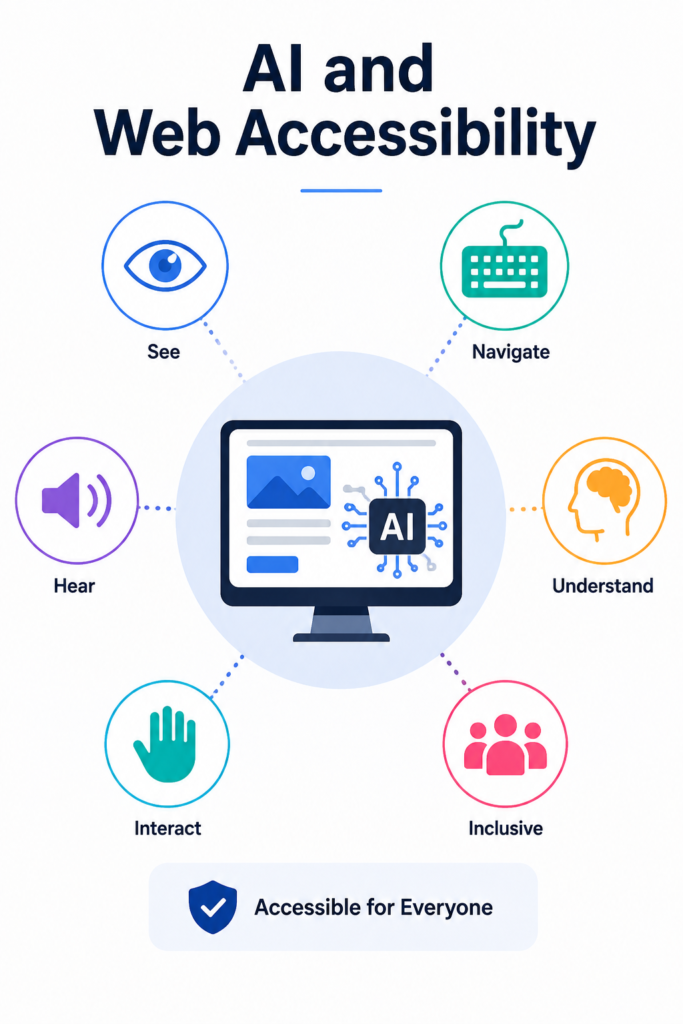
Web accessibility means building a website that works for everyone, including people with disabilities.
This includes:
- Screen reader compatibility (image descriptions)
- Keyboard navigation
- Readable contrast for low vision users
Without these, a website can become completely unusable for some visitors.
Why AI Is Making This Worse
AI tools learn from the existing internet — and most of the internet already has accessibility issues.
That means AI replicates:
- Missing alt text
- Poor contrast
- Broken forms
These issues often stay invisible until a real user tries to navigate the site with assistive tools.
The Numbers Behind This Problem
Most websites today still have accessibility issues, and the situation is getting worse as content production speeds up.
| What the Research Found | Why It Matters |
|---|---|
| Most websites have accessibility issues | This is the industry norm |
| Pages have dozens of errors | Problems are hidden but common |
| Error counts are rising | AI and scale are accelerating issues |
| Pages are more complex | More room for errors |
Legal Risks
Accessibility is no longer just a usability issue — it’s a legal risk.
- Lawsuits have doubled since 2020
- Online stores are the most common targets
- Costs can reach tens of thousands of dollars
Even companies with accessibility tools have faced lawsuits when those tools failed to fully address the issues.
The Real Cost
Over a billion people live with disabilities, representing massive spending power.
Most users will leave immediately if a site is hard to use. That means marketing spend is wasted before conversions even have a chance.
3 Things Marketing Teams Can Do
- Audit your tools: Understand accessibility limitations
- Track accessibility metrics: Treat it like performance data
- Include checks before launch: Make it part of campaigns
Common Mistakes
- Assuming AI tools produce accessible output
- Treating accessibility as only an engineering issue
- Relying on a single automated tool
- Ignoring accessibility metrics
- Waiting for complaints instead of testing
How Ad2Connect Thinks About Accessibility
At Ad2Connect, we treat a website’s usability as part of its overall performance. It’s not a separate box to check after launch.
A page that ranks well or drives traffic still fails if a real visitor can’t actually use it.
This connects to the same thinking behind our post on AI and human expertise in SEO, since AI tools are powerful assistants but still need real human judgment applied on top, whether that’s writing content or building a page people can actually navigate. It’s part of a broader SEO and content strategy built around real people actually being able to use what gets built, not just what looks good in a demo.
If your team has leaned on AI tools to build or update pages recently, that’s a good moment to check what those tools may have quietly missed.
Key Takeaways
- AI repeats accessibility problems at scale
- Issues remain invisible until users encounter them
- Legal risks are increasing
- Tools alone are not enough
- This is also a major growth opportunity