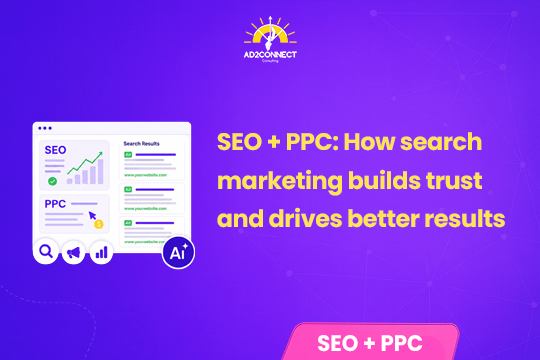
SEO and PPC: How Search Marketing Builds Trust and Drives Better Results
SEO and PPC are often treated as two separate marketing activities. SEO helps a website appear in organic search results, while PPC puts paid ads in front of potential customers.
But customers do not think in terms of SEO and PPC.
They simply search, compare, read reviews, watch videos, check competitors, and look for reasons to trust a business before making a decision.
That is why businesses need to think beyond individual channels. A strong search strategy connects SEO, PPC, content, reviews, reputation, and other online touchpoints to create a consistent experience for potential customers.
AI Overview Summary
SEO and PPC work better when they support the same customer journey. SEO can build long-term visibility, while PPC can capture high-intent searches and provide immediate visibility. When these channels are supported by useful content, positive reviews, strong landing pages, and a trustworthy online presence, they can reduce buyer hesitation and improve marketing performance.
A recent Search Engine Land case study followed a 26-week SEO and PPC strategy for an education SaaS company. The campaign combined reputation building, paid search data, commercial content, digital PR, and video content. The company improved its average organic position from 15.2 to 9.7, while CPA on relevant paid campaigns fell from $146 to $121.
The lesson is simple: customers need more than an ad or a ranking. They need enough useful information and positive signals to feel confident choosing your brand.
Table of Contents
- What Is the Connection Between SEO and PPC?
- Why SEO Alone Is Not Enough
- Why PPC Alone Is Not Enough
- How SEO and PPC Build Trust Together
- What the 26-Week Case Study Teaches Us
- The 5-Step SEO and PPC Trust Framework
- Common Mistakes Businesses Make
- How Ad2Connect Can Help
- Key Takeaways
What Is the Connection Between SEO and PPC?
Think about the last time you bought an expensive product or service online.
You probably did not see one advertisement and immediately buy it.
Instead, you may have searched Google, visited a website, checked reviews, watched a video, compared different providers, searched the brand name again, and then contacted the company.
Your customers behave in much the same way.
SEO and PPC are two important parts of that journey.
SEO helps your business appear naturally in search results when people are looking for information, products, or services.
PPC helps your business appear in paid advertising spaces when potential customers search for relevant terms.
When these channels work separately, businesses may miss important opportunities.
For example, your PPC campaign may reveal that customers are frequently searching for pricing, comparisons, features, or specific services. That information can help your SEO team create useful pages that answer those questions.
At the same time, your SEO data can show which topics and search terms already attract valuable visitors. Those insights can help your PPC team create more relevant campaigns.
This creates a feedback loop:
PPC generates search insights ? SEO creates useful content ? content builds trust ? PPC captures high-intent demand ? better landing pages support conversions.
Why SEO Alone Is Not Enough
SEO is one of the strongest ways to build long-term visibility.
A well-optimized page can attract visitors without paying for every click. It can also help establish your brand as a useful source of information.
But ranking is only one part of the buying journey.
Imagine someone searches for a service and finds your website on Google.
They may still ask:
- Is this company trustworthy?
- Are the reviews genuine?
- How much does the service cost?
- Is this company better than its competitors?
- Can I find examples of their work?
- What do existing customers say?
- What happens if something goes wrong?
If your website does not answer these questions, a high ranking may not lead to a conversion.
Modern search also gives users more ways to research a company. Search results can include reviews, videos, social content, forums, AI-generated answers, business profiles, and other third-party information.
That means your brand reputation outside your website matters too.
Why PPC Alone Is Not Enough
PPC can provide fast visibility.
You can create a campaign, target relevant searches, send visitors to a landing page, and measure clicks and conversions.
But paid visibility does not automatically create trust.
A customer may click your ad and still leave if the landing page is confusing, the price is unclear, the website looks outdated, or there are poor reviews elsewhere online.
This is why increasing the PPC budget is not always the answer.
Sometimes the real problem is what happens after the click.
A strong PPC campaign needs support from:
- Relevant landing pages
- Clear messaging
- Useful content
- Good reviews
- Strong brand reputation
- Fast website experience
- Simple conversion paths
- Consistent information across channels
In simple terms, PPC can get attention, but your overall digital presence has to earn the customer’s confidence.
How SEO and PPC Build Trust Together
SEO and PPC can support different stages of the same customer journey.
1. SEO Creates Discovery
SEO helps potential customers discover your business when they are searching for solutions.
For example, a person may search:
“Best digital marketing agency in Mumbai”
or:
“How much does SEO cost for a small business?”
Useful organic content can introduce your brand before the customer is ready to contact you.
2. PPC Captures High-Intent Searches
Some searches show strong buying intent.
Examples include:
- Digital marketing agency near me
- SEO agency Mumbai
- Google Ads agency Mumbai
- Performance marketing agency
- SEO services for ecommerce
PPC allows businesses to appear prominently for these valuable searches.
3. Content Answers Customer Questions
Once people discover your brand, they often need more information.
This is where blogs, comparison pages, case studies, service pages, FAQs, videos, and guides become important.
Content can remove uncertainty before a customer speaks with your sales team.
4. Reviews Provide Social Proof
People trust other people’s experiences.
Reviews and testimonials can help answer one of the most important questions in the buyer’s mind:
“Can I trust this company?”
That is why reputation management should not be treated as something separate from search marketing.
5. Consistency Strengthens the Brand
Imagine seeing one message in a Google ad, another message on the website, and completely different information on social media.
It creates confusion.
When your messaging is consistent across paid search, organic search, website content, social media, reviews, and other channels, your brand becomes easier to understand and trust.
What the 26-Week Case Study Teaches Us
The study followed an education SaaS company over 26 weeks. At the beginning, the company had an average organic position of 15.2 for core commercial keywords, an 11.4% paid search CTR for related themes, 37 Google Business Profile reviews with a 3.6-star average, and 212 referring domains.
Rather than focusing on one metric, the strategy addressed several problems at the same time.
Phase 1: Build Trust and Authority
During the first eight weeks, the company focused on strengthening external trust signals.
Its Google Business Profile grew from 37 reviews with a 3.6-star average to 164 reviews with a 4.3-star average.
A digital PR campaign also secured 23 editorial placements and increased referring domains from 212 to 235.
The lesson for businesses is straightforward.
Before asking people to buy, give them reasons to believe your brand.
Reviews, media mentions, useful content, backlinks, and other third-party signals can all contribute to that confidence.
Phase 2: Use PPC Data to Improve SEO
The next stage connected paid search insights with organic content.
The team found commercial searches involving pricing, competitor comparisons, and product features that were not fully covered on the company’s website.
This revealed 11 high-intent content opportunities.
The company then expanded existing commercial pages and created new pages around those topics. Those 11 URLs generated 8,742 organic sessions over the following 13 weeks. The related paid campaigns also saw CPA decline from $146 to $121.
This is one of the biggest opportunities for businesses.
Your PPC search-term data can tell you exactly what your potential customers want to know.
Instead of keeping that information inside the advertising team, use it to improve your SEO and content strategy.
Phase 3: Remove Trust Barriers
The company also discovered a negative Reddit discussion ranking on the first page for branded searches.
This matters because customers often search a company’s name after seeing an advertisement or discovering it through organic search.
The team responded by publishing a detailed pricing and value comparison video across YouTube, TikTok, and Instagram.
The video generated 81,400 views over seven weeks, and a manual review of 340 public comments found that 77.9% were positive. The negative Reddit thread later moved from position 4 to position 11 in manual SERP monitoring.
The important point is not that every business should create the same type of video.
The important point is that search marketing should identify and address the questions that create doubt.
What Were the Overall Results?
At the end of the engagement, the company’s average organic position for core commercial keywords improved from 15.2 to 9.7.
That moved important terms onto the first page.
Paid CTR declined from 11.4% to 9.8% during a period of broader AI Overview expansion, while paid impression share remained strong at 93%.
The study also reported an increase in AI Overview citation frequency for its tracked queries, from 4.8% to 31%.
These results show why businesses should avoid looking at one number in isolation.
A lower CTR does not automatically mean a campaign is failing.
A higher ranking does not automatically mean more customers.
More traffic does not automatically mean more revenue.
The real question is:
Are all of your search touchpoints helping customers move closer to a decision?
The 5-Step SEO and PPC Trust Framework
Here is a simple framework businesses can use.
Step 1: Map Your Search Touchpoints
Search your own brand name.
Then search for your key services.
Look at what customers see.
Check:
- Organic listings
- Paid ads
- Reviews
- Videos
- Social media
- Forums
- Business listings
- Competitor pages
- AI search results
You may find opportunities that do not appear in your regular SEO report.
Step 2: Find the Questions Customers Ask
Look at your PPC search terms.
Look at Google Search Console.
Review customer questions from sales and support teams.
Check comments and reviews.
Then create content that answers those questions in simple language.
Step 3: Find Trust Gaps
Ask yourself:
What could make a customer hesitate?
It could be:
- Poor reviews
- Missing pricing information
- Weak case studies
- No testimonials
- Confusing service pages
- Outdated content
- Poor landing page experience
- Negative third-party discussions
Fix the biggest trust gaps first.
Step 4: Connect SEO and PPC Data
Your SEO and PPC teams should not work with completely separate reports.
Share information such as:
- High-converting search terms
- Best-performing landing pages
- High-value keywords
- Customer questions
- Conversion data
- Competitor insights
- Content gaps
This makes your marketing budget work harder.
Step 5: Measure the Customer Journey
Do not ask only:
“Which channel generated the conversion?”
Also ask:
“What helped the customer trust us enough to convert?”
That shift can change how you prioritize your marketing efforts.
Common Mistakes Businesses Make
Treating SEO and PPC as Competitors
SEO and PPC do not need to compete for budget or attention.
They can work together.
PPC can provide immediate data and visibility, while SEO can build long-term organic visibility.
Creating Content Without Looking at Search Intent
Publishing more blogs does not automatically improve SEO.
The content needs to answer a real customer question.
Before creating a page, understand what the person is actually trying to accomplish.
Ignoring Brand Searches
Businesses often monitor generic keywords but forget to search their own brand name.
That is a mistake.
Brand searches can reveal reviews, complaints, outdated information, videos, social posts, and other content that influences buying decisions.
Focusing Only on Clicks
Clicks are useful, but they are not the final goal.
A campaign with fewer clicks can be more valuable if those clicks generate better leads and customers.
Using Technical Language
Marketing content should not sound like a textbook.
Your customers may not understand terms such as CTR, CPA, SERP, schema, or search intent.
Explain what these terms mean—or avoid unnecessary jargon.
Good marketing makes complex ideas easy to understand.
How Ad2Connect Can Help
Ad2Connect takes a broader approach to digital marketing.
The agency provides SEO, AI SEO, performance marketing, content marketing, social media marketing, online reputation management, CRO and analytics, website development, branding, marketing automation, and other digital marketing services.
This matters because modern search visibility is not controlled by one channel.
A business may need SEO to build organic visibility, PPC to capture high-intent searches, content to answer customer questions, reputation management to build trust, and analytics to understand what is actually generating results.
Ad2Connect’s SEO services include technical SEO, local SEO, ecommerce SEO, enterprise SEO, AI SEO, and SEO audits. Its performance marketing services include Google Ads, YouTube advertising, Meta Ads, remarketing, CRO, funnel strategy, and campaign analytics.
The goal should not simply be to generate more clicks.
The goal should be to create a search experience that helps the right people discover your business, understand your value, trust your brand, and take the next step.
Want to improve your search visibility and generate better-quality leads?
Talk to Ad2Connect about building an integrated SEO and PPC strategy for your business.
Key Takeaways
SEO and PPC should not be treated as isolated marketing channels.
Customers experience your brand as one journey.
They may see an ad, read a blog, check reviews, watch a video, compare competitors, search your brand name, and then contact you.
Every one of those interactions can increase—or reduce—trust.
The recent 26-week case study discussed by Search Engine Land demonstrates the potential value of connecting SEO, PPC, reputation, content, PR, and video instead of measuring each activity in isolation.
For businesses, the takeaway is simple:
Get found. Answer questions. Build trust. Remove doubts. Make it easy to choose you.
That is where SEO and PPC become more powerful—not as separate channels, but as connected parts of a customer-focused search strategy.
Quick Checklist
- Search your brand name and review page one.
- Check your highest-converting PPC search terms.
- Identify questions your website does not answer.
- Create content around high-intent topics.
- Improve weak landing pages.
- Monitor reviews and third-party mentions.
- Connect SEO and PPC reporting.
- Measure leads, customers, and ROI—not just clicks.