
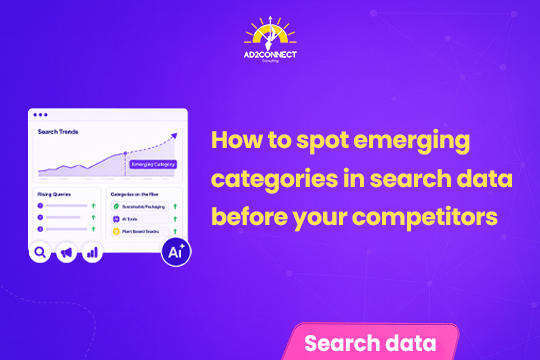
How to Spot Emerging Categories in Search Data Before Your Competitors
New markets rarely appear overnight.
Before a new product category, service, or business trend becomes popular, people usually start talking about it, searching for it, and asking questions about it.
The challenge is that these signals can be difficult to see at first.
Search volume may be small. Keyword tools may show little or no data. Several different terms may describe the same idea. Competition may still be low.
But that can actually be an opportunity.
If you know what to look for, search data can help you identify an emerging category before the market becomes crowded.
AI Overview Summary
An emerging category is a new or growing market that is starting to develop its own language, search demand, competitors, and customer needs.
You can often spot one by looking for several signals together:
- Searches for related terms are growing steadily.
- New keywords, regulations, standards, or industry terms are appearing.
- People use different phrases for the same problem.
- Search results are still changing frequently.
- Smaller businesses can compete with large brands.
- Commercial keywords such as “consultant,” “agency,” “cost,” “service,” or “template” begin appearing.
- Conversations about the topic are growing on social media, communities, YouTube, or AI tools before Google search volume becomes significant.
The important point is this: low search volume does not always mean low demand.
Sometimes it simply means the market has not decided what to call the problem yet.
Table of Contents
- What Is an Emerging Category?
- Why Search Data Can Reveal New Markets
- 6 Signs an Emerging Category Is Taking Shape
- Where Emerging Categories Appear Before Google
- How to Separate a Real Trend From a Short-Term Spike
- What to Do When You Find an Emerging Category
- Common Mistakes to Avoid
- How Ad2Connect Uses Search Data for SEO Strategy
- Key Takeaways
What Is an Emerging Category?
An emerging category is a market that is still being formed.
It could be a new technology, service, product type, business model, or customer need.
For example, think about how new technologies often begin. At first, people may not search for a specific service. They may simply ask questions such as:
- “Can this technology be used safely?”
- “Do I need this for my business?”
- “How does this work?”
- “What are the risks?”
At this stage, keyword tools may show very little search volume.
That does not necessarily mean there is no opportunity.
It may mean people have not agreed on the right words yet.
As awareness grows, the market starts creating its own language. New terms become common. Search volume increases. Businesses begin offering services. Competitors publish content.
That is when an emerging category starts becoming a real market.
Why Search Data Can Reveal New Markets
Search data gives businesses a view into what people want to understand.
It can show what people are searching for, how often they search, which terms are becoming more popular, and how competitive those terms are.
But you should not look at search volume alone.
A keyword with 100,000 searches may already be extremely competitive.
A keyword with 100 searches may be much more valuable if it represents a new business need and the competition is still weak.
This is why looking for change is often more useful than looking only at today’s numbers.
If a keyword grows from almost nothing to meaningful demand over several months, that change tells an important story.
The opportunity may be even bigger when several related keywords grow at the same time.
6 Signs an Emerging Category Is Taking Shape
1. Search Demand Is Growing
The first signal is simple: people are starting to search for the topic more often.
Do not focus only on one keyword.
Look for a group of related keywords.
For example, imagine these searches are growing:
- AI marketing tools
- AI marketing agency
- AI marketing strategy
- AI marketing automation
- AI marketing consultant
One keyword growing may be temporary.
Several connected keywords growing together are much more interesting.
This suggests that people are not just curious about a topic. They are developing different needs around it.
That is how a category begins to form.
2. New Industry Language Is Appearing
Emerging categories often get names before they get large search volumes.
This can happen through:
- New regulations
- Industry standards
- Certifications
- New technologies
- New job titles
- Product categories
- New business terms
For example, a new regulation may create a new business need.
Companies then need to understand the regulation, follow it, find experts, purchase tools, or create internal processes.
The regulation gives people a common name for the problem.
Search demand can follow.
This is why SEO teams should pay attention to industry news and developments, not just keyword tools.
A new term appearing repeatedly in industry conversations may become an important keyword later.
3. Keywords Are Fragmented
Another strong signal is messy language.
In a mature market, people usually agree on the main term.
For example, most people understand what “email marketing” means.
An emerging category is different.
People may use several terms to describe almost the same thing.
One person may call it:
“AI search optimization.”
Another may say:
“AI SEO.”
Someone else may use:
“GEO.”
Another business may call it:
“optimization for generative search.”
This creates a fragmented keyword landscape.
At first, this may look confusing.
But it can also be a major opportunity.
If the market has not settled on one name, businesses have an opportunity to establish clear language and become associated with a category.
The brand that consistently explains a new concept in simple language can sometimes influence how customers eventually search for it.
4. Competition Is Still Low
Growing demand is valuable.
Growing demand combined with low competition is even more valuable.
Look at the relationship between search volume and keyword difficulty.
If searches are increasing but strong competitors have not yet created detailed content, there may be an early opportunity.
This is especially useful for smaller businesses.
You do not always need the authority of a huge company to rank for an emerging topic.
When a market is new, relevance can matter more because there are fewer established resources.
That gives focused businesses a chance to build visibility before the market becomes crowded.
5. Commercial Searches Start Appearing
This is one of the most important signals.
People may initially search for information.
Then their searches become more practical.
For example:
“What is AI automation?”
can eventually become:
- AI automation agency
- AI automation consultant
- AI automation pricing
- AI automation services
- AI automation tools
That change matters.
It suggests people are moving from learning about a topic to looking for a solution.
When commercial keywords begin appearing around an emerging topic, businesses should pay attention.
It can indicate that a market is moving beyond curiosity and toward buying decisions.
6. The SERPs Are Still Changing
SERP means “search engine results page.”
In simple terms, it is the page you see after searching on Google.
A mature topic usually has predictable results.
The same large websites appear repeatedly. The content formats are clear. Search intent is well understood.
Emerging categories look different.
You may see:
- A small consultancy
- A large enterprise
- A news website
- A Reddit discussion
- A YouTube video
- A blog post
- A product page
all competing for the same search.
This is a useful signal.
It means Google may still be figuring out what type of content best answers the query.
That can create an opportunity for businesses that publish useful, focused content early.
Where Emerging Categories Appear Before Google
Google is not always the first place where a trend appears.
Sometimes the conversation starts somewhere else.
Social Media
Platforms such as LinkedIn, TikTok, Instagram, and other social networks can reveal new language before it becomes popular in Google searches.
Pay attention to:
- Repeated phrases
- New hashtags
- Growing discussions
- Questions people repeatedly ask
- New creators discussing the same subject
The exact wording people use can later become search keywords.
YouTube
YouTube is another useful source of early signals.
Look for:
- New video topics
- Repeated titles
- Growing channels
- Questions in comments
- New tutorials
- Explainer videos
If more people are creating content around the same problem, demand may be developing.
Reddit and Online Communities
Communities can be especially useful for B2B research.
People often describe problems in their own words.
Those words may be very different from the terms used by marketers.
That makes community discussions valuable for discovering real customer language.
If people in multiple discussions use the same phrase to describe a problem, add that phrase to your keyword research list.
Your Own Business Data
Do not forget your own customers.
Sales calls, support requests, website searches, emails, and customer questions can reveal emerging needs before keyword tools do.
For example, if your sales team keeps hearing the same question from prospects, that question may represent a growing market need.
Put those phrases into your SEO research.
Then monitor them over time.
How to Separate a Real Trend From a Short-Term Spike
Not every growing keyword represents an emerging category.
Some are simply news events.
A major announcement can cause search volume to jump for a few days and then disappear.
So how do you tell the difference?
Look at the Trend Over Time
Do not make a decision based on one month.
Look at several months of data.
A steady increase is more meaningful than one huge spike.
Check a Group of Keywords
One keyword can be misleading.
A group of related keywords gives you more confidence.
If several connected searches are increasing, the market may be developing.
Look for Commercial Intent
Ask whether people are moving from informational searches to solution-focused searches.
Words such as:
- Service
- Agency
- Consultant
- Cost
- Pricing
- Tool
- Template
- Software
can indicate that the topic is becoming commercially important.
Check Your First-Party Data
Compare search data with what your customers are saying.
If search demand is growing and your sales team is hearing more questions about the same subject, the signal becomes much stronger.
What to Do When You Find an Emerging Category
Finding an emerging category is only the first step.
The real advantage comes from acting early.
1. Create a Core Topic Page
Build a strong page that explains the category in simple language.
Answer the basic questions first.
- What is it?
- Why does it matter?
- Who needs it?
- How does it work?
- What problems does it solve?
This page can become the foundation for your content strategy.
2. Target the Long-Tail Keywords
Do not immediately chase the biggest keyword.
Look for specific searches with clear intent.
For example:
“AI SEO” may be competitive.
But a specific question such as:
“how to optimize content for AI search”
may provide a more realistic starting point.
Long-tail keywords can also help you understand what people actually need.
3. Answer Questions People Ask Before They Search
This is especially important for new markets.
Some customer questions may have little or no measurable search volume.
Do not automatically ignore them.
If customers ask those questions during sales calls, they are still valuable.
Create useful content around them.
As the market develops, those questions may become established search queries.
4. Build Practical Resources
Do more than publish another generic blog post.
Create useful resources such as:
- Checklists
- Templates
- Guides
- Calculators
- Comparison pages
- Examples
- Research reports
- Step-by-step tutorials
Practical content gives users a reason to visit your website.
It can also help your brand become associated with the new category.
5. Choose Your Language Carefully
When a category is new, the terminology may still be changing.
Choose a clear term and explain related terms where appropriate.
Then use your preferred terminology consistently across:
- Website pages
- Blog posts
- PR
- Case studies
- Service pages
Consistency can help customers understand what you offer and how it relates to the category.
6. Start Before Competition Becomes Expensive
This is the biggest advantage of identifying an emerging category early.
Once search demand becomes obvious, more businesses notice it.
More content gets published.
More backlinks are built.
Keyword difficulty increases.
Advertising becomes more expensive.
Getting visibility becomes harder.
Early action gives you more time to build authority.
Common Mistakes to Avoid
Mistake 1: Looking Only at Search Volume
A low-volume keyword is not automatically useless.
It may be an early signal.
Look at growth, related terms, intent, and competition together.
Mistake 2: Chasing Every Trend
Not every trend deserves a content strategy.
Ask whether the trend connects to your customers and business.
If there is no business relevance, growing search volume alone is not enough.
Mistake 3: Waiting for Perfect Keyword Data
Emerging categories often have imperfect data.
If you wait until a keyword reaches a large search volume, you may already be late.
Use search data together with customer conversations, social platforms, industry news, and competitor research.
Mistake 4: Publishing Too Late
A common SEO approach is to wait until a keyword becomes popular.
The problem is that everyone else can see it too.
The better opportunity may be to build useful content while the category is still forming.
Mistake 5: Ignoring Customer Language
Your keyword tool may tell you what people search for.
Your customers can tell you what they actually mean.
Listen to both.
How Ad2Connect Uses Search Data for SEO Strategy
At Ad2Connect, we believe SEO should be based on more than a list of keywords.
Search behavior changes constantly.
New technologies appear. Customer expectations change. New competitors enter markets. New terms become popular.
That means SEO strategies also need to evolve.
For clients across SaaS, eCommerce, D2C, and local businesses, the goal is not simply to find keywords with high search volume. We look for opportunities where customer demand, business value, competition, and search behavior come together.
An emerging category can be especially valuable because businesses have an opportunity to build visibility before the search landscape becomes crowded. Instead of waiting for a topic to become highly competitive, businesses can monitor early signals, create useful content, build topical authority, and adjust the strategy as customer language develops.
The same approach can also help businesses discover new service opportunities. If customer questions, search trends, and commercial keywords begin pointing in the same direction, the data may be telling you that a new market is forming.
That is where SEO becomes more than a traffic channel.
It becomes a way to understand where your market is going.
Key Takeaways
- Emerging categories often become visible in search data before they become obvious to the wider market.
- Low search volume does not always mean low demand.
- Look for groups of related keywords rather than one keyword.
- Watch new regulations, standards, technologies, and industry terms.
- Fragmented keyword language can be a sign that a category is still developing.
- Growing search demand combined with low competition can create an early SEO opportunity.
- Commercial terms can show when a trend is becoming a real market.
- Social media, YouTube, communities, and customer conversations can reveal trends before Google does.
- Do not confuse a short-term news spike with long-term market growth.
- Businesses that act early can build authority before competition increases.
Final Thought
The biggest SEO opportunities are not always the keywords with the biggest numbers.
Sometimes, they are the topics that are just starting to grow.
If you can identify a problem before everyone agrees on its name, understand how customers describe it, and create genuinely useful content around it, you may have an opportunity to build visibility before the competition arrives.
Search data can help you see that change.
You just have to look for the signals behind the numbers.