
How to Turn News Articles Into AI Search Assets
A news article used to have one main job get published, rank in search, attract readers, and generate traffic.
That is changing.
AI-powered search is changing how people discover and consume information. Instead of clicking through several search results, users can now get summaries, answers, videos, recommendations, and other information directly within search and AI experiences.
This does not mean articles are becoming useless.
It means the information inside an article can now do much more.
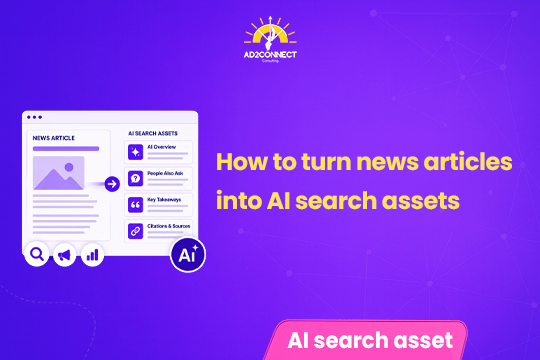
A single article can become a collection of useful AI search assets — facts, statistics, quotes, answers, videos, graphics, FAQs, social posts, and other formats that can reach audiences across search engines, AI platforms, social media, email, and websites.
The goal is no longer just to publish an article.
The goal is to make the information inside that article useful wherever your audience is looking.
By Snehal Singh | Published: August 7, 2026
AI Overview Summary
AI search is changing the traditional role of the article. Instead of treating an article as one fixed piece of content, businesses and publishers can break it into smaller, useful information assets that can be reused across different platforms and formats.
This approach is often described as liquid content. The idea is simple: valuable information such as verified facts, original data, expert quotes, explanations, and resources should not remain locked inside one article. It can be adapted into videos, social posts, graphics, FAQs, newsletters, reports, podcasts, and other formats.
For AI search, the content should also be easy to understand. Clear headings, direct answers, summaries, internal links, structured data, useful quotes, and well-organized information can make content easier for both people and search systems to process.
The biggest opportunity is not creating more content.
It is getting more value from the content you already create.
Table of Contents
- What Are AI Search Assets?
- Why the Traditional Article Is Changing
- What Is Liquid Content?
- How Multimodal Content Fits Into AI Search
- How to Turn a News Article Into AI Search Assets
- How to Structure Articles for AI Search
- Content Distribution: Don’t Stop at Google
- Personalization and AI Search
- Can AI Search Assets Create New Revenue Opportunities?
- Risks of Turning Articles Into AI Assets
- Common Mistakes to Avoid
- How Ad2Connect Approaches AI Search Content
- Key Takeaways
What Are AI Search Assets?
An AI search asset is a useful piece of information that can be easily understood, extracted, referenced, or reused in AI-powered search experiences.
It does not have to be a complete article.
It could be something as simple as:
- An original statistic
- A verified fact
- An expert quote
- A product comparison
- A research finding
- A definition
- A step-by-step explanation
- A table
- A checklist
- An FAQ
- A video
- An infographic
- A podcast
- A unique opinion or insight
Think about an article as a container.
Inside that container are many valuable pieces of information.
Instead of keeping everything inside one page, you can make those individual pieces useful in different places.
For example, an article about digital advertising trends could become a statistics page, LinkedIn posts, an infographic, a short video, a newsletter, a podcast discussion, and a set of FAQs.
The original research has not changed.
Only the way it is presented has changed.
Why the Traditional Article Is Changing
For years, the standard SEO content model was relatively straightforward:
Research ? Write article ? Optimize keywords ? Rank ? Get clicks.
That model still has value.
But search behavior is no longer limited to ten blue links.
AI Overviews, AI assistants, conversational search, social search, video platforms, and other discovery systems are changing how people find information.
This creates a new challenge for businesses.
Imagine you publish a detailed article containing 20 useful facts.
A reader may never read all 20 facts.
An AI system may only need one or two facts to answer a user’s question.
A social user may only want one statistic.
A video viewer may want a two-minute explanation.
A business customer may want a comparison table.
The information is the same, but the need is different.
That is why the article should not always be treated as the final product.
It can be the source material for many useful products.
What Is Liquid Content?
Liquid content is information that can move between formats, platforms, and audiences instead of remaining fixed in one traditional article.
The concept is especially useful in an AI-driven environment because AI tools make it easier to transform information into different formats.
Imagine you publish an article called:
“10 Digital Marketing Trends Businesses Should Watch in 2026.”
Instead of stopping after publishing the article, you could create:
- A list of the 10 trends
- A short video explaining the top three
- An infographic
- A LinkedIn carousel
- A newsletter
- A podcast episode
- A downloadable PDF
- An FAQ
- A statistics page
- A presentation
- A sales presentation
- A social media series
The article becomes the source.
The individual information becomes the assets.
The important point is that liquid content should not mean randomly copying and pasting the same article everywhere. Each format should serve a specific audience need.
How Multimodal Content Fits Into AI Search
People consume information differently.
Some prefer reading.
Some prefer watching videos.
Some want an infographic.
Some prefer listening to podcasts while traveling.
Others want a short answer and nothing more.
This is where multimodal content becomes important.
Multimodal content means presenting information through different formats, such as:
- Text
- Images
- Video
- Audio
- Charts
- Infographics
- Interactive tools
- Presentations
AI tools can make it much easier to create these different versions from existing information.
For example, a long industry report could be turned into a short summary, a presentation, a quiz, an infographic, or an audio discussion.
However, AI-generated formats still need human review.
A statistic that is correct in an article could become misleading when placed into a graphic without its context.
A quote could lose its meaning when shortened.
An AI-generated summary could accidentally leave out an important qualification.
The goal should therefore be faster content production with human quality control, not completely automated publishing.
How to Turn a News Article Into AI Search Assets
Once you understand the concept, the process becomes much easier.
Here are practical ways to turn an existing article into multiple AI search assets.
1. Extract the Main Facts
Start with the basics.
Ask:
What are the most important facts in this article?
Make a list.
For a news article, this might include:
- Who is involved?
- What happened?
- When did it happen?
- Where did it happen?
- Why does it matter?
- What happens next?
- What data supports the story?
This creates a simple information base that can be reused.
For business content, the same approach works.
If you publish an article about SEO, identify the most important definitions, statistics, recommendations, examples, and conclusions.
These can become individual content assets.
2. Turn Data Into Standalone Assets
Data is one of the strongest forms of reusable content.
Suppose your company publishes a study based on 500 customer responses.
Do not bury all the findings inside one blog post.
Turn important findings into standalone assets.
For example:
“72% of businesses say organic search remains an important source of leads.”
That single finding could become:
- A social media post
- A chart
- An infographic
- A presentation slide
- A video talking point
- A newsletter section
- A report highlight
If the data is original, clearly explain where it came from.
Original research gives people and search systems something useful to reference.
3. Create Question-and-Answer Content
Every useful article answers questions.
Find those questions and make the answers clear.
For example, an article about AI SEO could answer:
What is AI SEO?
AI SEO is the process of improving content and website visibility so that search engines and AI-powered systems can better understand, evaluate, and surface the information.
Why does AI search matter?
AI search can provide answers directly to users, changing how people discover brands and websites.
Does AI SEO replace traditional SEO?
No. Traditional SEO remains important. AI search adds another layer of visibility that businesses now need to consider.
These answers can be used inside the original article, FAQs, social content, videos, and other formats.
4. Repurpose Expert Quotes
Expert commentary can make content more credible and more memorable.
If your article includes an expert quote, give that insight a life beyond the article.
You can turn it into:
- A quote graphic
- A LinkedIn post
- A short video
- A newsletter highlight
- A podcast topic
- A social media discussion
A good quote can also become the starting point for a completely new piece of content.
The important thing is to preserve the original meaning and attribution.
5. Create Visual Content
Not every reader wants to go through 2,000 words.
A visual summary can communicate the main idea much faster.
For example, an article about SEO could become an infographic showing:
Traditional Search ? AI Search ? New Content Opportunities
A complex research report could become a chart.
A comparison article could become a table.
A process could become a flowchart.
Visual assets are especially useful for social media and presentations.
6. Turn Articles Into Video and Audio
Video and audio can extend the life of an article.
A 2,000-word article could become a five-minute video.
The same research could become a podcast discussion.
A long explanation could become several short videos, with each video answering one specific question.
The important thing is not to read the article word-for-word.
Instead, identify the most useful ideas and adapt them for the new format.
7. Build Supporting Content
A strong article can also become the starting point for a larger topic cluster.
Suppose you publish an article about AI search.
That article could lead to supporting content about:
- AI SEO
- Google AI Overviews
- Generative Engine Optimization
- Content optimization
- Entity SEO
- Structured data
- Internal linking
- AI visibility tracking
- Content repurposing
These pages can be connected through internal links.
Over time, this creates a stronger content ecosystem around the topic.
How to Structure Articles for AI Search
Creating multiple content formats is only part of the strategy.
The original article still needs to be easy to understand.
A well-structured article works better for both people and search systems.
Put the Important Information First
Do not make the reader wait for the answer.
Start with the most important information.
Then provide supporting details.
This is helpful for busy readers and makes the content easier to process.
Use Clear Headings
Break large topics into logical sections.
For example:
- What Is AI SEO?
- Why Is AI Search Important?
- How Does AI Search Work?
- How Can Businesses Optimize for AI Search?
A reader should be able to scan the headings and understand the article.
Add a Summary
A short summary at the beginning can help readers understand the article quickly.
For long articles, bullet points can make the main lessons easier to identify.
Highlight Important Questions and Quotes
If the article answers an important question, make that question visible.
If an expert provides an important insight, consider highlighting it.
This helps readers find the most valuable parts of the article without reading every paragraph.
Use Internal Links
Connect the article to relevant pages on your website.
Internal links can help readers discover related information while helping search engines understand the relationship between your pages.
For example, an AI search article could link to related Ad2Connect content about SEO, content marketing, analytics, performance marketing, and conversion optimization.
Use Structured Data Where Appropriate
Structured data gives search engines additional information about what a page represents.
For news publishers, appropriate NewsArticle structured data can help search engines understand news content.
For other content, use the schema type that accurately describes the page.
Structured data should support the content, not replace good content.
Content Distribution: Don’t Stop at Google
One of the biggest changes in modern search is that content discovery does not happen in one place.
People may discover your brand through:
- Google Search
- AI search
- YouTube
- Newsletters
- Podcasts
- Industry websites
- Online communities
This means your content strategy should consider distribution from the beginning.
Do not ask:
“How do we get this article to rank?”
Also ask:
“Where else does our audience look for this information?”
For example, if your target audience is active on LinkedIn, create a professional insight from the article.
If they prefer video, create a video explanation.
If they want quick information, create a short summary.
The same core knowledge can serve different audiences without becoming repetitive.
Personalization and AI Search
People do not always want the same version of a story.
Someone driving to work may prefer audio.
Someone sitting at a desk may prefer text.
Someone researching a purchase may want a comparison table.
Someone who already understands the topic may want only the latest update.
AI makes it easier to adapt content to these different needs.
This is one of the larger opportunities behind liquid content: instead of forcing everyone to consume the same format, businesses can create different paths to the same information.
For publishers and brands, this can improve engagement because the user gets information in a format that fits the situation.
Can AI Search Assets Create New Revenue Opportunities?
Yes.
Turning content into smaller, reusable assets is not only a visibility strategy.
It can also create new business opportunities.
For example, a company with valuable original research could create:
- Premium reports
- Industry benchmarks
- Data products
- Paid newsletters
- Research subscriptions
- Consulting services
- Lead-generation resources
- Training programs
A publisher with a large historical data collection could potentially provide structured data through licensing or APIs.
The opportunity is particularly interesting for industries that naturally generate large amounts of valuable information, such as finance, healthcare, science, sports, technology, and local news.
The principle is simple:
If your business owns valuable information, don’t think only about how to publish it. Think about how that information can be packaged, distributed, and monetized.
Risks of Turning Articles Into AI Assets
The strategy has real benefits, but it also comes with risks.
The biggest risk is losing context.
When an article is broken into individual facts, a fact can sometimes be separated from the explanation that made it meaningful.
This is especially dangerous with statistics, research, expert statements, and news.
AI-generated summaries can also introduce mistakes.
For example, an AI tool might combine information from different sources and produce an answer that sounds correct but contains an incorrect conclusion.
That is why human review remains essential.
The goal should not be:
Article ? AI ? Publish everywhere.
A safer process is:
Article ? Extract information ? Adapt format ? Human review ? Publish ? Monitor.
Accuracy should always come before speed.
Common Mistakes to Avoid
1. Creating Content Only for AI
Do not write awkward content simply because you think an AI system will understand it better.
Write clearly for people.
What helps humans understand content often helps machines understand it too.
2. Creating Too Many Low-Quality Versions
One article does not need to become 50 pieces of content.
Choose formats that make sense.
Quality is more important than volume.
3. Copying the Same Content Everywhere
Repurposing is not the same as duplication.
A LinkedIn post, video, newsletter, and blog should use the same core insight but adapt it for the platform.
4. Removing Context From Data
Never publish a statistic without explaining what it measures and where it came from.
Context protects your credibility.
5. Relying Completely on AI
AI is useful for summarizing, brainstorming, formatting, and repurposing.
But it should not replace fact-checking and editorial judgment.
6. Forgetting Your Website
Third-party platforms can help distribute content, but your website should remain the central home for your original information.
Build your authority on assets you control.
7. Measuring Only Traffic
Traffic is important, but it is not the only measurement.
Also consider:
- AI visibility
- Brand mentions
- Search impressions
- Engagement
- Leads
- Conversions
- Backlinks
- Newsletter signups
- Video views
- Assisted conversions
The goal is not simply to produce more content.
The goal is to create useful content that contributes to business results.
How Ad2Connect Approaches AI Search Content
At Ad2Connect, we believe the future of content is not about publishing more pages simply to increase the number of URLs on a website.
It is about creating useful information and finding more ways to make that information work.
Our approach starts with understanding the audience, search behavior, business goals, and existing content.
From there, we identify opportunities to turn valuable information into different content assets.
For example, one research-based article could support:
- SEO content
- AI search optimization
- Social media content
- Video topics
- Infographics
- FAQs
- Lead-generation assets
- Email content
- Supporting website pages
This approach helps businesses move from a “publish and forget” content model to a more connected content ecosystem.
It also fits naturally with the way Ad2Connect approaches SEO and analytics: understand what the data is telling you, identify the opportunity, and invest effort where it can contribute to measurable business growth.
For businesses that are already producing content but are not getting enough value from it, the opportunity may not be to publish more.
It may be to reuse, restructure, redistribute, and improve what already exists.
Key Takeaways
- An article can be much more than one webpage.
- AI search is changing how people discover and consume information.
- Valuable facts, data, quotes, answers, and resources can become individual AI search assets.
- Liquid content allows information to move between different formats and platforms.
- Multimodal content can help reach people who prefer video, audio, graphics, or text.
- Clear headings, summaries, answers, internal links, and structured data can make content easier to understand.
- Content distribution should extend beyond traditional Google search.
- AI can help repurpose content, but human review is essential.
- Original data and expertise can create stronger content assets and new business opportunities.
- The goal should not be to create more content. The goal should be to get more value from useful content.
Ad2Connect is a digital marketing agency helping businesses grow through SEO, performance marketing, content marketing, social media, website development, branding, conversion optimization, and analytics.
If your existing content is getting traffic but not creating enough visibility, engagement, or leads, an AI search content audit can help identify which existing assets can be improved, repurposed, or distributed in new ways.