
How to Scale SEO Content Updates With AI Without Losing Rankings
AI Overview Summary
SEO is not just about publishing new content. The pages already bringing visitors to your website also need regular attention. Over time, search rankings can change, competitors can publish better information, and Google can change what it considers the best answer.
The solution is not to rewrite every old page from scratch.
A better approach is to first identify what is working, find what has changed, update only the sections that need attention, and then measure the results. AI tools can help make this process faster, but they should support human judgment rather than replace it.
This guide explains how businesses can scale SEO content updates with AI while protecting existing rankings, improving content quality, and focusing on pages that can create real business value.
Table of Contents
- What Are SEO Content Updates?
- Why Existing Content Needs Regular Updates
- Why Rewriting Everything Can Hurt SEO
- How to Identify Pages That Need an Update
- The 14-Step SEO Content Update Process
- How AI Can Scale SEO Content Updates
- What AI Should and Should Not Do
- Common Mistakes to Avoid
- How Ad2Connect Approaches SEO Content Updates
- Key Takeaways
What Are SEO Content Updates?
SEO content updates are changes made to existing website pages to keep them useful, accurate, relevant, and competitive in search results.
Think of an old blog post like a shop that has been open for several years.
The shop may still have loyal customers, but some products may be outdated. Prices may have changed. New competitors may have opened nearby. Customers may also be looking for something different.
Your website works in a similar way.
A page that ranked well two years ago may slowly lose visibility because the information is no longer complete, competitors have created better pages, or Google has changed how it understands the search query.
That does not necessarily mean the entire page is bad.
In many cases, only a few parts need to change.
That is why a smart SEO content update focuses on the difference between what is already working and what needs improvement.
Why Existing Content Needs Regular Updates
Creating a new page is exciting because you are starting with a blank canvas.
Updating an existing page is different.
An older page may already have backlinks, internal links, search visibility, keyword rankings, user data, and SEO authority. Replacing everything without checking what is working can remove some of those benefits.
Search results also change continuously.
A competitor may publish a more useful guide. A previously important question may become less popular. Google may start showing an AI Overview, video, comparison table, product page, or another format for the same search.
The important lesson is simple:
Do not update content just because it is old. Update it because the data shows there is an opportunity to improve it.
Why Rewriting Everything Can Hurt SEO
One of the biggest mistakes businesses make is treating an SEO update as a complete rewrite.
Imagine that one section of your page is already ranking well for an important keyword.
If you completely rewrite that section, you may accidentally remove the words, information, links, or context that helped it rank.
The result?
A page that was supposed to become better can actually perform worse.
This is why SEO content updates should follow a preserve first, improve second approach.
Before changing anything, ask:
- Which keywords are already bringing visitors?
- Which sections are performing well?
- Which pages are ranking close to the first page?
- Which questions are visitors searching for?
- What information is now outdated?
- What are competing pages doing better?
- Has search intent changed?
- Are people still clicking the page?
The goal is not to make the page different.
The goal is to make the page more useful without destroying the value it already has.
How to Identify Pages That Need an Update
You do not need a complicated SEO system to find pages that may need attention.
Google Search Console is a good starting point.
Look at:
- Organic clicks
- Impressions
- Average position
- Click-through rate
- Search queries
- Pages receiving traffic
- Keywords where the page ranks between positions 5 and 20
A page ranking around position 8, for example, may be a better update opportunity than a page ranking at position 80.
Why?
Because the first page is already close to strong visibility. A carefully planned update may help it move higher.
You should also look for pages where impressions are high but clicks are low.
This can indicate that people see your page in search results but do not feel motivated to click it.
So before updating a page, find out why performance has changed.
The 14-Step SEO Content Update Process
Step 1: Check Google Search Console Data
Start with a fixed period of data.
A consistent measurement period gives you a clear baseline before you make any changes.
Record:
- Clicks
- Impressions
- Average position
- CTR
- Important search queries
This gives you a clear picture of where the page stands before making changes.
Without a baseline, it becomes difficult to know whether your update actually worked.
Step 2: Classify Each Section
Next, review the page section by section.
A simple four-label system works well:
Keep: The section is useful, accurate, and performing well.
Fix: The information is useful but outdated, weak, or poorly explained.
Remove: The section is unnecessary, incorrect, repetitive, or no longer relevant.
Add: The page is missing information that users now need.
This simple system prevents unnecessary rewriting.
Instead of saying, “Let’s rewrite this article,” you can say, “Let’s keep these five sections, improve these three, remove one, and add two.”
That is a much safer approach.
Steps 3-5: Study Keywords, Competitors, and Search Intent
Now look at what people are actually searching for.
Your existing page may rank for keywords you did not originally target.
Some of these keywords may represent valuable opportunities.
For example, a page about digital marketing may also receive impressions for:
- Digital marketing strategy
- Digital marketing services
- SEO marketing
- Online marketing for small businesses
- Digital marketing agency
These searches can tell you what users expect to find.
Next, look at competing pages.
Do not simply copy them.
Instead, ask:
What useful information do they provide that our page does not?
This could be:
- A comparison
- A practical example
- Original research
- A calculator
- A checklist
- Updated statistics
- Better explanations
- Frequently asked questions
- A clearer structure
Search intent matters just as much as keywords.
If Google is increasingly showing comparison pages for a particular search, adding more words to a traditional blog post may not solve the problem.
You may need to change the format instead.
Steps 6-7: Check What Has Changed
Information can become outdated surprisingly quickly.
Depending on the topic, check:
- Statistics
- Prices
- Product information
- Industry trends
- Regulations
- Software features
- Screenshots
- Examples
- Links
- Search results
- User expectations
A good content update should be based on current information rather than assumptions.
This is particularly important when AI is involved.
AI can help identify information that may need checking, but important facts should still be verified using reliable sources.
Step 8: Create a Content Update Brief
Do not immediately ask AI to rewrite the page.
First create a simple update brief.
The brief should explain:
- What should stay?
- What needs fixing?
- What should be removed?
- What needs to be added?
- Which keywords matter?
- What search intent should the page satisfy?
- What competitors are doing better?
- What business goal does the page support?
This is sometimes called a delta brief because it focuses on what needs to change rather than asking for an entirely new page.
That small difference can save a lot of time and protect existing SEO value.
Step 9: Update Only What Needs Improvement
Now write the changes.
Do not rewrite a good section simply because AI can rewrite it.
Update the sections marked for improvement.
Add information where a real gap exists.
Improve explanations where readers may be confused.
Add examples where they make the topic easier to understand.
If the page needs a new section, add it.
This approach produces content that is usually more natural because the page still retains the useful information that was already there.
Step 10: Fact-Check the Content
AI can write quickly.
That does not mean everything it writes is correct.
Every important claim should be checked.
Pay special attention to:
- Numbers
- Dates
- Prices
- Statistics
- Product features
- Company information
- Regulations
- Technical details
- Medical or financial claims
AI-generated content still needs human review and fact-checking before publication.
Step 11: Review Images
Content updates should not focus only on text.
Check your images too.
Ask:
- Is the image still relevant?
- Does it support the content?
- Is it high quality?
- Is it properly sized?
- Does it load quickly?
- Does it accurately represent the information?
Large or outdated images can also create a poor user experience.
Modern formats such as WebP or AVIF can help reduce image size when properly implemented.
The important point is that an SEO content refresh should improve the entire page experience, not just the words on the screen.
Step 12: Protect Existing SEO Elements
This is one of the most important parts of an SEO update.
Do not automatically change:
- URL
- Meta title
- Internal links
- Schema
- Existing keyword targeting
A URL that already has authority should generally be preserved unless there is a strong reason to change it.
The same principle applies to a meta title that already earns a good click-through rate.
Remember:
An SEO update should improve an existing asset, not accidentally destroy it.
Step 13: Improve Useful Page Features
Sometimes better SEO content is not about adding more paragraphs.
It can be about making information easier to use.
Depending on the page, consider adding:
- Comparison tables
- Calculators
- Checklists
- FAQs
- Interactive tools
- Step-by-step guides
- Visual summaries
- Product selectors
- Helpful filters
For example, instead of writing another 500 words explaining how to choose a service, you might create a simple comparison table.
This can help users understand the information more quickly.
AI coding tools can also make simple interactive features faster to build, but every feature should have a clear purpose.
Do not add an interactive element just because AI can create one.
Step 14: Measure the Results
Publishing an update is not the end.
It is the beginning of the measurement phase.
Compare your new performance against the original baseline.
Look at:
- Organic clicks
- Impressions
- Average position
- CTR
- Keyword coverage
- Conversions
- Leads
- Revenue
SEO results are not guaranteed. The value of measurement is that it tells you whether your particular change produced a positive result.
How AI Can Scale SEO Content Updates
Updating one page manually is manageable.
Updating hundreds or thousands of pages is much harder.
This is where AI can become useful.
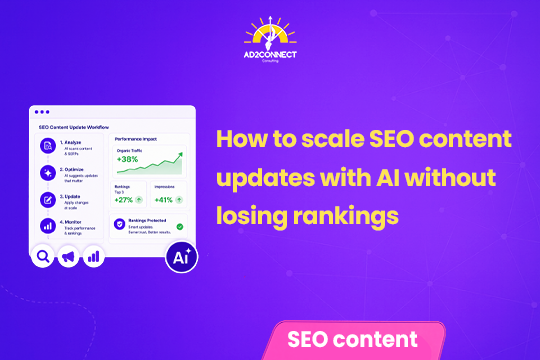
Instead of using AI only as a writing assistant, businesses can build a repeatable workflow around it.
For example:
- Collect Google Search Console data.
- Identify pages with declining performance or missed opportunities.
- Analyze search queries.
- Compare competitors.
- Identify missing topics and information.
- Create a content update brief.
- Generate only the required changes.
- Check facts.
- Review SEO elements.
- Prepare the page for publishing.
- Have a human review the changes.
- Publish and measure.
The important difference is that AI is not being asked to blindly rewrite thousands of articles.
It is being given a defined process.
AI can help make the process faster, but the strategy should still come from experienced SEO professionals.
What AI Should and Should Not Do
AI is very useful for repetitive work.
It can help:
- Analyze large amounts of content
- Identify possible content gaps
- Group search queries
- Create content briefs
- Suggest improvements
- Rewrite selected sections
- Check formatting
- Generate tables
- Find potential inconsistencies
- Support repetitive SEO tasks
But AI should not automatically decide everything.
Human experts should still review:
- Business priorities
- Brand positioning
- Important facts
- Search intent
- Content strategy
- Major SEO changes
- Final publication
The best approach is not AI versus humans.
It is AI plus human judgment.
AI can increase the amount of work your team can handle, while experienced SEO professionals make the important decisions.
Common Mistakes to Avoid
Rewriting Every Old Article
Older does not automatically mean worse.
Some pages may still perform extremely well.
Update only when the data shows an opportunity.
Changing the Publication Date Without Improving the Content
Changing the date alone does not make an article more useful.
Readers want better information, not simply a newer timestamp.
Adding Words Just to Increase Word Count
A 2,000-word article is not automatically better than a 1,000-word article.
The goal should be usefulness.
Letting AI Rewrite Everything
A complete AI rewrite can remove valuable information and change the page’s search focus.
Use AI selectively.
Ignoring Search Intent
Keywords tell you what people search for.
Search results can tell you what they expect to see.
Both matter.
Changing URLs Unnecessarily
An existing URL may already have backlinks, rankings, and authority.
Do not change it without a strong reason.
Publishing Without Measurement
If you do not record the original performance, you may never know whether your update worked.
How Ad2Connect Approaches SEO Content Updates
At Ad2Connect, we believe SEO content updates should be driven by data rather than guesswork.
Our approach starts by identifying which pages have the greatest opportunity for improvement.
We look at search visibility, rankings, clicks, search queries, content quality, user intent, and business value before recommending an update.
We then determine what the page actually needs.
Sometimes that means refreshing outdated information.
Sometimes it means improving the structure.
Sometimes it means adding missing sections.
In other cases, the best decision may be to consolidate pages, change the content format, or leave the page alone.
That last option is important.
Not every declining page needs a rewrite.
The reason behind the decline matters.
For businesses managing a large content library, AI can help make this process more efficient. But automation should follow a clear SEO strategy and quality-control process.
Our goal is not to create more content simply for the sake of creating more content.
The goal is to help businesses get more value from the content they have already invested in.
Key Takeaways
- Diagnose before you rewrite. Find out why a page needs an update.
- Protect what already works. Existing rankings, links, and useful content have value.
- Update the sections that need improvement. You rarely need to rewrite everything.
- Use Google Search Console data. Search data can reveal opportunities that are difficult to see by simply reading a page.
- Match search intent. Give users the type of information they are actually looking for.
- Use AI for scale, not blind automation. AI can speed up repetitive work, but human judgment remains important.
- Fact-check important information. AI-generated content still needs review.
- Measure after publishing. Compare results with a clear baseline.
- Focus on business results. Rankings and traffic matter, but leads, sales, and revenue matter too.
SEO content updates should not be treated as simple maintenance.
When done properly, they can turn existing pages into stronger assets without starting from zero.
The best place to start is not the writing.
Start with the data.