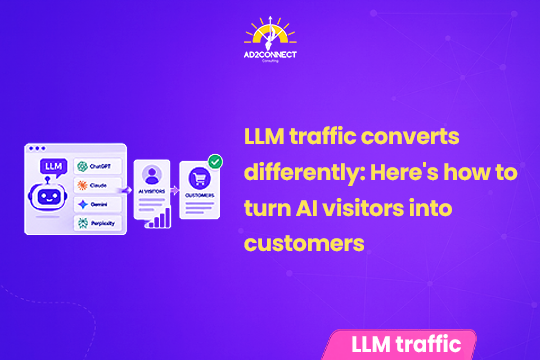
LLM Traffic Converts Differently: Here’s How to Turn AI Visitors Into Customers
A visitor from ChatGPT isn’t the same as a visitor from a Google Ads click. Treat them the same way, and you’ll lose them.
By Snehal Singh | Published: August 18, 2026
AI Overview Summary
LLM traffic is the growing stream of visitors who reach your website after an AI tool like ChatGPT or Google AI Mode cites you as a source. This traffic behaves very differently from paid search traffic. It converts at a much higher rate, but it also arrives with different expectations. A paid search visitor is comparing options. An LLM visitor has often already decided, and just wants to verify what the AI told them. Treating both groups the same, with the same landing pages and the same tracking, means losing the easiest conversions you’re likely to get. The fix is simple: build content that earns citations, design landing pages that build trust instead of pushing a hard sell, and set up tracking that actually captures where this traffic is coming from.
Table of Contents
- What Is LLM Traffic, and Why Does It Convert Better?
- Why LLM Visitors Behave Differently From PPC Visitors
- The Landing Page Mistake Most Businesses Make
- 4 Ways to Convert LLM Traffic Better
- PPC Landing Pages vs LLM Landing Pages
- Mistakes That Look Like Strategy
- How Ad2Connect Approaches LLM Traffic Conversion for Clients
- Key Takeaways
What Is LLM Traffic, and Why Does It Convert Better?
Paid search has always been reliable because you can track a click all the way to a sale. AI search works differently. A visitor arrives after an AI system has already helped shape their decision, before they ever land on your page.
Here’s the surprising part. Data shows LLM referral traffic converts at 20%. That’s the highest-converting channel in the dataset. It’s 61% higher than paid search.
Why does this happen? By the time someone clicks a link inside an AI answer, most of the thinking is already done. They’re not browsing anymore. They’re checking.
The volume from this channel is still small compared to Google Ads or organic search. But the people who do click are far closer to a decision. That makes each one worth more.
Why LLM Visitors Behave Differently From PPC Visitors
In a Google Ads campaign, you target a single search phrase. Someone searches “best CRM for small business,” and you show them an ad built around that exact phrase.
LLM users work differently. They give the AI context, not just a keyword. Something like: “I run a 50-person consulting firm on Google Workspace. What CRM works well with it, costs under $50 a user, and has good email automation?”
The AI does the comparing for them. By the time they click through to your site, they’re not looking for a page that stacks you up against ten competitors. They want to confirm the AI got it right.
This changes everything about what that visitor needs from your page.
There’s also a trust difference worth understanding. When someone clicks a paid ad, they know it’s paid for, so there’s a bit of built-in skepticism. When an AI cites your website as a source, it feels more like an independent recommendation. That trust is valuable, but only if what they find on your page matches what the AI told them. Break that promise, and you lose them fast, often faster than you’d lose a PPC visitor who was already primed to be skeptical.
The Landing Page Mistake Most Businesses Make
Most businesses point every kind of traffic at the same landing page. That’s a mistake with LLM visitors.
A PPC landing page is built for speed. Minimal navigation, a strong call to action, benefit-driven copy tied to one keyword. That works when someone is still comparing.
An LLM visitor isn’t comparing anymore. They want depth. They want to see the expertise behind the AI’s recommendation. A page that pushes a form immediately, with no supporting detail, feels like a bait-and-switch after what the AI just told them.
If you don’t adjust for this, you’ll bounce visitors who were actually your easiest conversions.
4 Ways to Convert LLM Traffic Better
1. Give AI a reason to cite you
AI tools favor content with real information gain. That means original data, expert quotes, and insights that aren’t just repeating what’s already on page one of Google.
- Look at your core pages. Are they saying anything a competitor isn’t already saying?
- Add original research, expert commentary, or a clear point of view that AI tools can pull from.
2. Track where AI is sending traffic, and show up around it
You can’t always control what an AI recommends. But you can see which sites it’s citing, and get your brand visible around them.
- Check which websites keep showing up as sources in AI answers for your topic.
- Consider display or video ads on those sites, including platforms like YouTube, which shows up often in AI citations.
3. Build a landing experience for specific, detailed questions
LLM users ask very specific questions. A generic contact form doesn’t match that specificity.
- Replace static forms with interactive tools, like calculators or short qualification quizzes.
- Consider a simple on-site chatbot that can continue the conversation the AI started.
4. Fix your tracking before you judge results
Most AI referral traffic shows up in analytics as “Direct” or unclassified. That makes it easy to underestimate.
- Stop relying only on last-click data to judge this channel.
- Add a “How did you hear about us?” option on your best-performing forms, with choices like “ChatGPT” or “AI Search.”
- Watch for spikes in direct traffic that line up with AI feature launches.
PPC Landing Pages vs LLM Landing Pages
| Factor | PPC Landing Page | LLM Landing Page |
|---|---|---|
| Visitor mindset | Still comparing options | Already decided, verifying |
| Design | Minimal, one clear call to action | Rich in detail, easy to explore |
| Content style | Short, benefit-driven, keyword-matched | Deep, expert-led, trustworthy |
| Trust level going in | Lower, knows it’s a paid ad | Higher, sees it as independent |
| Best conversion tool | Aggressive form or offer | Interactive tools, chat, detailed proof |
Mistakes That Look Like Strategy
Most businesses lose easy LLM conversions through the same handful of habits:
- Sending AI-referred visitors to the exact same page as paid search visitors
- Gating important information behind a form before earning any trust
- Ignoring “Direct” traffic spikes instead of digging into what’s driving them
- Assuming low traffic volume from AI sources means it isn’t worth optimizing for
- Writing content that just repeats what’s already ranking, giving AI no reason to cite it
- Skipping any way to ask new visitors how they actually found you
How Ad2Connect Approaches LLM Traffic Conversion for Clients
At Ad2Connect, a performance marketing agency in Mumbai working with SaaS, eCommerce, D2C, and local business clients, we treat LLM traffic as its own channel, not an extension of paid search. That means separate landing pages, separate tracking, and content built specifically to earn AI citations.
This connects closely to work we’ve written about before. A page that isn’t getting cited by AI often has the same root problem covered in our piece on measuring brand visibility in AI answers like Gemini, and content that keeps losing traffic to AI Overviews may actually be dealing with zero-click capture, one of the four types of content decay we cover elsewhere on this blog.
As a full-service digital marketing agency in Mumbai, we pair this AI-citation strategy with the conversion-focused thinking that comes from our best SEO agency in Mumbai services, so the traffic AI sends you actually turns into leads instead of quietly bouncing.
If you’re seeing unexplained direct traffic or suspect your best content isn’t showing up in AI answers, that’s exactly the kind of audit our team runs for clients.
Key Takeaways
- LLM traffic converts higher than paid search, but it behaves completely differently. Treat it like PPC traffic, and you’ll lose the advantage.
- AI visitors have usually already decided. Your landing page should build trust and depth, not push a hard sell.
- Earning the citation matters as much as converting the click. Content needs real information gain to get picked by AI tools in the first place.
- Fix your tracking. Most AI referral traffic hides inside “Direct” traffic unless you build in a way to catch it.
- Treat LLM traffic as its own channel, with its own pages, its own tracking, and its own strategy.
Ad2Connect is a digital marketing agency helping SaaS, eCommerce, D2C, and local businesses grow through data-driven SEO, performance marketing, and content strategy. If you’re not sure how much of your traffic is coming from AI tools, or whether it’s converting, talk to our team about running an AI traffic audit.