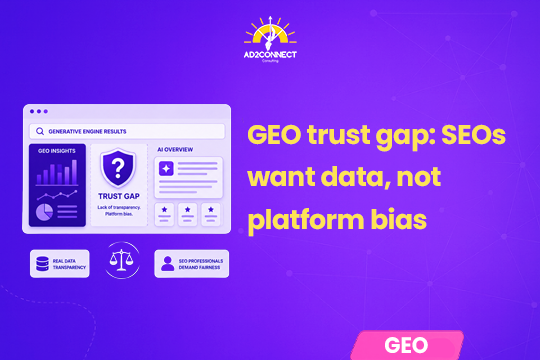
GEO Trust Gap: SEOs Want Data, Not Platform Bias
A recent industry survey found something strange. People rate AI visibility data as highly valuable, then say they wouldn’t spend money on a tool that provides it. Here’s why.
By Snehal Singh | Published: August 17, 2026
AI Overview Summary
A recent survey of 163 SEO and AI search professionals found a clear gap. People rated AI visibility data, like whether a brand gets cited by tools such as ChatGPT or Google’s AI Overviews, as very valuable, scoring it around 4.2 out of 5. But when asked if it’s worth investing budget in a dedicated platform to track that data, the score dropped to around 3.2 out of 5. This isn’t a pricing problem. Only about 7% of people who raised concerns pointed to cost. The real issue is trust. Most respondents don’t believe the numbers these platforms produce, because the methodology behind AI visibility scores is rarely made public, and results can shift simply because AI models behave differently for every user. This matters for any business investing in GEO (Generative Engine Optimization), because it means visibility scores should be treated as one directional signal, not gospel, until you understand how they’re built.
Table of Contents
- What This Survey Actually Found
- Why the Trust Problem Isn’t About Price
- What SEOs Actually Said Was Wrong
- Why Nobody Can Fully Solve the Trust Problem
- What This Means If You’re Investing in GEO
- AI Visibility Data vs AI Visibility Platforms
- Mistakes That Look Like Strategy
- How Ad2Connect Approaches GEO and AI Visibility for Clients
- Key Takeaways
What This Survey Actually Found
A recent survey asked 163 people working in SEO and AI search visibility two simple questions.
First, how valuable is AI visibility data, things like whether your brand gets mentioned by ChatGPT, or cited in Google’s AI Overviews? People rated this highly. Around 4.2 out of 5.
Second, is it worth spending money on a dedicated platform that tracks this data? The score dropped noticeably. Around 3.2 out of 5.
That’s the whole story in two numbers. People want the information. They just don’t trust the tools selling it to them.
This gap held steady even as more responses came in, growing from 36 replies to over 160. The number barely moved. Whatever is causing this gap, it isn’t random noise. It’s a real, consistent pattern.
Why the Trust Problem Isn’t About Price
Here’s the part that surprised even the person running the survey. Only about 7% of respondents said cost was their main concern.
Far more people, well over half, said either “I don’t believe this number” or “I can’t connect this to real business results.”
That ratio matters. If this were a pricing problem, cheaper tools would fix it. But cheaper tools won’t fix a trust problem. And right now, trust is the real issue.
What SEOs Actually Said Was Wrong
When people were asked to explain their biggest concern in their own words, a few themes came up again and again.
The most common complaint, raised by about a quarter of respondents, was about trust and unclear methodology. People simply don’t know how these platforms calculate their scores.
Close behind that was a struggle to connect AI visibility numbers to actual business results, like leads or revenue. Many pointed out that AI answers change every time you ask, since results can vary based on who’s asking and how the question is phrased. That makes it hard to tell if a score change is a real shift or just random variation.
Several people raised a more structural concern. Many GEO tools track visibility using a fixed list of sample prompts that you choose yourself. If you pick the prompts, you’re deciding in advance what you should show up for, then grading yourself against your own list. One person called this a self-fulfilling prophecy.
Why Nobody Can Fully Solve the Trust Problem
Here’s an uncomfortable truth about this whole category of tool. The methodology, the exact formula behind an AI visibility score, is usually the company’s most valuable asset.
If a company fully published how their scoring works, competitors could copy it, and the product would essentially become free. So most companies keep it private. That’s not unique to GEO tools either. Keyword research tools have worked this way for decades, without most SEOs ever seeing what’s happening under the hood.
This creates a real bind. People want proof the numbers are accurate. Companies can’t fully provide that proof without giving away their product. Interestingly, almost nobody in the survey proposed an alternative, like independent audits or published accuracy testing, that might actually solve this.
What This Means If You’re Investing in GEO
None of this means AI visibility data is useless. It means it should be treated the way experienced SEOs have always treated third-party SEO data: directional, not exact.
A rising or falling visibility score is a signal worth paying attention to. It’s not proof of cause and effect on its own. Pair it with other signals, like actual website traffic, branded search volume, and real conversions, before making big decisions based on one dashboard number.
AI Visibility Data vs AI Visibility Platforms
| Factor | The Underlying Data | The Platforms Selling It |
|---|---|---|
| Perceived value | High, rated around 4.2/5 by practitioners | Lower, rated around 3.2/5 |
| Main concern | Not usually questioned directly | Trust in methodology, accuracy |
| Biggest objection | N/A | “I don’t believe this number” |
| Price as an issue | N/A | Rarely, only about 7% of complaints |
| How to use it | As one directional signal | With healthy skepticism, alongside other data |
Mistakes That Look Like Strategy
Businesses investing in GEO and AI visibility tracking often fall into the same traps:
- Treating an AI visibility score as a hard fact instead of a directional signal
- Choosing your own list of tracked prompts, then measuring success against that same list
- Reacting to every small score change as if it’s a meaningful trend
- Never asking a vendor how their scoring methodology actually works
- Skipping real business metrics, like leads or revenue, in favor of a single visibility number
- Assuming a cheaper tool will fix a trust problem, when trust and price are two different issues
How Ad2Connect Approaches GEO and AI Visibility for Clients
At Ad2Connect, a full-service digital marketing agency in Mumbai working with SaaS, eCommerce, D2C, and local business clients, we treat AI visibility numbers the same way experienced SEOs have always treated third-party data. Useful, directional, and never the whole picture.
This connects to work we’ve written about before. Our piece on measuring brand visibility in Gemini and other AI tools covers why a single AI mention shouldn’t be treated as a finished result, and clients often ask us this alongside questions about GEO and realistic revenue targets, since both come back to the same core issue: connecting AI visibility to money, not just mentions.
As one of the more established SEO agencies in Mumbai, and through our performance marketing agency in Mumbai services, we pair whatever AI visibility tool a client uses with real business metrics like traffic, leads, and revenue, so no single dashboard number drives a major budget decision on its own. If your current GEO reporting feels like a number you can’t fully trust or act on, that’s exactly the kind of review our team runs for clients.
Key Takeaways
- This is a trust problem, not a pricing problem. Only a small share of concerns raised were actually about cost.
- AI visibility data is valuable, but the tools measuring it need context. Treat scores as directional signals, not exact facts.
- Watch out for self-selected prompt tracking. If you choose the prompts you’re measured against, the results can flatter you without meaning much.
- No vendor can fully open their methodology. It’s their core product, so some trust gap is likely permanent in this category.
- Pair AI visibility scores with real business metrics like traffic, leads, and revenue before making big decisions.
Ad2Connect is a digital marketing agency helping SaaS, eCommerce, D2C, and local businesses grow through data-driven SEO, performance marketing, and content strategy. If your AI visibility reporting feels hard to trust or hard to act on, talk to our team about connecting it to real business results.