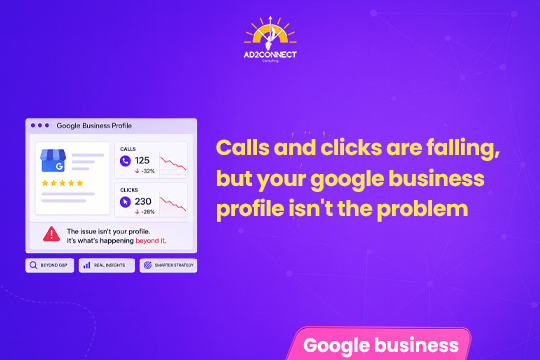
Calls and Clicks Are Falling, But Your Google Business Profile Isn’t the Problem
New local search data shows rankings holding firm while calls and website clicks quietly slip. The real shift isn’t a ranking loss. It’s where the customer’s journey now ends.
By Snehal Singh | Published: September 2, 2026
AI Overview Summary
Fresh data on Google Business Profiles confirms that local rankings are staying steady, even as calls and website clicks keep declining year over year. Direction requests are moving the opposite way and climbing fast. The likely explanation: more customers now finish their entire search journey inside Google Maps itself, instead of clicking through to a website or picking up the phone. Reviews are playing a bigger role than ever, since Google’s AI systems increasingly lean on review sentiment and structured tags to answer questions directly, without sending anyone a click. For local businesses, this means call volume alone can no longer tell the full story. Direction requests and Google Business Profile completeness now need equal attention.
Table of Contents
- The Real Picture Behind Falling Calls
- Why Q1 Data Set Off Alarm Bells
- The Corrected Numbers: What Q1 and Q2 Actually Show
- Two Ranking Systems Now Run Side by Side
- The US, EU, and UK Aren’t Following One Trend
- What This Means for How You Report Local Performance
- Mistakes That Look Like Strategy
- How Ad2Connect Approaches Local SEO for Clients
- Key Takeaways
- FAQ: Google Business Profile Calls and Clicks
The Real Picture Behind Falling Calls
Local SEO watchers have flagged a strange pattern this year. Rankings look normal. But calls and website clicks keep dropping anyway.
Early numbers made the problem look huge. Some reports pointed to local search performance falling by nearly half in the U.S. That figure turned out to be inflated.
A closer look at the same data, checked this time against a full second quarter, tells a smaller and steadier story. Calls and clicks are still down. But the decline is far milder than first reported. And one metric is climbing fast in the opposite direction.
Why Q1 Data Set Off Alarm Bells
A separate study looked at nearly 180 Google Business Profiles. It found something unusual. AI-driven local packs were often showing just two businesses instead of the standard three. Many left out the click-to-call button altogether. On the whole, they surfaced far fewer unique businesses than a traditional Map Pack.
Several respected local SEO voices spotted the same pattern independently. Rankings stayed put. Performance quietly slid.
An early read of the Q1 numbers made the situation look worse than it actually was. Actions and impressions appeared to have dropped by roughly half. That figure was alarming enough that some agencies were advised to shift budget toward paid search.
Under closer review, it didn’t hold up.
The Corrected Numbers: What Q1 and Q2 Actually Show
A recheck of the Q1 figures painted a far calmer picture. Year over year, in the U.S.:
- Website clicks and calls each fell by roughly 16%, while direction requests rose more than 31%.
- Desktop Search impressions rose by over 12%.
- Mobile Search impressions dropped by around 21%.
- Desktop Maps impressions fell by close to 18%.
Q2 data, measured against this corrected baseline, shows the same broad pattern, just softer. U.S. calls and website clicks are still slipping, but more slowly. Direction requests keep climbing.
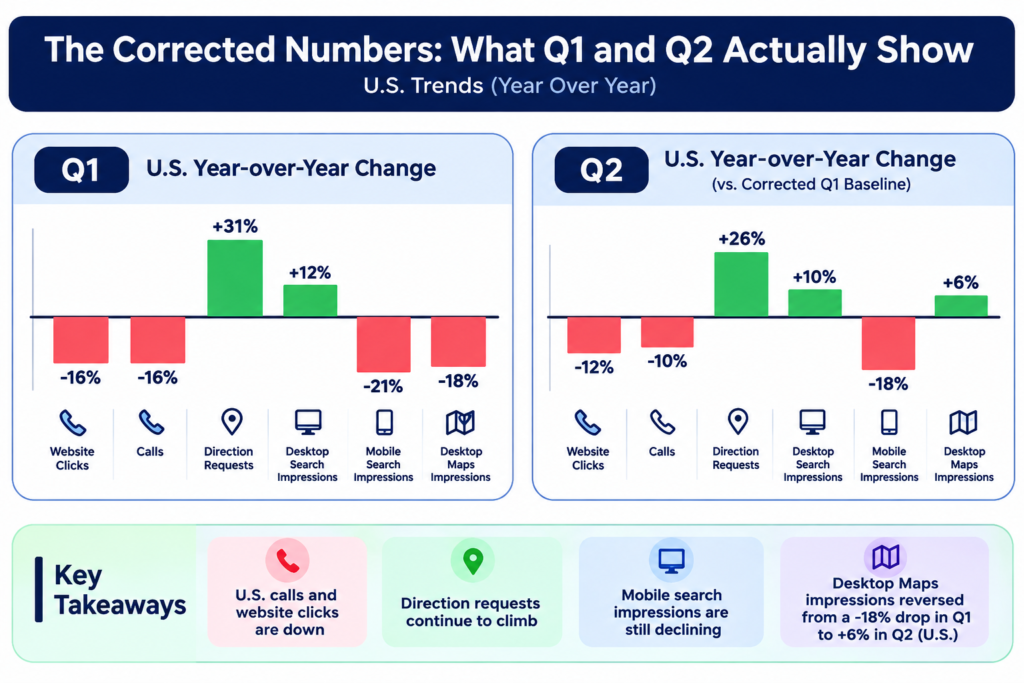
The sharpest shift is desktop Maps impressions. They fell hard in Q1. By Q2, they’d turned positive. That’s a real reversal, and it’s specific to the U.S. right now.
Two Ranking Systems Now Run Side by Side
Here’s the part every local business owner should understand, even without a data background. Google is quietly running two separate systems at once, and they don’t work the same way. The first is the traditional Maps ranking system. It leans on proximity, relevance, engagement, and prominence. These are the same signals local SEO has relied on for years. This system decides whether your business even shows up on the map. The second system sits behind AI Mode and Gemini. It works very differently. It looks at your web presence. It checks how well your business matches a known entity online. It weighs your brand authority. It also reads the tone of your customer reviews. All of this gets layered on top of your Google Business Profile. One system gets you onto the map. The other decides whether Google’s AI trusts your business enough to answer a customer’s question directly, skipping the click entirely. Reviews sit right at the center of that second system. Google now prompts reviewers with structured tags like atmosphere, price, and cleanliness. It no longer depends only on free-text comments. This builds cleaner, more usable data for its AI to draw on. That single shift helps explain the pattern in the numbers. Direction requests keep rising because people get their answer straight from the AI or the map itself. Calls and website clicks keep slipping because there’s often no reason left to leave Google’s own ecosystem.
In short: rankings still measure whether you’re visible. Reviews increasingly measure whether you’re trusted.
The US, EU, and UK Aren’t Following One Trend
It’s easy to assume other countries are just a few months behind the U.S. The data says that’s not quite right.
In the EU, desktop Maps impressions actually fell faster in Q2 than in Q1. Direction requests kept growing there too, just at a slower pace.
The U.K. showed the opposite swing. Mobile Maps impressions dropped sharply in Q2, while direction requests and website clicks kept climbing.
Neither market is simply trailing the U.S. by a quarter. Each region is moving along its own path, shaped by local user habits and how fast Google rolls out AI features there.
What This Means for How You Report Local Performance
If your monthly report still leads with call volume alone, it’s only telling half the story. Direction requests deserve the same weight now.
Businesses with complete, accurate Google Business Profiles are capturing more of whatever calls, clicks, and directions remain up for grabs. Profile quality isn’t optional anymore. It’s one of the few levers a business still has direct control over.
Mistakes That Look Like Strategy
- Panicking over falling call volume without checking whether direction requests are rising to offset it.
- Treating a single quarter of data as a permanent trend, the same mistake the original Q1 numbers made.
- Shifting budget to paid search based on a local “crisis” that a corrected data set later disproved.
- Ignoring review quality, when review sentiment now directly feeds how AI systems recommend businesses.
- Assuming your market mirrors U.S. trends exactly, when the EU and U.K. are showing genuinely different patterns.
How Ad2Connect Approaches Local SEO for Clients
As a best local SEO agency working with businesses across Mumbai and Malad, we’ve seen this exact pattern in client data long before it became an industry-wide story. Rankings hold steady. Call volume dips. And nobody can explain why, until direction requests and Maps engagement get pulled into the same report.
That’s why our work as a top SEO company and agency in Mumbai, India never stops at rankings alone. We track calls, website clicks, direction requests, and profile completeness together. A business can look perfectly healthy on one metric while quietly losing ground on another.
Reviews get close attention in our process. As one of the best branding agencies in Mumbai, we know review sentiment now shapes brand authority signals well beyond the map pack. We help clients build a steady, structured review pipeline instead of leaving it to chance, since that data increasingly feeds the AI systems now answering customer questions directly.
This kind of layered, data-first thinking is what a boutique digital marketing agency in Malad, Mumbai brings to local SEO that a generic checklist simply can’t. If your calls have been slipping and you’re unsure why, that’s exactly the audit our local SEO services team runs before recommending any changes. Where local visibility needs a paid push alongside organic work, our performance marketing agency in Mumbai team builds that in as a complement, not a replacement.
Key Takeaways
- Rankings are stable, but the journey has shifted. Falling calls and clicks don’t automatically mean falling visibility.
- Direction requests are the metric most reports skip. They’re rising even as calls and clicks fall, and deserve equal weight in your reporting.
- Two ranking systems now run in parallel. Traditional signals decide if you’re on the map; web presence and review sentiment increasingly decide if AI trusts you enough to answer on your behalf.
- Reviews are no longer just social proof. They’re raw data that AI systems now use to decide whether to recommend your business.
- Don’t assume your market mirrors the US. The EU and UK show genuinely different patterns, not a delayed copy of the same trend.
Ad2Connect is a boutique digital marketing agency in Malad, Mumbai helping SaaS, eCommerce, D2C, and local businesses grow through data-driven local SEO, performance marketing, and branding strategy. If your Google Business Profile calls have been slipping, talk to our team about running a local visibility audit.