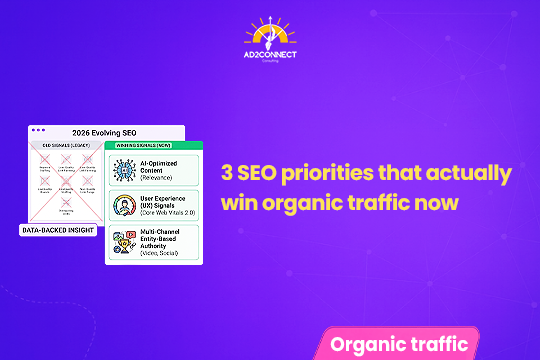
3 SEO Priorities That Actually Win Organic Traffic Now
Not every page deserves the same effort. Here is how to prioritise your SEO work so it drives real clicks and real revenue, not just rankings on paper.
By Snehal Singh | Published: September 5, 2026
AI Overview Summary
Winning organic traffic today means choosing where in the buyer funnel to focus. Informational (TOFU) searches now see zero-click rates of 60 to 70 percent, since AI Overviews often answer the question directly. Comparison (MOFU) and purchase-ready (BOFU) searches still drive real clicks and sales. The smart move is to put most effort into MOFU and BOFU content, use TOFU mainly to build authority, and structure content so it can still earn a mention inside AI Overviews when clicks are not the goal.
Table of Contents
- Priority 1: Decide Where You Play in the Funnel
- Why TOFU Content Is Losing Its Old Job
- Priority 2: Put Your Real Effort Into MOFU and BOFU
- Priority 3: Structure Content for AI Overviews Too
- Funnel Stages at a Glance
- Mistakes That Look Like Strategy
- How Ad2Connect Approaches SEO Priorities for Clients
- Key Takeaways
- FAQ: SEO Priorities for Organic Traffic
Priority 1: Decide Where You Play in the Funnel
Every SEO project runs on limited time and limited budget. You cannot chase every keyword at once. So the first real decision is not which keywords to target. It is where in the buyer funnel your content should live.
Marketers usually split content into three stages. TOFU means top of funnel. That is informational content, like “what is SEO.” MOFU means middle of funnel. That is comparison content, like “X vs Y.” BOFU means bottom of funnel. That is content close to a purchase, like pricing pages and demos.
Once you sort your pages into these three buckets, the picture gets clearer fast. You can see where your traffic comes from. You can also see where it is not converting.
Why TOFU Content Is Losing Its Old Job
For years, informational blog posts were the easiest way to pull in traffic. Write a helpful guide, rank on Google, and watch the clicks roll in.
That job is getting harder. Zero-click rates for informational searches now sit around 60 to 70 percent. That means Google often answers the question directly on the results page, through AI Overviews or a snippet. The user gets an answer right there. They never need to click through to your site at all.
This does not mean TOFU content is useless. It still helps build topical authority. It still supports internal linking to your more valuable pages. But treating it as your main traffic engine, the way it worked five years ago, no longer holds up.
Priority 2: Put Your Real Effort Into MOFU and BOFU
Here is the part that matters most for most businesses. MOFU and BOFU queries still drive real clicks. They also convert far better.
Think about the difference. Someone searching “what is content marketing” wants a quick answer. An AI Overview happily gives it to them. But someone searching “best CRM software for small business,” or checking a pricing page, is close to a decision. They are far more likely to click through, compare options, and buy.
That is exactly why smart SEO teams now shift most of their content budget toward MOFU and BOFU pages. Comparison articles, “X vs Y” posts, pricing pages, and product pages deserve more attention than one more broad informational post.
Priority 3: Structure Content for AI Overviews Too
If you do invest in TOFU content, accept what the real goal is now. It is not about winning the click. It is about winning a mention inside an AI Overview.
That changes how you write. Old featured snippet habits still work well here. Give a clear, direct answer near the top of the page. Use short paragraphs. Keep the formatting simple, so Google can lift it easily. Adding FAQ schema also helps AI Overviews credit your brand by name, even when the user never clicks through.
Here is the part worth sitting with, because it is where most SEO plans quietly go wrong. Teams keep measuring success the old way, by simply counting sessions and rankings, and by that old yardstick a page that gets summed up inside an AI Overview looks like a failure, since the visit never shows up in the analytics dashboard at all. But the real picture is more hopeful than that, because the number of searches happening every day keeps growing faster than the zero-click rate is climbing, which means the total pool of clicks across the internet has actually grown, even as any single page’s own click-through rate has shrunk. Organic search still sends over half of all website traffic, and it converts at rates paid ads rarely match. So the real risk is not that SEO stopped working. It is that a business keeps pouring its limited budget into broad, easy-to-summarise topics, while its competitors quietly move that same effort into the comparison guides, the pricing pages, and the demo pages that AI cannot fully answer on its own. Those are exactly the pages still worth a real click, and a content plan that ignores this split is choosing to fight for a shrinking slice of the funnel, while leaving the bigger, more valuable slice wide open for someone else.
Funnel Stages at a Glance
| Funnel Stage | Example Query | Zero-Click Risk | Where to Focus Effort |
|---|---|---|---|
| TOFU (Top of funnel) | “What is SEO” | High (60-70%) | Build authority, target AI Overview citations, not clicks |
| MOFU (Middle of funnel) | “Best CRM software for small business” | Lower | Comparison content, “X vs Y” pages, buying guides |
| BOFU (Bottom of funnel) | “Pricing”, “Book a demo” | Lowest | Clear CTAs, schema markup, fast page experience |
Mistakes That Look Like Strategy
- Publishing more TOFU blog posts, while ignoring comparison and pricing pages.
- Treating every page the same, instead of prioritising by funnel stage and revenue impact.
- Measuring success only by traffic, while ignoring brand visibility from AI Overviews.
- Skipping FAQ schema on informational content, and missing out on AI Overview credit.
- Assuming falling clicks always mean falling demand, without checking if total search volume grew.
How Ad2Connect Approaches SEO Priorities for Clients
Ad2Connect is a boutique digital marketing agency in Malad, Mumbai, and one of the top SEO companies in Mumbai, India. Before we write a single page, our SEO services team sorts a client’s content into TOFU, MOFU, and BOFU stages first. That one step is what separates a real Best SEO Agency in Mumbai from one that just publishes blog posts and hopes for the best.
For clients who need faster, measurable growth, our performance marketing team, known as one of the trusted performance marketing agencies in Mumbai, works alongside SEO to cover the gap while organic MOFU and BOFU content builds momentum. As a Local SEO Agency in Mumbai, we apply this same funnel-first thinking to local search too. “Near me” searches are almost always closer to a decision than a definition.
Content built purely to rank rarely converts on its own. That is why our branding and creative teams, working as a leading branding agency in Mumbai and a creative advertising agency in Mumbai, shape the comparison pages and pricing pages our SEO team prioritises. Together, they read well and they convert well. That combination is what a digital marketing agency in Malad, Mumbai should really deliver: traffic that turns into real business.
Key Takeaways
- Decide where you play in the funnel first. Sort content into TOFU, MOFU, and BOFU before you decide what to work on.
- TOFU content is losing clicks, not value. Zero-click rates of 60-70% mean AI Overviews often answer informational searches directly.
- MOFU and BOFU content still converts. Comparison pages, pricing pages, and demo pages deserve the bigger share of your budget.
- Write TOFU content for AI Overview mentions, not just clicks. Use clear answers and FAQ schema.
- Look at the full picture. Total search volume keeps growing, so fewer clicks on one page do not always mean less demand.
Ad2Connect is a digital marketing agency helping SaaS, eCommerce, D2C, and local businesses grow through data-driven SEO, performance marketing, branding, and content strategy. If your content plan still treats every page the same way, it’s time to rethink your funnel.