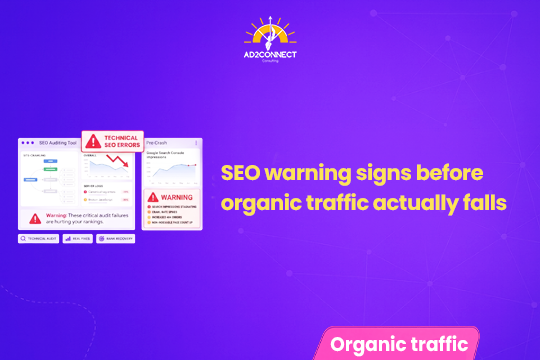
SEO Warning Signs Before Organic Traffic Actually Falls
A healthy traffic graph can quietly hide a real problem. Here are the early signals worth checking, before a drop shows up in your monthly report.
By Snehal Singh | Published: September 5, 2026
AI Overview Summary
A big drop in organic traffic is easy to spot. The harder part is catching the warning signs before that drop ever appears in a report. A site’s total traffic can even grow while it quietly loses the commercial searches that actually drive leads and sales. The real signals hide in the details: rankings slipping for high-intent terms, clicks falling while impressions stay flat, and traffic composition shifting from commercial to informational. Catching these early lets a business fix the problem before revenue takes the hit.
Table of Contents
- Why a Healthy Traffic Graph Can Still Hide a Problem
- The Real Warning Signs to Watch For
- A Real Example: Traffic Up, Leads Down
- The AI Overview Signal Most Teams Miss
- Warning Signs at a Glance
- Mistakes That Look Like Strategy
- How Ad2Connect Approaches Early SEO Warning Signs for Clients
- Key Takeaways
- FAQ: SEO Warning Signs
Why a Healthy Traffic Graph Can Still Hide a Problem
A sharp drop in organic traffic is easy to notice. The chart falls, and everyone reacts fast.
The harder problem is quieter than that. Performance can weaken well before any drop shows up in a monthly report. A commercially important page can start slipping for a handful of searches, while the site’s overall traffic number still looks fine.
Traffic volume is a useful number, but it is a blunt one. A website can hold onto its total sessions, or even grow them, while it quietly loses visibility on the keywords that actually bring in business. That kind of loss hurts revenue far more than a small dip in casual, informational clicks ever would.
The Real Warning Signs to Watch For
Most traffic problems leave clues long before they show up as a clear decline. A few things worth watching closely:
- An important page slips for a small set of searches, even if the site’s average ranking barely moves.
- Google keeps switching between different pages on your site for one query that used to have a clear winner.
- Impressions hold steady or rise, while clicks level off or fall.
- Overall traffic looks healthy, but fewer visitors reach the pages that actually bring in leads or sales.
None of these looks alarming on its own. That is exactly the problem. A small drop across a few high-value searches can matter more to a business than hundreds of new, low-value rankings. Yet those new rankings are what make the overall report look good.
A Real Example: Traffic Up, Leads Down
Picture a law firm’s website where organic traffic grew 22 percent in one year. At first glance, that looks like a strong result.
But look closer at the individual pages, and the story changes. Most of that growth came from three informational articles. One broad, general article started pulling in several thousand visits a month on its own.
Meanwhile, the service pages told a different story. Clicks to the main service page had fallen. Visibility for the more specific, high-intent searches had weakened. In short, the site had more total traffic than a year ago. But it may have been getting fewer of the visits that actually turn into paying clients.
The AI Overview Signal Most Teams Miss
One pattern deserves special attention. Clicks fall, but impressions stay steady or even grow. That usually means a change in user behaviour, not a ranking problem.
It often means users get their answer right on the results page. AI Overviews, featured snippets, or another on-page feature do the job for them. Your page is still being shown. It is just not being clicked as often, because Google, or an AI tool, already answered the question.
Here is the part worth slowing down for, because it changes how a business should read its own SEO reports. Say overall sessions look flat, down just 1 percent. But real inquiries from those same pages have fallen by 25 percent. Most teams see that flat top-line number and assume the site is fine. That instinct is backwards. The real story usually sits inside the query mix, not the headline number, and it takes real digging to find it. A few high-value search terms may have quietly slipped a few spots. That shift is small enough to barely dent an average ranking number. But it is large enough to change how many real buyers reach your service pages at all. At the same time, the traffic mix itself may have shifted. More casual, informational visits arrive. Meanwhile, the people who were actively searching for your service start landing somewhere else, or on a weaker page, or not at all. That is exactly why the smart response to a lead drop is not to ask whether SEO is to blame in the abstract. Split traffic by intent. Talk to whoever actually handles the inquiries. Figure out precisely what changed. SEO data can tell you what people searched for and where they landed. It cannot tell you everything that happened after that click.
Warning Signs at a Glance
| What You See | What It Might Mean | What To Check |
|---|---|---|
| Overall traffic is flat or growing | Commercial pages may be losing ground while informational pages gain | Split landing pages by intent: informational vs commercial |
| Impressions steady, clicks falling | AI Overviews or featured snippets may be answering the query directly | Check CTR and which SERP features now appear for those queries |
| A few high-value keywords slip a few spots | Small ranking dips on valuable terms can hurt more than they show | Track keyword sets by intent, not just average position |
| Leads fall while sessions barely move | Traffic mix or landing pages may have quietly changed | Talk to the team handling inquiries, not just the dashboard |
| Several pages in one topic lose visibility together | A competitor may have built stronger, more complete coverage | Review the whole content cluster, not just the weakest page |
Mistakes That Look Like Strategy
- Watching only the total traffic number, without splitting it into informational and commercial visits.
- Assuming stable rankings mean stable performance, without checking clicks and CTR too.
- Reacting to one page’s drop, instead of checking if the whole topic cluster is losing ground.
- Blaming SEO for a lead drop, without first checking what actually happened to those leads.
- Waiting for a visible drop in the monthly report, instead of watching the smaller signals along the way.
How Ad2Connect Approaches Early SEO Warning Signs for Clients
Ad2Connect is a boutique digital marketing agency in Malad, Mumbai, and one of the top SEO companies in Mumbai, India. Our SEO services team never looks at total traffic alone. We segment every client’s pages by intent, so a rising informational number never quietly hides a falling commercial one. That habit is a big part of why clients call us a Best SEO Agency in Mumbai, not just an agency that reports on rankings.
For clients who cannot afford to wait for a slow ranking recovery, our performance marketing team, one of the trusted performance marketing agencies in Mumbai, steps in to protect lead flow while the organic fix takes effect. As a Local SEO Agency in Mumbai, we apply the same early-warning approach to local rankings too. A dip in map-pack visibility often shows up quietly, long before local leads actually drop.
When a content cluster starts losing ground to a competitor, the fix is rarely just technical. Our branding and creative teams, working as a leading branding agency in Mumbai and a creative advertising agency in Mumbai, help rebuild pages so they read stronger and rank stronger. That full-picture approach is what a real digital marketing agency in Malad, Mumbai should offer: catching the problem early, not just reporting it after the damage is done.
Key Takeaways
- A healthy traffic graph can hide a real problem. Total sessions can grow while commercial visibility quietly falls.
- Watch impressions versus clicks. Steady impressions with falling clicks often means AI Overviews or snippets, not a ranking loss.
- Split traffic by intent. Informational and commercial pages tell very different stories, even in the same report.
- Small ranking dips on high-value terms matter more than they look, even if the average ranking barely moves.
- When leads fall, talk to people, not just dashboards. SEO data shows where visitors landed, not what happened next.
Ad2Connect is a digital marketing agency helping SaaS, eCommerce, D2C, and local businesses grow through data-driven SEO, performance marketing, branding, and content strategy. If your traffic looks fine but your leads don’t, it may be time for a closer look.