Search Console AI Reports Are Now Global, Plus What Else Google Said
Four small Google updates landed in the same week: a worldwide reporting rollout, a lesson on recovery timing, a note on markdown, and a warning about a sitemap trick. Here’s what each one actually means for your website.
By Snehal Singh | Published: September 8, 2026
AI Overview Summary
Google made four separate announcements in one week that matter for anyone running a website. First, Search Console’s AI reports and the AI search opt-out are now available worldwide, showing which pages appear in AI Overviews, AI Mode, and AI-powered Discover. Second, Google’s confirmed that fixing issues tied to a major algorithm update can take months to show results, and that a ranking drop right after a link disavow is usually caused by something else. Third, that on his own test sites, only SEO tools ask for content in markdown format, not major AI crawlers. Fourth, a sitemap trick that adds a changing timestamp to URLs as a bad idea, since it signals that a page’s address keeps changing when it shouldn’t. The common thread across all four: check what you already have, like server logs and update dates, before reaching for a workaround.
Table of Contents
- Search Console AI Reports Are Now Available Worldwide
- Recovery From a Big Update Can Take Months
- Only SEO Tools Are Asking for Markdown
- Why Sitemap Cache-Busting Is a Bad Idea
- This Week’s Updates at a Glance
- Mistakes That Look Like Strategy
- How Ad2Connect Approaches Google’s Weekly SEO Signals
- Key Takeaways
- FAQ: Google’s Latest SEO Updates
Search Console AI Reports Are Now Available Worldwide
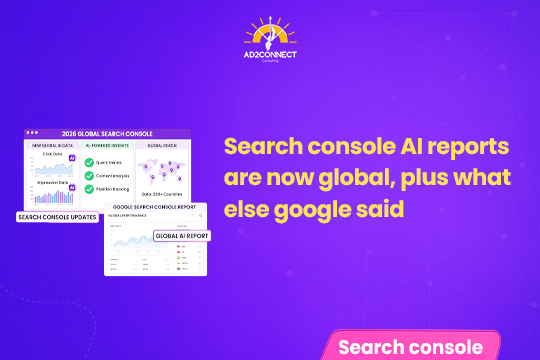
Google confirmed that its Search Console AI reports, along with the AI search opt-out control, rolled out to every website worldwide on August 31.
These reports show impressions from AI Overviews, AI Mode, and the AI-powered version of Discover. The data is broken down by page, country, and date, so a site owner can see roughly where their pages are showing up inside Google’s AI features.
Not every website will see much here. Sites with very few AI impressions may not show meaningful data in the report yet.
It’s worth being clear about what this report doesn’t do. It shows where a page appears inside AI features, not what that appearance actually earns in clicks or visits. Google has also said that using the opt-out toggle will not affect how a site ranks elsewhere in normal search results.
Recovery From a Big Update Can Take Months
Google’s John Mueller answered a website owner who had disavowed hundreds of links they considered harmful, only to see a key ranking drop about two weeks later.
Mueller’s response was reassuring but firm. A small disavow file is very unlikely to crash an entire site on its own. He suggested reviewing the disavow file first. Then look for other explanations, such as a broad spam update landing around the same time.
He also made an important point about timing. If the drop is tied to a wider algorithmic update, a fix can take a long time to show effects. Sometimes it takes many months, not days or weeks. This lines up with what Google has said before about link disavows specifically. They take months to be fully processed, not days.
We covered this case in more depth in our earlier post on how ranking recovery timelines work after an SEO issue is fixed, including a full breakdown of how long different types of problems typically take to resolve.
Only SEO Tools Are Asking for Markdown
A website owner asked whether any major AI crawler had ever requested content in markdown format, a simpler, more compact version of a web page’s text. They were considering building a markdown version of their site to reduce server load.
Mueller shared what he’d seen on his own test sites. The only crawlers actually asking for markdown were SEO tools, not the well-known AI bots. He was careful to note that his own sites are just one sample. Results could look different elsewhere.
His practical suggestion was simple. Before building anything new, check your own server logs for the “Accept” header on incoming requests. See who’s actually asking for what. That data will tell you far more than a general assumption ever could.
Why Sitemap Cache-Busting Is a Bad Idea
The last story involved a technique some larger sites use: adding a changing timestamp to sitemap URLs so that search engines are forced to fetch them fresh every day.
Mueller called this approach a mistake. Doing this signals to search engines that a page’s canonical address keeps changing, which isn’t true and isn’t helpful. It can create confusion around which version of a URL search engines should trust and track.

His guidance was to keep sitemap URLs clean and stable, and to rely on the sitemap’s existing “lastmod” field to tell search engines when a page has actually changed. That field already does the job the timestamp trick was trying to solve, without the side effects.
This Week’s Updates at a Glance
| Update | What Changed | What To Do |
|---|---|---|
| Search Console AI reports | Now live for every website worldwide | Check the report; don’t expect click-level detail yet |
| Recovery after a big update | Fixes can take months to show results | Set realistic timelines, don’t panic and overcorrect |
| Markdown for AI crawlers | Mostly requested by SEO tools, not major AI bots | Check your own server logs before building anything new |
| Sitemap cache-busting | Confirmed as a bad practice by Google | Remove changing parameters; use the lastmod field instead |
Mistakes That Look Like Strategy
- Reacting to a ranking drop with a drastic fix before confirming the actual cause.
- Building new technical infrastructure, like a markdown version of a site, based on assumption instead of server log data.
- Adding tricks like cache-busting parameters to sitemaps instead of trusting standard fields like lastmod.
- Treating a new Search Console report as proof of AI traffic value, when it only shows appearances, not outcomes.
- Expecting a quick bounce-back after fixing an issue tied to a broad algorithm update.
How Ad2Connect Approaches Google’s Weekly SEO Signals
Google makes small announcements like these every week, and most of them get missed by businesses that are busy running their day-to-day operations. As one of the Best SEO Agency in Mumbai, part of our job at Ad2Connect is simply staying on top of these updates and translating them into decisions our clients can actually use.
We treat every update the same way Google’s own advice suggests: check the data you already have before reaching for a new tool or trick. For clients who come to us as a Top SEO Company In Mumbai, India, that means real server log reviews, real Search Console checks, and real update timelines, not guesswork dressed up as strategy.
This same approach carries over into how we support clients as a Performance Marketing agency, since knowing what’s actually happening in organic search helps decide when paid campaigns should step in to cover a gap, and when they shouldn’t.
Key Takeaways
- Search Console’s AI reports are now global, showing where pages appear in AI Overviews, AI Mode, and Discover, though not what those appearances earn in clicks.
- Ranking recovery after a big update takes time. Sometimes many months, so plan for a slow climb, not a sudden jump.
- Don’t build for assumptions. Check your own server logs before adding new infrastructure like a markdown layer.
- Skip sitemap tricks. Keep URLs stable and let the lastmod field do its job.
- Check before you build. Nearly every Google update this week pointed back to data site owners already had access to.
Ad2Connect is a digital marketing agency in Malad, Mumbai, helping businesses stay ahead of Google’s changes through data-driven SEO, performance marketing, and honest, update-aware strategy. If you’re not sure how a recent Google change affects your website, talk to our team.