What Happens Before Search Drives Decisions
By the time someone types a brand name into Google, the decision is usually already made. The real battle for customers is happening on surfaces your analytics can’t see — and it’s what actually drives the search that follows. Here’s where that happens, and what to do about it.
By Snehal Singh | Published: 9th September 2026
AI Overview Summary
Most people no longer u se search engines to discover what to buy. They use search to confirm a decision they’ve already started making somewhere else — on Instagram or YouTube, through a visual search tool like Google Lens, in a conversation with an AI chatbot, or simply because a friend or influencer mentioned it first. This means a large part of the buying journey now happens before a search ever occurs, and it’s mostly invisible in Google Analytics or Search Console. Searches that look like fresh discovery, especially short, brand-and-product searches, are frequently just the final click on a decision made elsewhere. Search isn’t shrinking — it’s simply moved later in the journey, while still quietly getting full credit for demand it didn’t create. Brands that only optimise the search step end up under-investing in the earlier stages that actually earn the customer. The fix is to build visibility across every surface a buyer touches — search, social, visual, AI answers, and local — not just the last click before checkout.
Table of Contents
- Search Used to Be Where the Journey Started
- Where Discovery Really Happens Now
- What Actually Happens Before the Search Bar
- Why Your Analytics Can’t See Any of This
- Search Isn’t Shrinking — It’s Moving
- The New Shape of the Buying Journey
- How to Tell If This Is Already Happening to Your Brand
- What to Actually Do About It
- Mistakes Brands Keep Making
- Key Takeaways
Search Used to Be Where the Journey Started
There was a time when “search” and “discovery” meant almost the same thing. Someone had a problem, didn’t know which brand could solve it, opened Google, typed a broad question, and scrolled through options until one stood out.
That model still shapes how most businesses plan their marketing today. Rank for the broad keyword. Get found. Win the click. It made sense when search really was the starting point of the journey.
It isn’t anymore, at least not for a large share of purchases. People are forming opinions, developing preferences, and shortlisting brands long before they open a search engine — and when they finally do search, they’re often just confirming what they already decided.
Where Discovery Really Happens Now
Discovery hasn’t disappeared. It’s just moved off the search bar and onto surfaces that don’t look like search at all.
- Short-form video and reels. Instagram, YouTube Shorts, and similar feeds now do a huge share of the early “what’s out there” work, often without the viewer even searching for anything.
- Visual and camera search. Tools like Google Lens let someone point a phone at an object — a plant, a pair of shoes, a piece of furniture — and get an instant answer, no keyword typed at all.
- AI chat assistants. A growing number of people now ask a conversational AI tool for a recommendation the way they’d once have typed a search query, especially for open-ended questions like “what should I buy for X.”
- Influencers and community platforms. A mention in a review thread, a creator’s video, or a friend’s story often builds more trust than any ad, and it happens well before a formal search.
- Recommendation engines. The “you might also like” logic behind most shopping and content apps is quietly shaping preference in the background, every single day, for almost every user.
None of these look like search. All of them are doing the job search used to do — building awareness, shaping preference, and narrowing the field down to one or two real options.
What Actually Happens Before the Search Bar
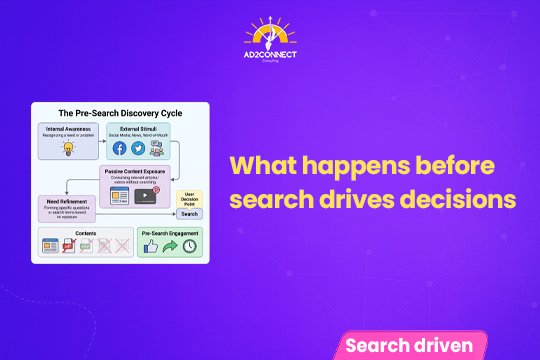
Picture a fairly ordinary scenario. Someone scrolls past a reel showing a product in use, in a way they can picture themselves using it. A few days later, they notice a friend using something similar and ask about it. Later that week, they spot the same kind of product in a shop window while walking past. By the time they finally sit down and search the brand name, the decision is close to finished — the search is just the last step before checkout.
By the time a search happens, it’s usually short and specific: a brand name, a product name, sometimes a model number. That kind of query isn’t someone exploring options anymore. It’s someone who already knows exactly what they want and is simply looking for the fastest, most trustworthy way to buy it.
Why Your Analytics Can’t See Any of This
Here’s the part that catches most marketing teams off guard: none of the earlier stages show up cleanly in reporting.
When someone develops interest in a product through a reel, a recommendation, a chatbot answer, or a chance encounter, and then searches the brand name before buying, that search gets logged as a branded search conversion. On paper, it looks like search did the work. In reality, search was just the last, easiest step in a journey that started somewhere else entirely.
This is a genuinely long chain of cause and effect that most reporting dashboards were never built to capture, and it’s worth sitting with for a moment because it changes how a business should think about where its marketing budget actually earns results: a person can watch a handful of short videos over several days, slowly warm up to a brand they’d never have searched for on their own, ask an AI assistant to compare it with an alternative, mention it to a colleague, see the product again in a store a week later, and only then, finally, type the brand’s name into Google before buying — and every analytics tool involved will report that single search as the moment demand was created, when it was really the moment demand was cashed in.
That’s a problem, because it means marketers keep crediting search with discovery work it isn’t actually doing. Budgets follow the data. If the data says “search converts,” search keeps getting funded, while the content, social presence, and visibility on visual and AI-driven discovery surfaces that actually built the preference get treated as a nice-to-have.
Search Isn’t Shrinking — It’s Moving
It’s tempting to read all this as “search is dying.” It isn’t. People are still searching constantly — they’re just searching differently, and later in the process.
Search has shifted from a discovery tool to a confirmation and verification tool for a large share of queries. That’s a change in role, not a decline in importance. A weak or slow experience at the confirmation stage can still lose a customer who was already convinced, which is exactly why search visibility still deserves real investment — just not the entire budget.
The New Shape of the Buying Journey
The old funnel assumed a fairly straight line: awareness, then interest, then a search-driven comparison, then purchase. The new one looks more like this:
| Stage | What Happens | Where It’s Visible |
|---|---|---|
| Passive exposure | Person sees a product on social media, visual search, or in real life | Rarely tracked — outside most analytics tools |
| Preference development | Interest builds through repeated, often unconscious exposure, including AI-assisted recommendations | Almost never tracked |
| Confirmation search | Short, specific search — brand name, product name, sometimes with “price” or “near me” | Fully tracked, but misread as discovery |
| Purchase | Transaction happens, often on the same visit as the confirmation search | Fully tracked |
How to Tell If This Is Already Happening to Your Brand
You don’t need expensive tools to spot the pattern. A few signals in data you probably already have are enough to start.
| Signal | What It Suggests | What To Check Next |
|---|---|---|
| Branded search volume rising without matching ad spend or SEO gains | Demand is building somewhere outside search | Social, video, and community engagement trends over the same period |
| High share of converting queries already include your brand name | Visitors are arriving pre-decided, not comparing options | Where those visitors say they first heard of you |
| Direct and branded traffic rising alongside social or video engagement | Preference is likely forming off-search | Campaign-level content performance on those platforms |
| New customers can’t clearly explain “why Google” when asked how they found you | Search was the last click, not the real source | A simple post-purchase “how did you hear about us” question |
What to Actually Do About It
Show up where preference actually forms. That means genuine investment in social content, short video, and visual discovery — not as a branding afterthought, but as a real driver of demand that search will later take credit for.
Make sure you’re the answer when the confirmation search happens. If someone already knows your brand and searches for it, you still need to win that click with a fast, clear, trustworthy result — that part of the funnel hasn’t gone anywhere.
Track visibility, not just clicks. Where does your brand show up in AI-generated answers, recommendation feeds, and local search results, not only in classic blue-link rankings? A Best Local SEO Agency will tell you that “near me” and local-intent searches are some of the purest confirmation searches there are, and winning them still depends on groundwork done long before the search happens.
Stop crediting the last click for everything. Even a simple, directional model — asking new customers how they found you, or tagging campaigns so you can see assisted influence — beats assuming search alone deserves the budget.
Mistakes Brands Keep Making
- Treating every branded search as proof that SEO or paid search “worked,” without asking what built the demand in the first place.
- Cutting social, video, or visual-content budgets because they don’t show a direct, last-click conversion.
- Assuming a flat or falling top-of-funnel search volume means interest in the category is falling, rather than checking if it simply moved to another surface.
- Ignoring how a product actually gets discovered by real customers, in favour of only optimising the stage that’s easiest to measure.
Key Takeaways
- Search is increasingly a confirmation stage, not a discovery stage, for a large share of buying decisions.
- Discovery has spread to video, visual search, AI chat assistants, and recommendation engines — surfaces most analytics tools never touch.
- Search isn’t shrinking; its role is changing. It still deserves investment, just not the entire budget.
- Short, brand-specific searches are a signal, not proof of demand created by search itself.
- Budgets should follow where preference actually forms, not just where the easiest-to-measure conversion happens to land.
Ad2Connect is a full-service digital marketing agency in Mumbai helping SaaS, eCommerce, D2C, and local businesses grow through data-driven SEO, performance marketing, branding, and content strategy. If you’re not sure how much of your search traffic is really coming from somewhere else, talk to our team about running a full-funnel visibility audit.