
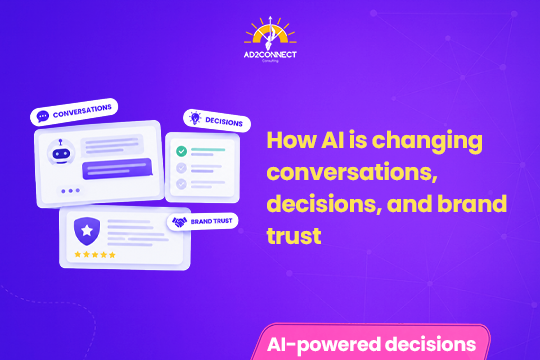
How AI Is Changing Conversations, Decisions, and Brand Trust
Artificial Intelligence is no longer just a backend tool for analytics or automation. It is now actively shaping how brands communicate, how customers make decisions, and how trust is built or broken in digital experiences.
From chatbots answering queries to AI-driven ad targeting and recommendation engines, AI has become deeply embedded in modern marketing systems. But while it improves speed and scale, it also raises an important question:
What happens to brand trust when machines start leading conversations and decisions?
Conversations Are Becoming Automated, Not Personal
Today, many businesses rely on AI-powered chat systems to handle customer conversations. These tools are efficient and available 24/7, which makes them valuable for a digital marketing agency in Mumbai or a performance marketing agency in Mumbai managing large-scale campaigns.
However, something subtle is changing.
Conversations are becoming faster—but less human.
Customers often receive accurate responses, but not always emotionally intelligent ones. When a user is frustrated or confused, an AI may still respond correctly, but it cannot fully understand tone, urgency, or emotion the way a human can.
Over time, this creates a gap between efficiency and empathy—and empathy is what builds long-term trust.
AI Is Influencing Decisions More Than Ever
AI now plays a major role in decision-making across industries:
- Product recommendations on e-commerce platforms
- Automated ad targeting and bidding
- Content suggestions for SEO campaigns
- Customer segmentation in CRM systems
For a best SEO agency in Mumbai or a creative advertising agency in Mumbai, AI can quickly analyze data and suggest what is “likely to work.”
But here is the challenge:
AI optimizes for patterns—not purpose.
It may recommend strategies based on past performance, but it does not fully understand brand vision, emotional storytelling, or cultural context.
That is why human oversight remains essential, especially in branding and marketing decisions.
Why Over-Automation Weakens Strategic Thinking
As businesses increasingly depend on AI for decision-making, there is a hidden risk: loss of strategic depth. AI can process massive datasets and recommend actions in seconds, but it cannot fully interpret why a brand exists or how it should emotionally connect with its audience.
For example, a creative brand agency in Mumbai working on a luxury campaign may prioritize storytelling, cultural sensitivity, and emotional positioning—elements that AI might not prioritize unless explicitly trained to do so.
When decisions are left entirely to automation, brands may end up with campaigns that are technically efficient but emotionally disconnected. Over time, this weakens differentiation, making brands feel generic in a highly competitive digital space where identity and trust matter more than ever.
Brand Trust in an AI-Driven World
Trust is becoming the most valuable asset in digital marketing.
Recent industry studies show that while AI improves personalization and engagement, it also increases consumer skepticism about authenticity and transparency.
Customers are now asking:
- Is this message written by a human or AI?
- Can I trust this recommendation?
- Is this brand being transparent with me?
A top branding & design agency in Mumbai understands that trust is not built through automation alone—it is built through consistency, honesty, and emotional connection.
If AI feels too “machine-like,” customers may disengage, even if the content is technically accurate.
Balance Between AI Efficiency and Human Emotion
The most successful brands today are not choosing between AI and humans—they are combining both.
Here’s how the balance works:
- AI handles data analysis, automation, and personalization
- Humans handle storytelling, strategy, and emotional intelligence
- AI speeds up decisions
- Humans validate direction
This hybrid approach is used by the best digital marketing agency in Malad and other leading agencies to ensure both performance and authenticity.
When Trust Breaks in AI-Driven Systems
Trust can break when:
- AI-generated content feels repetitive or generic
- Customers feel they are only interacting with machines
- Brands over-automate communication without human support
- Decisions lack transparency
Consumers are becoming more cautious about AI-generated content and increasingly prefer brands that show authenticity and human oversight.
What Businesses Should Focus On
To build stronger brand trust in an AI-driven world, businesses should:
- Use AI as a support system, not a replacement for humans
- Maintain human involvement in customer-facing communication
- Be transparent about AI usage
- Focus on emotional storytelling in branding
- Combine automation with human creativity
This is especially important for companies offering local SEO services in India, best SEO services in Mumbai, and performance marketing services in Mumbai, where trust directly impacts conversions.
Final Thoughts
AI is transforming how brands communicate, decide, and scale. It brings speed, intelligence, and automation—but also introduces new challenges in trust and authenticity.
The future of marketing is not about replacing humans with AI.
It is about using AI to enhance human creativity, not erase it.
Brands that strike this balance will not only perform better—they will also earn deeper, long-term trust from their audiences.