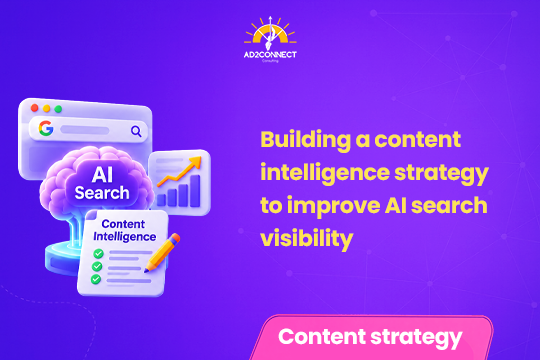
Building a Content Intelligence Strategy to Improve AI Search Visibility
Publishing more content will not help customers decide. Here is how to use real customer information to build content that people trust and AI tools can find, check and recommend.
By Snehal Singh| Published: November 17, 2026
AI Overview Summary
A content intelligence strategy is a way of planning content around real customer needs and the facts your business already knows, rather than around guesses. AI has made content easier to produce, but publishing more pages does not necessarily help customers make decisions. Better AI search visibility starts with clear, consistent facts. When your information conflicts across websites, profiles and old pages, AI answers can reflect that confusion. A strong strategy uses customer data with permission, builds briefs around intent, keeps one source of facts, stops outdated pages from causing risk, and measures success by business outcomes such as qualified enquiries, sales and fewer support questions.
Table of Contents
- What Is Content Intelligence?
- Why Publishing More Content No Longer Works
- Step 1: Build Every Brief Around Real Customer Intent
- Step 2: Measure and Improve Your AI Search Visibility
- Step 3: Create One Source of Truth for Your Brand
- Step 4: Stop Content Decay Before It Becomes a Risk
- Step 5: Measure Business Outcomes, Not Just Traffic
- Quick Diagnosis: What Are You Seeing?
- Mistakes That Look Like Strategy
- How Ad2Connect Approaches Content Intelligence for Clients
- Key Takeaways
- FAQ: Content Intelligence Strategy
What Is Content Intelligence?
Content intelligence sounds technical, but the meaning is simple. It connects what your customers need with what your business knows.
Think of a good shopkeeper. They listen to what customers ask every day, and they know their products very well. So when someone walks in, they give a clear and honest answer.
A content intelligence strategy does the same thing at scale. It collects real questions from real customers, matches them with accurate business facts, and turns both into content that answers the question properly.
Why Publishing More Content No Longer Works
AI tools have made it very easy to write articles quickly. But publishing more does not necessarily help customers decide. A customer who is choosing between three providers does not need a fourth generic article.
There is also a deeper problem. Many businesses say slightly different things in different places. The website lists one price, an old blog post lists another, and a business profile shows a third.
Imagine a clinic that shows a ?500 consultation fee on its website but ?700 on an old listing. A human visitor may notice the mismatch and call to check. An AI tool simply picks one, or mixes both.
When information conflicts across sources, AI answers can reflect that confusion. Those inconsistencies can then surface in front of your future customers.
Step 1: Build Every Brief Around Real Customer Intent
A content brief is the short plan a writer follows before writing a page. Most briefs start and end with a keyword. A better brief starts with the customer.
Understanding customer intent across the whole buying journey is critical. To see the full picture, combine your search queries with other sources, always with the right permission:
- CRM data and past enquiries
- Call centre notes and sales conversations
- Customer reviews and survey answers
- Paid media results
- Social media comments and questions
The source article suggests building each brief around four questions. We find it helpful to keep them in plain words:
- Who is asking, and what situation are they in?
- What decision are they trying to make?
- What do they already believe or worry about?
- What proof will help them feel sure?
Step 2: Measure and Improve Your AI Search Visibility
AI search visibility means how often, and how correctly, AI tools show your brand when customers ask questions. The article uses a simple framework called Found, Scored, Trusted and Recommended. It helps you judge visibility without assuming every AI platform works the same way.
Stage 1: Get Found
Found asks one basic thing: can AI systems discover and retrieve your information? If the answer is no, nothing else matters, because a page that cannot be reached cannot be used.
So check the basics first. Make sure your key pages load, your facts sit in plain text, and nothing important is hidden.
Stages 2 to 4: Get Scored, Trusted and Recommended
The later stages build on the first one. Roughly speaking, they ask whether your content measures up against the alternatives, whether it can be believed, and finally whether an AI tool would actually recommend you to a customer.
Clear facts and honest answers help at every stage.
A Simple AI Visibility Test
You can run a basic check today. Ask the same questions your customers ask in several AI tools, then look at the answers:
- Does your brand appear at all?
- Are your prices, timings and services described correctly?
- Are you compared fairly with competitors?
- Does the tool recommend you, or only mention you?
Save the results with the date. Repeat the test every month to see if your work is helping.
Step 3: Create One Source of Truth for Your Brand
This is the heart of the strategy. Without one reliable record of your facts, every page you publish is a chance to say something slightly different.
What a Brand Intelligence Layer Is
The article calls this a context memory graph, or a brand intelligence layer. The name is fancy, but the idea is basic. It is one organised record of what your business knows.
That record can include your services, prices, locations, timings, policies, team members, and the answers to your most common questions. Every page, profile and campaign then draws from the same facts.
Why It Helps AI Answer Correctly
Microsoft’s GraphRAG research shows how knowledge graphs help AI answer questions. In everyday words, when facts are connected and clear, AI has an easier job.
The practical benefit of a single source of truth is that every answer your business gives, whether on a landing page, in a social post, in a sales call script, or in a reply to a customer review, comes from the same verified facts, so the customer hears one consistent story instead of several slightly different ones, and AI tools that read your content from many places are far less likely to mix conflicting details into an answer that sounds confident but is wrong.
Step 4: Stop Content Decay Before It Becomes a Risk
Old pages do not just lose traffic. They can also create business risk. A page that still promotes an expired offer or an old price may cost you a sale or damage trust.
That is why content needs a regular review, not a one-time publish. Check your most important pages every quarter. Update the facts, remove what is outdated, and merge pages that repeat each other.
Our guide on content decay and how to fix it explains how to tell which pages need a refresh and which need a different approach.
Step 5: Measure Business Outcomes, Not Just Traffic
Traffic is easy to count, but it does not pay the bills. The article recommends measuring content by business outcomes.
Ask whether your content drives qualified enquiries, purchases, or fewer avoidable support requests. If people read a page and then still call to ask the same question, the page is not doing its job.
You can use Google Search Console to see which pages get clicks. Then pair that with your enquiry data to see which of those pages actually bring customers.
Quick Diagnosis: What Are You Seeing?
| What You Notice | What It May Mean | What to Do |
|---|---|---|
| AI tools quote a wrong price or timing | Your facts conflict across pages or profiles | Fix every source and keep one master record |
| AI tools never mention your brand | You may not be found or trusted yet | Check that your pages are reachable and clearly describe your business |
| Traffic is up but enquiries are flat | Content does not match real buyer intent | Rebuild briefs using sales and call data |
| Customers keep asking the same questions | Pages are not answering them clearly | Add direct answers and update the page |
| An old page still promotes a past offer | Content decay is creating risk | Update, merge or remove the page |
Mistakes That Look Like Strategy
These habits feel productive, but they usually waste time and money.
- Publishing more pages instead of better ones. Volume does not help a customer decide.
- Writing briefs from keywords alone. Keywords show what people type, not what they worry about.
- Letting every team write its own facts. Marketing, sales and support should share one record.
- Ignoring old pages. Outdated offers and prices quietly damage trust.
- Judging success by traffic alone. Visits mean little without enquiries or sales.
- Using customer data without permission. Always use data with the proper consent.
How Ad2Connect Approaches Content Intelligence for Clients
At Ad2Connect, we begin with the customer, not the keyword. Many businesses searching for the best local SEO services in Mumbai want to be found by nearby customers and described correctly. So we check what people ask, what AI tools say, and where your facts disagree.
Customer insight also comes from paid campaigns, because ad results show what people respond to. Our team offering performance marketing services in Mumbai shares these findings with the content team, which makes every brief stronger.
Finally, consistent facts need a consistent voice. As a creative brand agency in Mumbai, we help clients say the same clear thing everywhere, so customers and AI tools both get one trustworthy story.
Key Takeaways
- Content intelligence connects needs with knowledge. It joins what customers need with what your business knows.
- More content is not the answer. Publishing more does not necessarily help customers decide.
- Conflicting facts confuse AI. Inconsistent information across sources can appear in AI answers.
- Build briefs around intent. Use search, CRM, sales, reviews, surveys and social data with permission.
- Keep one source of truth. A shared record of facts keeps every page consistent.
- Test your AI visibility. Ask AI tools your customers’ questions and repeat monthly.
- Measure what matters. Track qualified enquiries, purchases and fewer support requests.
Ad2Connect is a digital marketing agency helping SaaS, eCommerce, D2C, and local businesses grow through data-driven SEO, paid media, and content strategy. If AI tools describe your business incorrectly, or your content is not turning into enquiries, talk to our team about a content intelligence review.