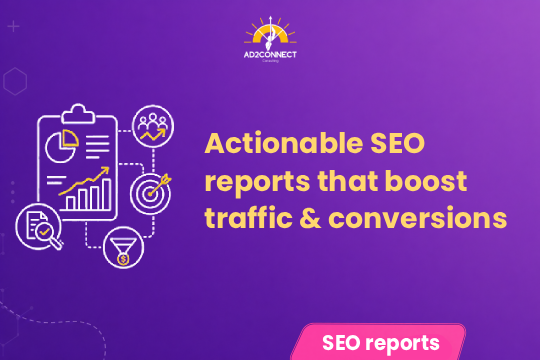
Actionable SEO Reports That Boost Traffic & Conversions
Most SEO reports look detailed—but they don’t help you grow.
If you’re a business owner in Mumbai, you’ve likely seen reports filled with charts, rankings, and traffic numbers. Yet, your phone isn’t ringing more, and your leads haven’t improved.
What you actually want is simple: more inquiries, better conversions, and clear ROI from your marketing spend.
This is exactly where actionable SEO reports make the difference—and in this guide, you’ll learn how to create them.
Actionable SEO reports
Actionable SEO reports are reports that go beyond data and provide clear, specific actions to improve traffic, conversions, and revenue.
- Business outcomes like leads and sales
- Insights instead of raw data
- Clear next steps for improvement
- Connecting SEO performance directly to ROI
Summary
- Traditional SEO reports fail because they focus on metrics, not decisions
- Actionable SEO reports prioritize leads, conversions, and ROI
- Every report must include clear next steps
- Tracking the right KPIs improves marketing performance
- Businesses that act on insights grow faster
Why Most SEO Reports Don’t Deliver Results
After working with small and mid-sized businesses, one issue shows up repeatedly:
Reports are created for presentation—not for decision-making.
The real problem:
Most agencies track what’s easy, not what matters.
What usually goes wrong:
- Too much focus on traffic and impressions
- No connection between SEO and revenue
- No clarity on what actions to take
- Overwhelming data with no prioritization
Even businesses working with a top SEO provider often feel stuck because the reporting lacks direction.
Common Mistakes That Kill SEO ROI
1. Tracking Vanity Metrics
Traffic growth looks impressive—but if it doesn’t convert, it’s meaningless.
A jump from 5,000 to 10,000 visitors means nothing if leads stay the same.
2. No Conversion Tracking
Many businesses fail to track:
- Calls
- Form submissions
- WhatsApp inquiries
Without this, you cannot measure success.
3. No Action Plan
Most reports stop at:
“Here’s what happened.”
But they don’t answer:
What should we do next?
4. Overcomplicated Reports
Business owners don’t need 20 charts.
They need:
- Clarity
- Direction
- Decisions
How to Create Actionable SEO Reports
Step 1: Start With Business Goals
Before looking at SEO metrics, define:
- Monthly lead targets
- Cost per lead
- Revenue goals
SEO should support business growth—not just rankings.
Step 2: Focus on High-Impact Metrics
Limit your report to what actually matters:
- Organic leads
- Conversion rate
- Cost per lead
- Top-performing pages
- High-intent keywords
This keeps reports simple and effective.
Step 3: Turn Data Into Insights
Instead of saying:
“Traffic dropped by 12%”
Say:
“Traffic dropped due to a ranking decline for a high-intent keyword. Updating this page can recover lost leads.”
Step 4: Add Clear Action Steps
Every report should include 3–5 clear actions.
Examples:
- Optimize top 5 pages for conversions
- Improve internal linking
- Target high-intent local keywords
- Fix drop in specific keyword rankings
If there are no actions, the report has no value.
Step 5: Connect SEO to Revenue
This is where most reports fail.
Your report should show:
- Leads generated
- Conversion rate
- Estimated revenue
- ROI from SEO efforts
Without this, SEO feels like an expense—not an investment.
Case Study
Client: Local service provider (Malad)
Goal: Increase qualified leads
Before Actionable SEO Reports:
- Monthly traffic: 10,800
- Leads: 42/month
- Conversion rate: 0.38%
- Cost per lead: ?1,500
What We Changed:
- Focused on high-intent keywords
- Optimized landing pages
- Added call tracking
- Introduced weekly actionable reporting
- Improved CTAs and user flow
Results After 3 Months:
- Traffic: 14,200 (+31%)
- Leads: 118/month (+181%)
- Conversion rate: 0.83%
- Cost per lead: ?620 (?58%)
- ROI: 3X improvement
Expert Insights
Insight 1: Not All Traffic Is Equal
High traffic does not guarantee high revenue.
Insight 2: Most Conversions Come From Few Pages
In most campaigns:
- 70–80% of leads come from 20% of pages
Insight 3: Local SEO Works Faster for SMEs
Businesses focusing on local SEO often see faster results and higher conversions.
Insight 4: Weekly Reporting Drives Faster Growth
Monthly reports delay action.
Actionable Checklist
- Does your report track leads and conversions?
- Are business goals clearly defined?
- Are top-performing pages highlighted?
- Are underperforming areas identified?
- Does the report include clear action steps?
- Is SEO performance linked to revenue?
- Can you understand the report in under 5 minutes?
Conclusion
SEO reports should not confuse you—they should guide your next move.
The difference between businesses that grow and those that don’t is simple:
One tracks data
The other acts on insights
By implementing actionable SEO reports, you turn SEO from a cost into a growth engine.