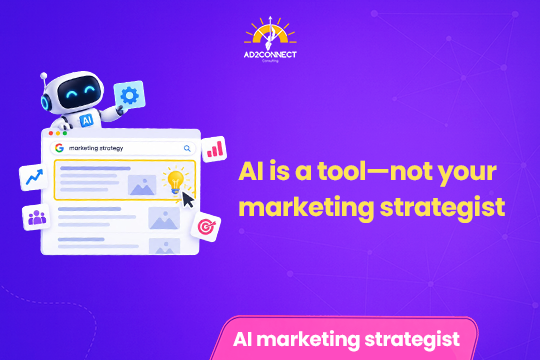
AI Is a Tool—Not Your Marketing Strategist
AI can draft, sort, and summarize in seconds. But it cannot know your business, and it will never be held responsible when its advice goes wrong.
By Snehal Singh | Published: October 12, 2026
AI Overview Summary
AI is a tool, not a marketing strategist. It is excellent at drafting, sorting data, and speeding up repetitive work, but it does not understand your customers, your sales process, or your business goals. Having access to an AI tool does not make someone qualified to run marketing. The safest approach is to keep strategy with experienced marketers, ask AI to show proof for its claims, and have a person review every recommendation before money or reputation is put at risk.
Table of Contents
- What Does “AI Is a Tool” Really Mean?
- Tool vs Strategist: What Is the Difference?
- Why AI Advice Sounds So Convincing
- Where AI Helps and Where a Strategist Is Needed
- Keep Strategy With Experienced Marketers
- Ask AI to Show Its Proof
- A Simple, Safe Way to Use AI in Marketing
- Mistakes That Look Like Strategy
- How Ad2Connect Approaches AI in Marketing
- Key Takeaways
- Frequently Asked Questions
What Does “AI Is a Tool” Really Mean?
It means AI performs the work you hand to it, but it does not decide which work is actually worth doing, in the same way that a hammer can drive a nail very well yet cannot design the house.
The trouble starts when a busy owner types a question into a chatbot, receives a confident answer, and passes it to the team as an instruction. The answer may be perfectly fine, or it may be completely wrong for your business, and nobody finds out until the money is gone.
Tool vs Strategist: What Is the Difference?
A tool follows instructions and produces output, whereas a strategist decides what the goal is, why that goal matters, and which path is worth taking to reach it.
Think of a GPS and a driver: the GPS suggests a route, but the driver knows that the road is flooded, that the passenger is running late, and that a shortcut would be unwise today, and marketing works in exactly the same way.
Why AI Advice Sounds So Convincing
AI tools are built to write clear, confident, well-organized answers, and that polished style makes every answer feel trustworthy even when the facts underneath are weak or invented.
Here is the deeper reason a tool cannot take over the strategist’s chair: a real marketing strategy is built from information that never appears in any prompt, such as how your last three campaigns actually performed, why your best customers chose you over a cheaper rival, which of your salespeople closes deals fastest, what your cash flow can handle this quarter, and what your competitors quietly changed last week, and because AI answers only from the words it has been given and the patterns it has learned, it fills every one of those gaps with a reasonable-sounding guess, which means the more important the decision is, the more dangerous that smooth guess becomes, and the more a person who knows the whole picture is needed to catch it before it turns into a costly mistake.
There is another problem. Having access to AI does not make someone qualified to run marketing, just as owning a stethoscope does not make someone a doctor, so the tool is only as useful as the person judging its output.
Where AI Helps and Where a Strategist Is Needed
AI is genuinely useful, and the real challenge is knowing which jobs to give it and which jobs to keep for yourself.
It works well when the task is repetitive, the answer can be checked quickly, and a mistake is inexpensive to correct. It works badly when the task requires detailed knowledge of your customers, your sales process, or your long-term goals.
| Marketing Task | What AI Can Do | What a Strategist Must Do |
|---|---|---|
| Ads and posts | Draft first versions quickly | Edit for brand voice and approve |
| Keywords and data | Group, sort, and summarize | Spot-check and decide what matters |
| Monthly ad budget | Suggest ideas and scenarios | Set the amount based on goals and cash flow |
| Target audience | List possible groups | Choose who is truly likely to buy |
| SEO and brand direction | Offer options to consider | Own the plan and the results |
| Claims about results | Draft the wording | Confirm every claim has real proof |
Keep Strategy With Experienced Marketers
Strategy decisions depend on three things that AI cannot see on its own: the business itself, its customers, and its sales process.
Take a simple example, in which an AI tool suggests that a store should double its advertising spend from ?50,000 to ?1,00,000 a month because more reach means more sales, which sounds perfectly sensible.
An experienced marketer would ask different questions, such as whether the website is ready for more visitors, whether the sales team has time to follow up on additional leads, and whether the current budget is already reaching everyone who is likely to buy, because without those answers extra spending may simply produce extra waste.
If You Are a Business Owner or Executive
You do not need to be a marketing expert to use AI wisely, but you do need access to someone who is.
When you receive advice from an AI tool, ask an experienced marketer to examine it before you act, because this takes only a few minutes and can prevent a very costly detour.
If You Are Learning Marketing
AI can make a beginner feel like an expert overnight, which is exactly the danger, because the answers look so professional that it becomes difficult to notice what is missing.
A better path is to make the real work part of your training by building a campaign, watching what happens, and learning from the results, while using AI to speed up repetitive tasks rather than to skip the learning.
Ask AI to Show Its Proof
This is one of the simplest habits you can build: whenever an AI tool gives you search marketing advice, ask it to explain exactly where that advice comes from.
Ask questions like these: What is your source? Is this a rule, a guess, or an opinion? What would prove this wrong?
Then check the answer yourself, and if the tool cannot point to anything solid, treat the advice as an interesting idea rather than an established fact.
The same rule applies to your own content. Before you publish a claim about your results, your services, or your industry, make sure your business can support it with real evidence.
A Simple, Safe Way to Use AI in Marketing
You do not have to avoid AI. You simply need a clear process.
- Let AI prepare. Use it to draft, gather ideas, and organize information.
- Let a person decide. An experienced marketer checks the output against your goals, customers, and budget.
- Check the facts. Verify every number, quote, and claim before it goes live.
- Record and review. Write down what you changed and why, then review the results after a few weeks.
This approach keeps the speed of AI and adds the judgment of an experienced person, which delivers most of the benefit with far less of the risk.
Mistakes That Look Like Strategy
Some habits feel modern and efficient, but they quietly cause trouble:
- Copying AI advice straight into a plan. Speed feels smart until the results arrive.
- Trusting a confident tone. Confident wording is not proof.
- Letting non-marketers approve marketing changes. Access to a tool is not the same as experience.
- Publishing AI-written claims unchecked. One false statistic can damage your credibility.
- Using AI to replace learning. Beginners who skip practice never build real judgment.
- Skipping review to save time. The time saved is usually paid back, with interest, in fixes.
How Ad2Connect Approaches AI in Marketing
At Ad2Connect, we use AI every day, and we also check it every day, because it speeds up our research and first drafts while every plan is still shaped and approved by a person who understands the client’s business.
As a boutique digital marketing agency in Mumbai, we work closely with each client, which means we learn their customers and sales process before recommending anything. That context is exactly what a general AI tool is missing.
The same thinking guides our search work, and our team behind the best SEO company in Mumbai treats AI suggestions as starting points and tests them against real data before any page or keyword plan changes.
It also applies to paid campaigns. As a performance marketing agency in Mumbai, we use automation for routine tasks, while budget and targeting decisions stay with people who answer for the results. If you would like a second opinion on an AI-made plan, we are happy to review it.
Key Takeaways
- Treat AI as a tool. It is excellent for drafts, sorting, and summaries.
- Keep strategy with experienced marketers. Strategy needs knowledge of the business, customers, and sales process.
- Have a marketer review AI advice. This matters most when the person asking is not a marketer.
- Ask for proof. If the tool cannot support a claim, do not publish or act on it.
- Learn by doing. Beginners grow through real campaigns, not shortcuts.
Ad2Connect is a digital marketing agency in Malad, Mumbai, helping businesses grow through SEO, performance marketing, branding, and content. Not sure if an AI-made marketing plan is right for your business? Talk to our team for a clear, honest review.