Why AI SEO Is More Complex Than Traditional SEO
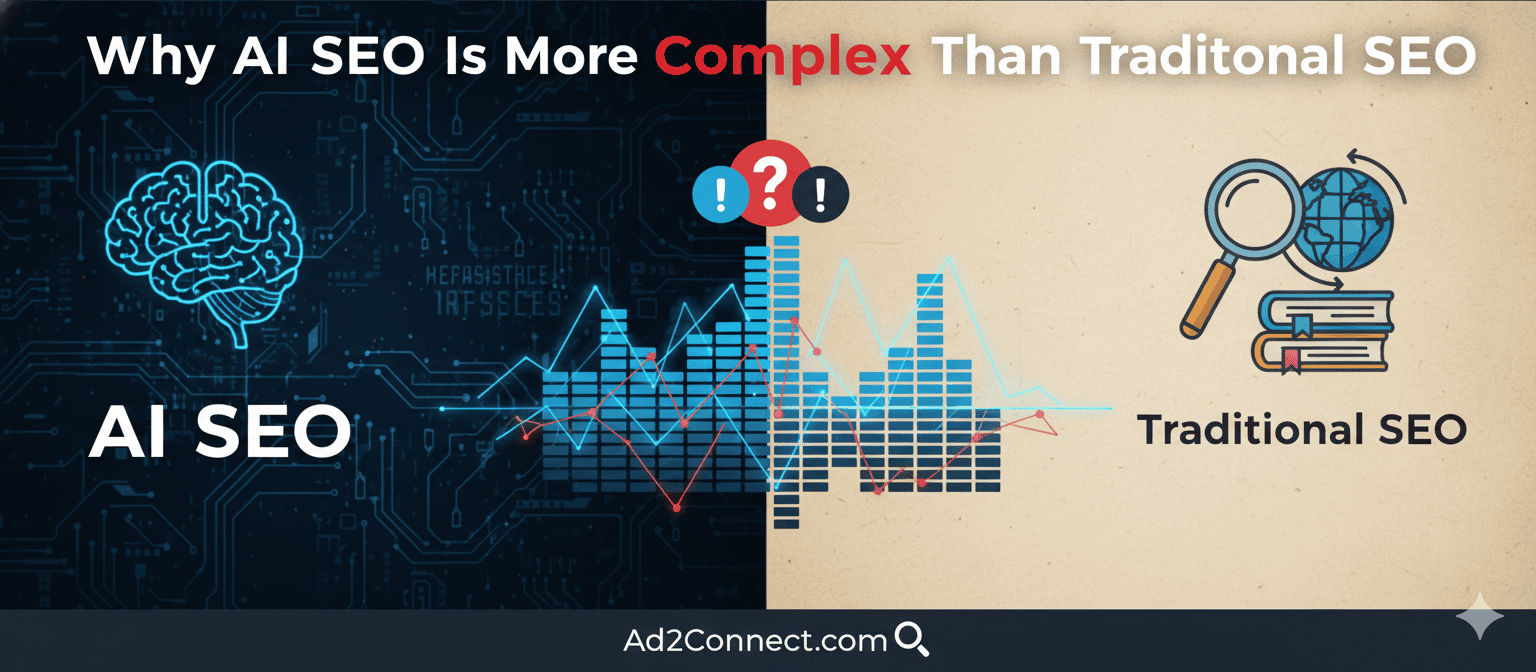
SEO has always required technical skill and strategic thinking, but the rise of AI in search has changed the rules. Search engines no longer rely only on keywords and links. They now interpret meaning, learn from user behavior, and generate answers directly in results. That’s why AI SEO is more complex than traditional SEO: you are optimizing not just for rankings, but for visibility inside intelligent systems that summarize and judge information.
This shift matters because discoverability now depends on how well your content aligns with intent, trust, and engagement. Brands that still rely on keyword-first tactics risk losing visibility, while those that adapt to AI-driven search can build durable authority in their niche.
What Makes AI SEO Different
Traditional SEO focused on three main levers: keywords, technical optimization, and backlinks. AI SEO expands this into a broader system that includes natural language understanding, entity relationships, and feedback from user behavior. Search engines now evaluate not only what your page says, but how people interact with it and whether your brand appears credible across the web.
Instead of optimizing for a static algorithm, marketers are now optimizing for a learning system. This system adapts based on user satisfaction and on how confidently it can summarize your content into an answer. That added layer of interpretation is what makes AI SEO more complex.
From Keywords to Concepts
In classic SEO, you might target a phrase like “best CRM software.” In AI SEO, the system tries to understand the concept behind that phrase. It connects ideas such as customer management, sales automation, and small business workflows.
This means content must be written to cover topics holistically. Rather than repeating a keyword, you explain the full problem and its solutions. This is where AI Optimization (AIO) and Content Intelligence Optimization (CIO) come into play. They help ensure your content reflects how machines interpret meaning, not just how humans type queries.
Rankings vs. Visibility (VEO)
In an AI-driven SERP, ranking first is no longer the only goal. Your brand may appear inside an AI-generated summary even if your page is not listed at the top. Visibility now includes being referenced, paraphrased, or cited in an answer.
Visibility Engine Optimization (VEO) focuses on making content easy for AI systems to extract. This involves clear definitions, structured sections, and concise explanations. The outcome is not only traffic, but brand presence within AI answers, which can influence user trust and future searches.
Pages vs Knowledge Systems (TEO)
Search engines increasingly treat the web as a network of entities rather than isolated pages. They evaluate whether your site demonstrates authority across an entire subject, not just on one keyword.
Topical Expertise Optimization (TEO) means building connected content around a theme. For example, instead of publishing one article about AI SEO, you create supporting pieces about AI SEO tools, AI SEO use cases, and AI SEO comparisons with traditional methods. This signals depth and helps machines understand your role as a reliable source.
How the Search Journey Changed
The old model of search followed a predictable path: users searched, clicked a blog post, explored a product page, and converted. In AI-driven search, users may first encounter an AI-generated explanation. Only after that do they decide which brand to trust.
This favors companies that provide clear, example-driven content. It disadvantages thin pages and generic “top 10” lists that add little insight. The journey is now shaped by interpretation and trust rather than simple keyword matching.
Practical Strategies for AI SEO
1. Optimize for Intent
Instead of writing only “What is AI SEO?” create content such as “How ecommerce brands use AI SEO to improve product discovery” or “AI SEO strategies for B2B SaaS in North America.” This aligns with user intent and introduces context that improves relevance.
2. Structure for AI Overviews
Use question-based headings, short explanatory paragraphs, and lists. AI systems extract answers more easily when content is clearly organized. This increases the chance of your brand being included in summaries rather than buried in results.
3. Build Trust with Experience
Lived Experience Optimization (LEO) focuses on showing that your insights come from real use. Add case studies, author credentials, and first-party data. Replace vague claims like “AI improves engagement” with specific outcomes such as “our team increased dwell time by 27% using this workflow.”
4. Conversion-First Design
With fewer clicks available, each visit matters more. Optimize for mobile usability, fast loading, and clear calls to action. Conversion Rate Optimization (CRO) and Marketing Experience Optimization (MEO) ensure that visitors who do arrive are guided toward meaningful actions.
Behavioral SEO Signals
Search engines increasingly rely on how users interact with content. Signals such as dwell time, scroll depth, click-through rate, and engagement help validate relevance.
You can improve these by adding jump links, visuals, step-by-step sections, and interactive tools. Breaking long text into scannable sections also keeps users engaged longer, which feeds positive feedback into ranking systems.
Conclusion
AI SEO is more complex than traditional SEO because it operates within a system shaped by intent, trust, behavior, and machine learning. Success now requires moving from keywords to concepts, from rankings to visibility, and from traffic to experience.