
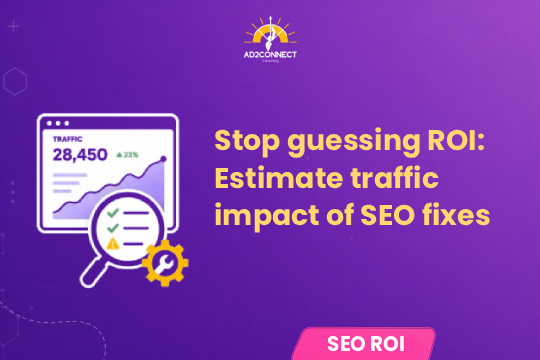
Stop Guessing ROI: Estimate Traffic Impact of SEO Fixes
Every quarter, mid-sized business owners across Mumbai face the same frustrating scenario: you review an extensive technical audit packed with red flags, hand over lakhs to a development team to change hundreds of tags, and watch your bottom-line revenue remain completely flat.
Post-Google’s March 2026 Core Update, the margin for error is gone. With AI Overviews answering search queries directly on the SERP and capturing a massive share of informational clicks, treating every technical error with equal importance is an expensive mistake. You don’t need to fix every minor warning your automated software flags. You need a clear, mathematical framework to isolate the changes that actually drive pipeline growth.
As a business owner, you want predictable customer acquisition, lower costs per lead (CPL), and measurable ROI. Achieving this requires moving away from vanity metrics and learning to precisely model search engine visibility into actual business value.
Estimate Traffic Impact of SEO Fixes
To accurately estimate traffic impact from SEO fixes, group your target URLs by template type, extract their exact baseline clicks and impressions from Google Search Console, and apply realistic click-through rate (CTR) lift models (typically 10% to 22% for phrases moving from page two to page one), while adjusting down for search results featuring zero-click AI summaries.
Summary
- Isolate URL Assets: Never forecast across an entire domain. Isolate impact calculations strictly to the specific URLs altered by the technical update.
- Target Positions 8–15: The fastest organic growth comes from moving keywords sitting on the cusp of page one into prominent, high-intent ranking spots.
- Discount for AI Overviews: Deduct 30% to 50% from traditional CTR models if the target keyword’s SERP is heavily dominated by automated summaries.
- Balance Costs vs. Revenue: If the projected traffic lift value is less than the engineering hours required to deploy the code, skip the fix.
The Data-Driven Forecasting Framework
Why Standard SEO Projections Fail
Most cookie-cutter strategies from a generic digital marketing agency in Mumbai treat site optimization like a magical light switch. They promise that repairing broken links or adjusting sitemaps will boost traffic universally across a site.
Search engines do not rank websites as a single monolith; they evaluate distinct URL paths, topical authority buckets, and page layouts. If your e-commerce collection pages suffer from poor internal linking, resolving that code issue will only benefit those specific product listings, not your corporate blog content.
Step-by-Step Solution to Forecast Organic Lift
[Isolate Impacted URLs via GSC] ? [Identify Keywords in Positions 8-15] ? [Apply Realistic CTR Delta] ? [Subtract Zero-Click Deficit] = True Traffic Impact
Step 1: Map the Scope and Isolate URL Exposure
Isolate the exact pages affected by your proposed structural changes. Open Google Search Console, filter your performance report by page directory, and examine the past 90 days of performance. This establishes your clear baseline for monthly clicks and impressions.
Step 2: Target the “Striking Distance” Keywords
Filter your keyword report for queries where your average ranking position is between 8 and 15. These pages are indexing well enough to be recognized by algorithms but miss out on meaningful traffic. This is where your highest-converting Professional SEO services yield their fastest returns.
Step 3: Model the CTR Delta Against the 2026 SERP Landscape
Do not rely on outdated, static CTR templates from years ago. Today’s search environment requires look-forward modeling:
- Low AI Displacement SERPs: If the keyword features standard organic blue links below paid ads, assume a clean 12% to 15% increase in click-through rates when moving into the top 5 positions.
- High AI Displacement SERPs: If an AI snippet completely answers the user’s question, reduce your traffic expectations significantly. For local intent search terms, ensuring you are optimized by a premium Best Local SEO Company in Mumbai allows you to leverage local map packs to balance out any traditional organic click loss.
Step 4: Build a Three-Tier Financial Scenario
Present your forecasting using a transparent risk-managed framework instead of a single speculative figure:
| Forecasting Scenario | Risk Adjustments Applied | Expected Traffic Lift Percentage |
|---|---|---|
| Conservative Baseline | High competitor ad spend, heavy zero-click AI interference. | 5% – 10% increase in clicks |
| Expected Mid-Case | Standard search intent alignment, normal indexing timelines. | 11% – 18% increase in clicks |
| Aggressive Growth | Total market capture, minimal AI footprint on transactional terms. | 19% – 26% increase in clicks |
Case Study: From Technical Audit to Realized ROI
Let’s review a realistic scenario modeled for a B2B professional services enterprise headquartered in Malad, Mumbai.
The Problem
The business was spending heavily on digital acquisition but saw its digital customer base plateauing. An architectural review showed that a series of incorrect robots.txt rules were blocking search engines from cleanly rendering their high-intent, localized service landing pages. The pages had dropped from the top of page one to an average position of 12.
- Baseline Traffic Exposure: 15,000 targeted impressions per month.
- Current Clicks: 300 clicks per month (A low 2% CTR due to page two positioning).
- Current Leads: 6 conversions per month (2% on-page conversion rate).
- Current Cost Per Lead (CPL): ?6,000.
The Technical Fix & Forecast
Instead of rolling out a generic sitewide content overhaul, the engineering team applied a precise fix to clear the faulty crawl instructions on those 10 specific geo-targeted pages. We projected a realistic mid-case scenario: reclaiming a position #4 spot, yielding a conservative 10% organic click-through rate.
The Actual Results (90 Days Post-Deployment)
- New Clicks: 1,500 monthly clicks (An increase of 1,200 highly relevant visits).
- New Leads Generated: 30 conversions per month (Maintaining the standard 2% conversion rate).
- CPL Optimization: The cost per lead dropped down to ?1,200 because organic acquisition offset paid dependency.
- Net Business Return: With an average client contract value of ?120,000 and a 15% lead-to-close rate, the 24 additional monthly leads generated 3.6 new closed accounts. This delivered ?432,000 in recurring monthly revenue from a single technical code fix that required less than five hours of development time.
Expert Insights from the Trenches
- The Core Web Vitals Illusion: Many automated platforms encourage business owners to chase perfect 100/100 performance scores. In practice, unless your site is severely broken or takes over 5 seconds to load on standard mobile connections, raising a page speed score from 85 to 95 provides almost zero measurable traffic lift. Direct your engineering budget toward resolving core crawling, indexation, or semantic framework issues instead.
- Brand Data Distorts Projections: Always strip out your company’s brand name keywords when modeling your baseline exposure. Brand queries carry incredibly high click-through rates that obscure the actual visibility of your non-brand commercial pages.
Actionable Checklist for Business Owners
- Filter Out Vanity Errors: Review your current SEO audit report and filter out low-impact alerts like minor missing image alt tags on legacy blog posts.
- Isolate High-Intent URLs: Identify the top 20 pages on your site that directly generate lead forms, phone calls, or product checkouts.
- Check Search Console Rankings: Note the queries driving impressions to those pages that currently sit between positions 8 and 15.
- Audit the Live SERP Layout: Manually search your top 5 targeted keywords to verify if paid advertising or AI blocks leave enough visible real estate for organic web links.
- Calculate the Minimum Value: Multiply your current impressions by a conservative 8% CTR lift to see if the resulting traffic values justify the estimated development costs.
Conclusion
Estimating the traffic impact of your SEO fixes takes the mystery out of organic search investments. By isolating your URL assets, filtering for queries within striking distance of page one, and adjusting your expectations for modern AI-driven search layouts, you can confidently invest marketing capital where it drives measurable business returns. Stop guessing your performance metrics and start engineering your growth.