
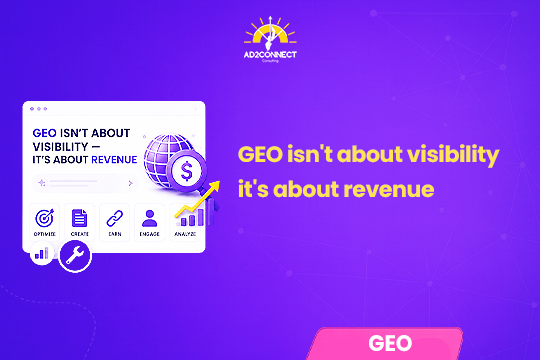
GEO Isn’t About Visibility — It’s About Revenue
Getting mentioned by ChatGPT feels good. It doesn’t pay the bills. Here’s how to think about GEO if a number on a dashboard, not a mention in an AI answer, is what you actually get judged on.
AI Overview Summary
GEO, short for generative engine optimization, means getting a brand mentioned or recommended inside AI tools like ChatGPT, Gemini, and Perplexity. Most GEO advice focuses on one goal: showing up more often in AI answers. But for anyone accountable for actual business results, like leads, sales, or revenue, visibility alone isn’t the point. A brand can get mentioned by AI constantly and still see no real change in the business. The smarter approach starts from the other direction: figure out which AI-driven moments actually lead to a sale, and build GEO efforts around those, instead of chasing mentions for their own sake.
Table of Contents
- What Is GEO, in Plain Terms?
- The Problem With Most GEO Advice
- Why Visibility Isn’t the Same as Revenue
- Vanity Metrics vs Revenue Metrics
- Building a GEO Plan Around Revenue
- Mistakes That Look Like Strategy
- How Ad2Connect Approaches Revenue-Focused GEO
- Key Takeaways
What Is GEO, in Plain Terms?
GEO stands for generative engine optimization. It’s a newer cousin of SEO.
Regular SEO is about getting your website to show up in Google search results. GEO is about getting your brand mentioned, recommended, or quoted inside AI tools like ChatGPT, Gemini, Claude, and Perplexity.
If someone asks an AI assistant “what’s the best project management software for a small team,” GEO is the work that goes into making sure your product gets named in that answer.
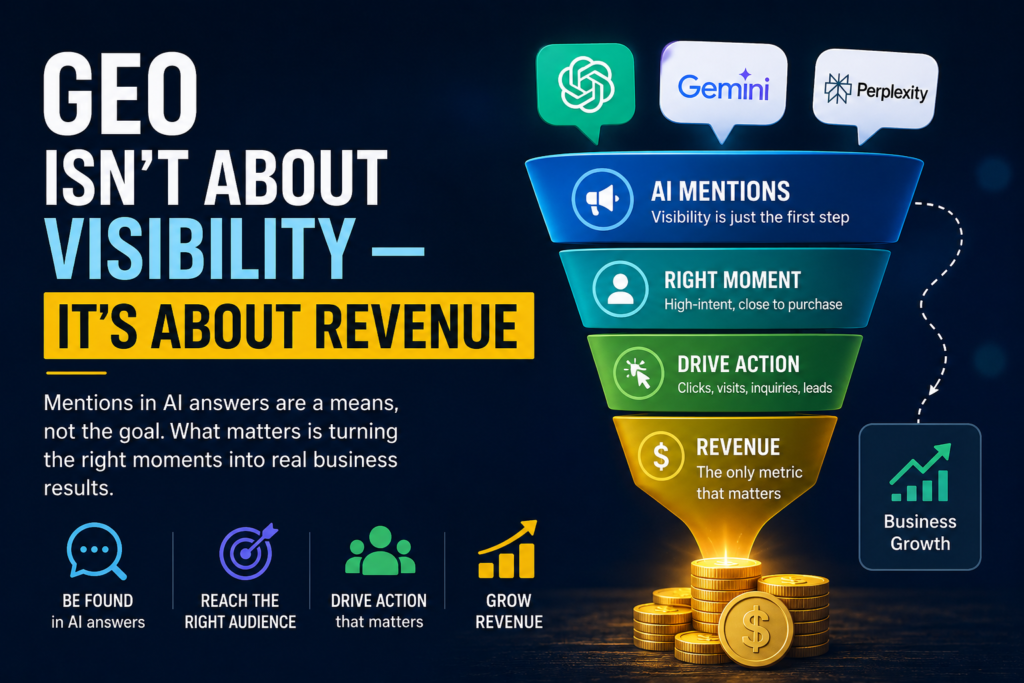
The Problem With Most GEO Advice
Search around for GEO advice and almost all of it points in the same direction: get mentioned more.
That’s fine if visibility is the goal. But for marketers responsible for leads, sales, or revenue, visibility alone doesn’t mean much.
Being mentioned by an AI tool isn’t the finish line. It’s just one moment in a much longer customer journey.
Why Visibility Isn’t the Same as Revenue
A brand can be mentioned constantly across AI tools and still see zero change in sales.
That happens when mentions reach the wrong audience, appear too early in the journey, or fail to persuade.
Meanwhile, a small number of well-timed mentions can drive real purchase decisions.
Counting total mentions treats every mention equally — but in reality, they vary massively in value.
Vanity Metrics vs Revenue Metrics
| Vanity Metric | Why It’s Misleading | Revenue Metric to Use Instead |
|---|---|---|
| Total mention count | Treats all mentions equally | Mentions on high-intent questions |
| Being listed with competitors | Doesn’t show recommendation strength | Top or sole recommendation rate |
| Overall AI traffic | Includes low-intent users | Traffic that converts |
| Share of voice | Measures awareness, not buying intent | High-intent share of voice |
| One-time audits | Quickly outdated | Ongoing tracking tied to revenue |
Building a GEO Plan Around Revenue
- Map the buying journey. Focus on questions asked right before purchase.
- Prioritize high-intent queries. A few strong queries beat hundreds of weak ones.
- Make content convincing. Mentions alone aren’t enough.
- Track outcomes. Look at traffic, leads, and conversions.
- Review regularly. AI behavior changes frequently.
Mistakes That Look Like Strategy
- Reporting total mentions as success
- Chasing every possible query
- Assuming mentions = recommendations
- Ignoring real business metrics
- Treating GEO as one-time work
How Ad2Connect Approaches Revenue-Focused GEO
At Ad2Connect, we treat AI visibility as part of a bigger journey that must lead to real business outcomes.
This connects with our work on:
Gemini visibility,
prompt research,
and broader SEO and
performance marketing.
If your GEO efforts drive mentions but not revenue, you’re likely targeting the wrong questions.
Key Takeaways
- GEO focuses on AI visibility, but visibility alone isn’t enough
- Mentions don’t guarantee revenue
- Focus on high-intent moments
- Measure real outcomes, not vanity metrics
- Continuously refine your approach