
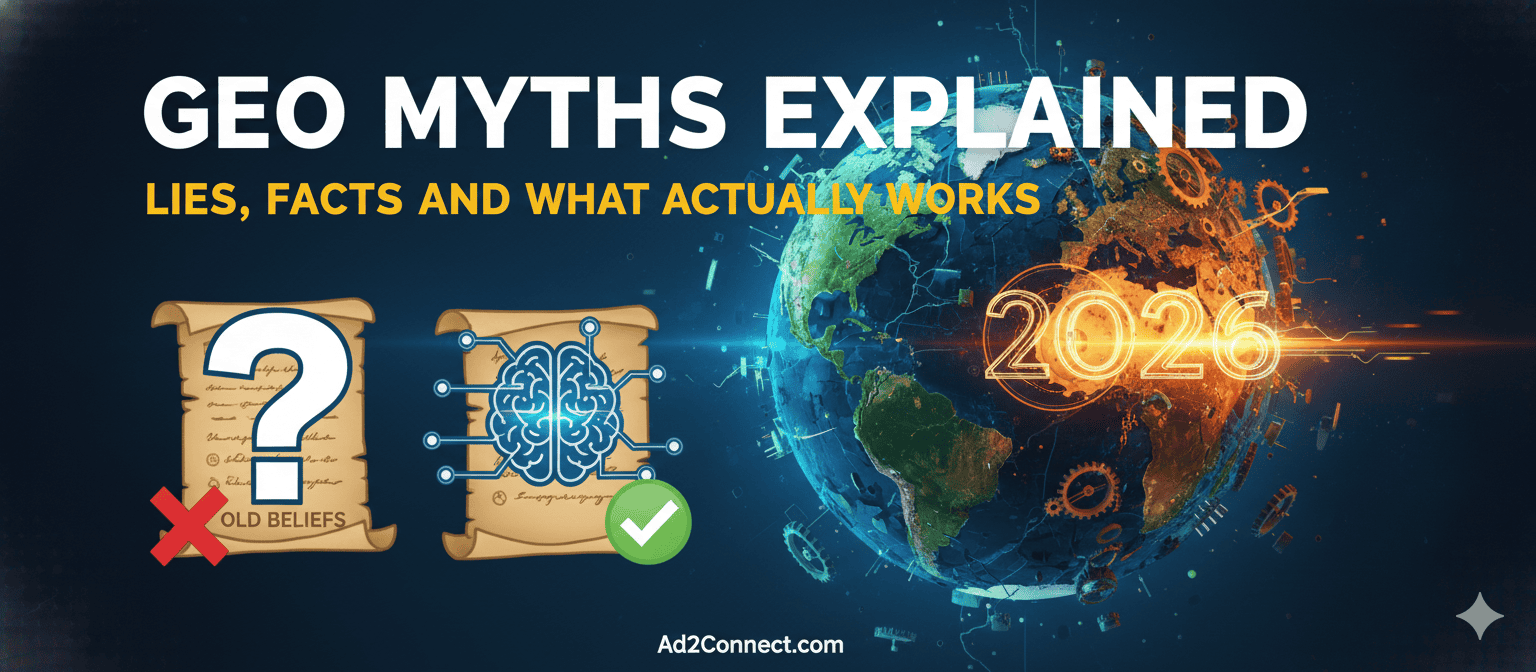
GEO Myths Explained: Lies, Facts, and What Actually Works in 2026
Why GEO Myths Are Everywhere
“SEO is dead.”
“AI search will replace websites.”
“GEO is the only thing that matters now.”
These statements sound convincing, especially in a time when AI-generated search results are becoming more visible. But they are also the reason GEO myths are spreading faster than facts. As search evolves, fear-based narratives and oversimplified advice often fill the gap before clarity does.
Generative Engine Optimization (GEO) is not a lie, but many of the claims surrounding it are. This article separates reality from exaggeration by breaking down the most common GEO myths, explaining how generative search engines actually work, and showing you what strategies genuinely improve visibility in AI-driven search experiences.
If your goal is sustainable growth, brand trust, and long-term discoverability, this guide will help you focus on what truly matters.
What Is Generative Engine Optimization (GEO)?
A Clear and Extractable Definition
Generative Engine Optimization (GEO) is the practice of optimizing digital content so AI-powered search engines can clearly understand it, trust it, and reference it when generating answers, summaries, or AI overviews.
Unlike traditional SEO, which primarily aims to rank pages in search results, GEO focuses on:
- Helping AI systems interpret context accurately
- Reinforcing entities such as brands, authors, and concepts
- Structuring content so it can be easily summarized or cited
Crucially, GEO does not replace SEO. It relies on strong SEO foundations to work effectively.
The Most Common GEO Myths
Myth 1: GEO Has Replaced SEO
One of the biggest GEO myths is that traditional SEO is no longer relevant. This belief suggests that keywords, internal links, technical optimization, and site structure no longer matter.
The reality is the opposite. Generative engines still depend on:
- Search indexes and crawlers
- Structured, accessible websites
- Signals like relevance, authority, and usability
Without solid SEO fundamentals, GEO efforts lack the data AI systems rely on. GEO enhances SEO, it does not eliminate it.
Myth 2: AI Search Makes Website Traffic Irrelevant
Another common lie is that AI-generated answers mean users will stop visiting websites altogether. While AI overviews may reduce clicks for some queries, traffic still plays a critical role.
Website visits are essential for:
- Conversions and revenue generation (CRO)
- Brand storytelling and differentiation
- First-party data collection
- Building long-term customer relationships
Brands that succeed optimize for assisted discovery, appearing in AI answers while still offering enough value to encourage deeper engagement.
Myth 3: Authority No Longer Matters in GEO
Some claim that AI models treat all content equally. In practice, authority is more important than ever.
Generative engines favor sources that demonstrate:
- Clear expertise and experience
- Consistent topical focus (TEO)
- Recognition as trusted entities
This aligns with Google’s E-E-A-T principles and extends them into AI-based trust systems. Industry analysis shows that many GEO claims ignore how heavily AI relies on authoritative sources.
Myth 4: GEO Is Just Prompt Engineering
There is a growing belief that GEO can be “hacked” using clever phrasing or prompt-style writing. While prompts influence AI behavior in testing environments, they do not create sustainable visibility.
Content built purely for prompts often lacks:
- Depth and originality
- Real-world experience
- Editorial credibility
AI-driven search rewards clarity, completeness, and usefulness, not gimmicks.
What Actually Differentiates GEO from Traditional SEO
The real difference between GEO and traditional SEO lies in how success is measured and how content is interpreted.
Traditional SEO focuses on ranking pages and driving clicks. GEO focuses on whether your content is:
- Understood as a reliable source
- Accurately summarized
- Referenced or cited in AI-generated responses
Despite this difference, both approaches depend on the same core principles: quality content, strong structure, and user-first intent.
What Actually Works in GEO Today
Entity-First Content Strategy
GEO performs best when content is built around entities rather than keyword repetition. This means clearly defining and reinforcing:
- Brands
- Authors
- Concepts
- Related topics
Instead of repeating phrases unnaturally, strong content connects topics naturally to related entities such as Generative Engine Optimization, AI Overviews, and search quality guidelines.
Structured, Scannable Content
AI systems prefer content that is easy to parse and summarize. Clear structure benefits both machines and humans.
- Logical heading hierarchies
- Short paragraphs
- Bullet points for key ideas
- Clear summaries and definitions
Helpful Content Over High Volume
GEO strongly aligns with Google’s Helpful Content System. Publishing more content does not improve visibility if it does not add value.
Effective GEO content:
- Answers real user questions
- Provides practical guidance
- Reflects genuine expertise
Optimize Beyond One Search Engine
Modern discovery is multi-channel and multi-engine. GEO intersects with:
- AIO (AI Overview Optimization)
- VEO (Voice Experience Optimization)
- SMO (Social Media Optimization)
- CIO (Conversational Intent Optimization)
- MEO (Multi-Engine Optimization)
Actionable GEO Tips You Can Use Today
- Add clear definitions for important concepts
- Strengthen internal links between related topics
- Cite credible external sources
- Include FAQ sections with concise answers
- Display author credentials and editorial standards
- Use descriptive alt text for images to improve accessibility and AI context
Conclusion: Stop Believing GEO Lies and Build Real Visibility
GEO is not a replacement for SEO, a traffic killer, or a shortcut to visibility. The biggest GEO myths thrive because they oversimplify a complex evolution in search.
What actually works is consistent:
- Strong SEO foundations
- Clear, entity-driven content
- Real expertise and authority
- A genuine focus on helping users
AI-driven search rewards brands that are trustworthy, useful, and well-structured. The sooner you stop chasing myths and start building clarity, the more future-proof your content strategy becomes.