
How Google Ads Quality Score Impacts Your CPCs
Why Some Advertisers Pay More for the Same Click
Two advertisers bid on the same keyword. One pays $1.30 per click. The other pays $4.10. The difference is not budget—it is Quality Score.
Google Ads Quality Score is Google’s way of measuring how relevant and useful your ad and landing page are to users. While many advertisers focus on bids and budgets, Quality Score quietly shapes how much you pay per click and whether your ads appear at all.
In competitive markets like the US, UK, and EU—where CPC inflation is common—understanding how Quality Score truly works can be the difference between profitable growth and wasted spend.
What Is Google Ads Quality Score?
Quality Score is a diagnostic metric shown on a scale from 1 to 10. It estimates how relevant and useful your ad experience is compared to competitors targeting the same keyword.
- Expected click-through rate (CTR)
- Ad relevance
- Landing page experience
These signals are driven by Google’s machine learning systems, making Quality Score part of AI-driven optimization rather than a fixed rule set.
How Quality Score Affects CPCs
Google Ads uses an auction to determine which ads appear, where they appear, and how much each advertiser pays.
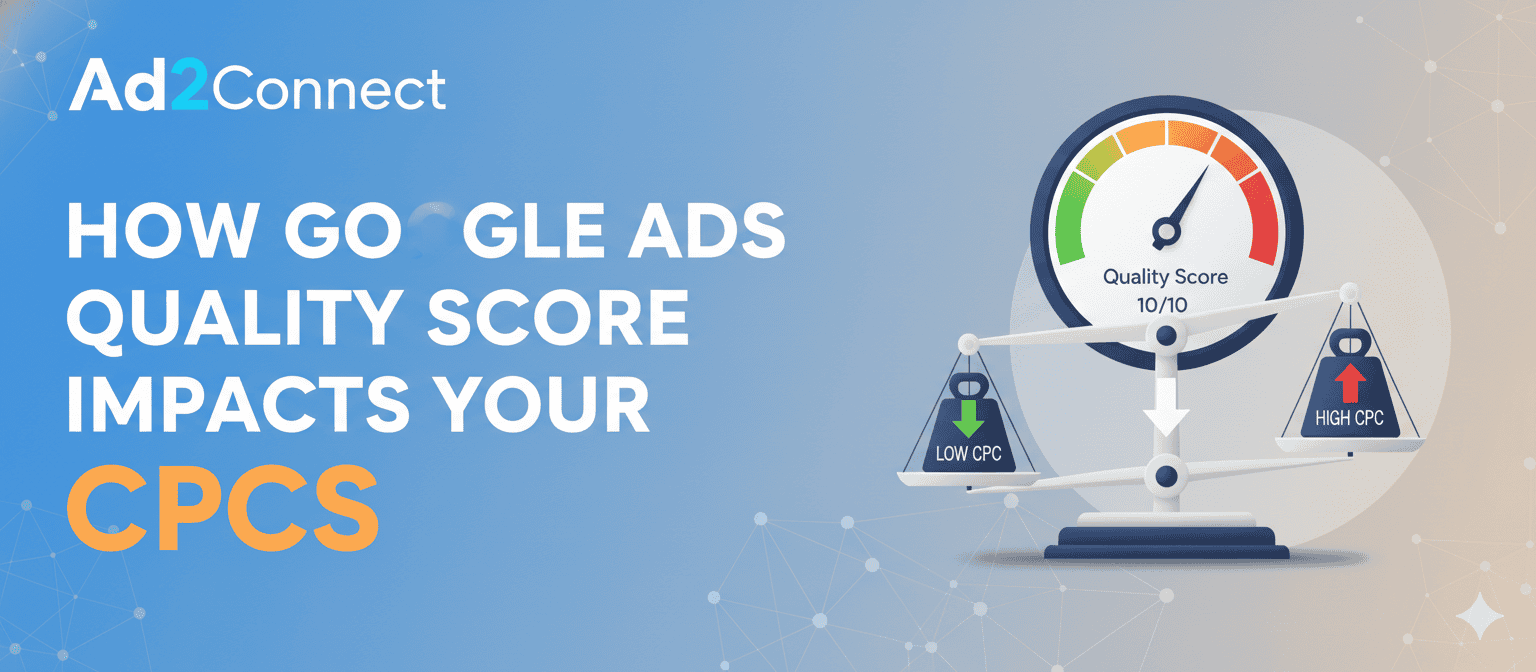
- Higher Quality Score = lower CPCs
- Lower Quality Score = higher bids required
Advertisers with strong relevance and good user experience often pay significantly less for the same traffic.
The Three Components That Control Quality Score
1. Expected CTR
Expected CTR predicts how likely users are to click your ad based on past performance and keyword-to-ad alignment.
- Use keywords in headlines
- Highlight specific benefits
- Add strong calls to action
2. Ad Relevance
Ad relevance measures how closely your ad matches the keyword’s meaning.
- Use tight keyword clusters
- Write tailored messaging
- Match intent explicitly
3. Landing Page Experience
Landing page experience evaluates content relevance, speed, mobile usability, and transparency.
- Load in under 3 seconds
- Match the ad promise
- Use clear headings
- Show trust signals
Quality Score vs CPC Impact
| Quality Score Range | CPC Impact | Competitive Position | Cost Efficiency |
|---|---|---|---|
| 1–3 | Very High | Weak | Low |
| 4–6 | Moderate | Average | Medium |
| 7–10 | Low | Strong | High |
Why Quality Score Is Often Misunderstood
- It does not directly set CPC
- A perfect 10 is not required
- Budget alone cannot fix relevance
Google rewards usefulness, not just financial power.
Is Quality Score Inflating Your CPCs?
- Are most keywords below 6?
- Do ads look similar across ad groups?
- Do landing pages feel generic?
- Is mobile UX slower than desktop?
- Are bounce rates above 60%?
If you answered “yes” to two or more, Quality Score may be raising your CPCs.
Tips, Strategies, and Examples
Segment by Intent
- Informational
- Commercial
- Transactional
Improve Landing Page UX
- High contrast text
- Logical heading structure
- Keyboard-accessible buttons
- Clear calls to action
Use First-Party Data
- Customer match lists
- CRM audiences
- Past converters
Apply Social Media Optimization
Test headlines and offers on social platforms, then reuse the highest-engagement language in PPC ads.
Use Content Intelligence Optimization
Analyze query reports, heatmaps, and on-page behavior to refine ad copy and landing page content.
Behavioral SEO and Engagement Signals
- Time on page
- Bounce rate
- Navigation depth
Improve engagement using bullet points, videos, and FAQs.
Conclusion: Relevance Is Cheaper Than Bidding
Quality Score is Google’s pricing model for usefulness.
Advertisers who match intent, improve UX, write relevant ads, and deliver helpful landing pages pay less per click and gain more visibility.