
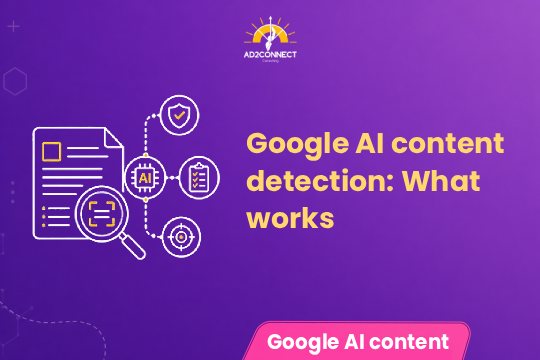
Google AI Content Detection: What Works
Most businesses are using AI to create content—but very few are getting results.
You publish blogs, invest in SEO, maybe even hire a digital marketing agency in Mumbai. Traffic comes in slowly… but leads don’t. Rankings fluctuate. And competitors with fewer pages outrank you.
What you actually want is simple: consistent leads, predictable ROI, and content that Google trusts.
This is where Google AI content detection changes everything—and where most businesses are getting it wrong.
Google AI content detection
Google AI content detection evaluates content based on quality—not whether it’s written by AI. Content ranks when it demonstrates real expertise, originality, and usefulness.
AI content is flagged as spam when it:
- Lacks real-world experience
- Feels generic or repetitive
- Doesn’t solve the user’s intent
To rank in 2026, combine AI efficiency with human insight and structured, value-driven content.
Summary
- Google does NOT penalize AI content directly
- Low-quality, generic AI content is filtered out
- Real experience and depth are critical
- Google AI Overviews favor clear, structured answers
- Content must drive outcomes, not just traffic
Why Most AI Content Fails (And Gets Ignored)
1. No Real Experience
Google now prioritizes E-E-A-T (Experience, Expertise, Authority, Trust).
If your content:
- Doesn’t include real examples
- Has no data or proof
- Feels like it’s written for everyone
…it will not rank.
This is a major gap we see even in projects handled by some best SEO agencies in Mumbai.
2. Misunderstanding Google AI Overviews Impact on SEO
Google AI Overviews are reducing clicks on weak content.
Users now get:
- Direct answers
- Summaries
- Key points
If your content is not structured for extraction, it won’t appear.
3. Businesses Focus on Content Volume, Not Value
We’ve audited multiple websites where:
- 40+ blogs were published
- Traffic increased slightly
- Leads stayed flat
Because:
- No intent mapping
- No conversion strategy
- No differentiation
What Actually Works in 2026
Step 1: Write for Intent, Not Just Keywords
Instead of targeting:
“SEO services”
Target:
- “Why SEO isn’t generating leads”
- “How to reduce cost per lead from SEO”
This aligns with real business problems.
Step 2: Add Proof-Based Content
Include:
- Case studies
- Numbers
- Before/after results
This is the strongest signal for Google AI-generated content SEO.
Step 3: Structure for AI Overviews
Use:
- Direct answers in first 50 words
- Bullet points
- Clear subheadings
This increases visibility in AI-generated results.
Step 4: Combine AI + Human Strategy
AI helps with:
- Speed
- Drafting
Humans add:
- Strategy
- Experience
- Conversion thinking
Step 5: Optimize for Conversions
Every page should answer:
“What should the user do next?”
Without this, even top rankings won’t generate revenue.
Case Study
A service-based business approached us after working with a creative agency in Mumbai.
Before:
- 25 AI-generated blogs
- Traffic: 6,500/month
- Leads: 10/month
- Cost per lead: ?2,200
What We Did:
- Rewrote content with real insights
- Added internal linking strategy
- Optimized for Google AI content detection signals
- Improved conversion flow
Results (90 Days):
- Traffic: 10,200/month (+57%)
- Leads: 42/month (+320%)
- Cost per lead: ?850
- ROI: 3.5x
This is where a performance marketing agency in Mumbai approach changes outcomes—focusing on revenue, not just rankings.
Expert Insights
Insight 1: Generic Content Is Dead
If your content can be written by anyone, it won’t rank.
Insight 2: Short, Useful Content Beats Long, Useless Content
We’ve seen:
- 800-word targeted blogs outperform
- 3000-word generic articles
Insight 3: Local SEO + AI Content = Massive Opportunity
Most businesses ignore:
- Location-based intent
- Service-specific queries
This is where a local SEO agency in Mumbai can create strong advantages.
Actionable Checklist
Before publishing any content:
- Does it solve a specific problem?
- Does it include real numbers or proof?
- Is the first 50 words a direct answer?
- Is it structured for AI Overviews?
- Does it guide the user to take action?
- Is it better than competitors?
If not, don’t publish it.
Conclusion
Google AI content detection is not a threat—it’s a quality filter.
Businesses that rely on generic AI content will struggle to rank and convert. Those who combine AI with real expertise, structured content, and conversion-focused strategy will dominate search results.
In 2026, winning SEO is simple:
Not more content—better content.