
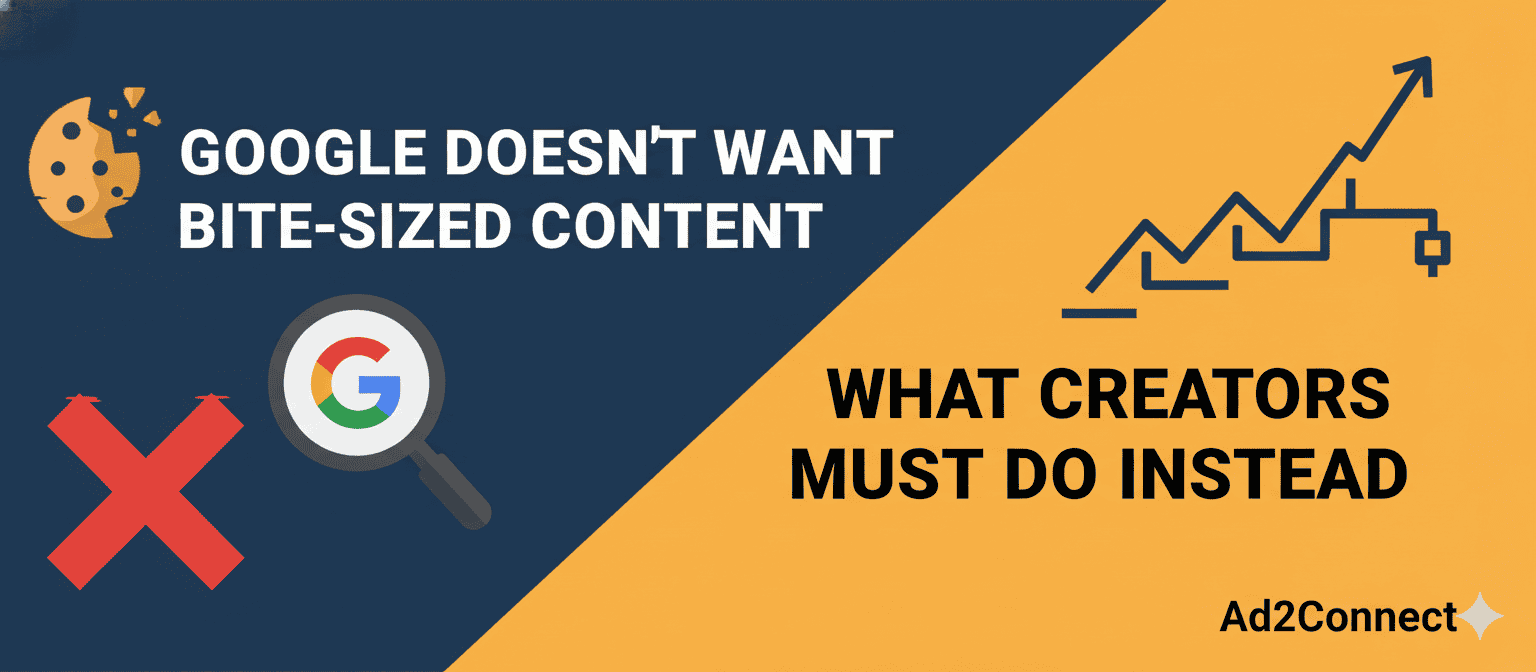
Google Doesn’t Want Bite-Sized Content: What Creators Must Do Instead
Why Bite-Sized Content No Longer Works
For years, content marketers followed a simple rule: shorter is better. Break topics into small posts, target one keyword per page, and publish frequently.
That strategy no longer works.
Google has made it clear that creating bite-sized content purely for SEO purposes can hurt visibility. With AI Overviews, semantic search, and intent-based ranking systems, Google now favors comprehensive, unified content experiences over fragmented pages.
This guide explains why Google doesn’t want bite-sized content, what that means for modern SEO, and how to restructure your content to align with Google’s Helpful Content system.
What Google Means by “Bite-Sized Content”
Bite-sized content is not inherently bad. The problem occurs when content is created primarily to rank rather than to help users.
Common examples include:
- Multiple thin pages covering the same topic with minor keyword variations
- Articles that answer only one small question without broader context
- Artificially splitting content to increase page count
- Pages written for crawlers instead of real readers
Instead of publishing one authoritative guide, some sites create many shallow articles. Individually, none of them fully satisfy search intent.
Why Google Discourages Bite-Sized Content
1. Google Ranks Topics, Not Just Pages
Modern Google systems evaluate topical authority, entity relationships, and contextual relevance. One strong resource often outperforms many weak ones.
2. AI Overviews Need Context-Rich Content
AI-powered search results rely on content that answers related questions, covers edge cases, and provides structured explanations. Thin pages lack the context required to be cited.
3. Fragmentation Sends Negative Behavioral Signals
Bite-sized pages often lead to high bounce rates, pogo-sticking, and low dwell time. These signals indicate poor user satisfaction and impact rankings.
How AI Search Changed Content Evaluation
With the rise of AI Overviews and generative search, Google favors content that demonstrates depth, clarity, and real expertise.
This shift supports AI Optimization (AIO), Topical Entity Optimization (TEO), and Language Entity Optimization (LEO). Pages that cover a subject holistically are more likely to be surfaced and trusted.
What Google Wants Instead
Google’s guidance is clear: create fewer pages, but make them better.
Preferred content characteristics:
- End-to-end topic coverage
- Clear structure with logical headings
- Multiple search intents addressed
- Evidence of experience and expertise
- Helpful, user-first explanations
How to Fix Bite-Sized Content
Step 1: Audit and Consolidate
Identify pages that overlap in topic or intent. Merge them into one authoritative resource and redirect weaker URLs.
Step 2: Improve Structure Without Fragmentation
- Use short paragraphs
- Add bullet points and tables
- Include jump links
- Use clear H2 and H3 headings
Step 3: Serve Multiple Intents on One Page
| Search Intent | How to Address It |
|---|---|
| Informational | Definitions and explanations |
| Exploratory | Examples and comparisons |
| Practical | Steps and frameworks |
| Decision-based | Tools and next actions |
Conclusion: Depth Wins Modern Search
Google isn’t asking creators to publish less content. It’s asking them to publish better, more complete content.
If your site relies on bite-sized pages created for keyword coverage, now is the time to evolve. Consolidate your expertise, improve structure, and focus on delivering real value.