
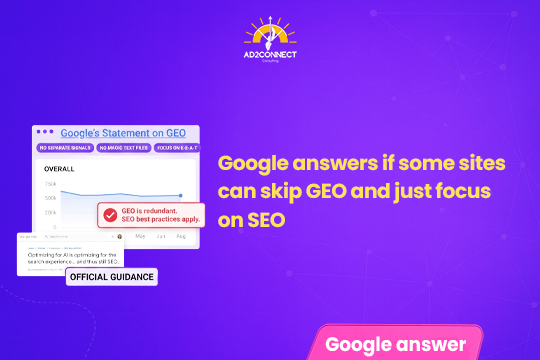
Google Answers If Some Sites Can Skip GEO and Just Focus on SEO
Someone finally asked Google straight out: does every business really need a separate AI-search strategy? The answer was shorter, and more useful, than most of the advice being sold right now.
By Snehal Singh | Published: September 2, 2026
AI Overview Summary
A user on Bluesky asked Google’s John Mueller whether certain industries — he gave adult content and gambling as examples — could reasonably ignore Generative Engine Optimization (GEO) since Google search still drives most of their discovery. Mueller’s answer was blunt: from Google’s side, there is nothing special a business needs to do for its AI-generated search answers. That’s because Google’s AI Overviews are built directly from the same crawled index and the same ranking signals that power regular search results, plus a set of related follow-up searches. If your pages are already well optimized for standard SEO, they are already positioned to be pulled into Google’s AI answers — there is no separate, parallel system to chase. That doesn’t mean every AI platform works the same way, but for Google specifically, GEO and SEO are the same underlying work wearing two different names.
Table of Contents
- What Is GEO, and Why Is Everyone Suddenly Talking About It?
- The Question: Can Some Industries Just Skip GEO?
- Google’s Answer, Straight From John Mueller
- Why “Nothing Special” Is the Real Insight Here
- What This Actually Means for Your SEO Strategy
- GEO Myth vs. Reality: A Quick Comparison
- Mistakes That Look Like Strategy
- How Ad2Connect Approaches SEO and AI Search for Clients
- Key Takeaways
- FAQ: GEO vs. SEO
What Is GEO, and Why Is Everyone Suddenly Talking About It?
GEO stands for Generative Engine Optimization. In plain terms, it means trying to get your business mentioned or cited inside AI-generated answers — the kind you see in Google’s AI Overviews, or in tools like ChatGPT and Perplexity.
Over the past couple of years, GEO has turned into its own mini-industry. Consultants sell audits. SEO plugins now generate special files meant to help AI tools “understand” your content better. Agencies pitch it as a brand-new discipline, separate from traditional SEO, with its own rules and its own price tag.
Some of that is genuinely useful. A lot of it is repackaged SEO advice with a new label on the box.
The Question: Can Some Industries Just Skip GEO?
That backdrop is exactly why one question to Google stood out. A user on Bluesky asked John Mueller, who works on Search at Google, something direct: are there industries where GEO simply doesn’t matter yet? The user pointed to sectors like adult content and gambling, where regular Google search still seems to drive most of the discovery.
It’s a fair question. If AI search hasn’t meaningfully changed how customers find you, why spend budget optimizing for it?
Google’s Answer, Straight From John Mueller
Mueller’s reply was short and, honestly, a little deflating for anyone selling GEO as a completely separate service. He said he wasn’t sure what the extra step would even be — from Google’s side, nothing special is required for a page to show up well in generative AI responses in search.
No separate checklist. No hidden ranking factor unique to AI Overviews. No industry exemption needed, because there was never a separate system to be exempt from in the first place.
Why “Nothing Special” Is the Real Insight Here
The reason Mueller’s answer makes sense comes down to where Google’s AI search results actually come from. They aren’t generated from some independent AI-only index. They’re pulled directly from Google’s existing crawled search index — the same one that produces your regular blue-link rankings.
Practically, that means Google’s AI Overviews draw from whichever pages are already ranking well for a given query, plus a handful of closely related “query fan-out” searches — the follow-up questions a curious searcher would naturally ask next. A page earns its way into an AI Overview largely the same way it earns a top-10 ranking: relevant content, clear structure, solid E-E-A-T signals, technical health, and enough authority that Google trusts it to answer the question well. There’s no shortcut that skips that foundation, and there’s no separate foundation to build instead — which is really the whole point of Mueller’s answer, and the part that gets lost every time GEO gets pitched as something businesses need to buy on top of their existing SEO work.
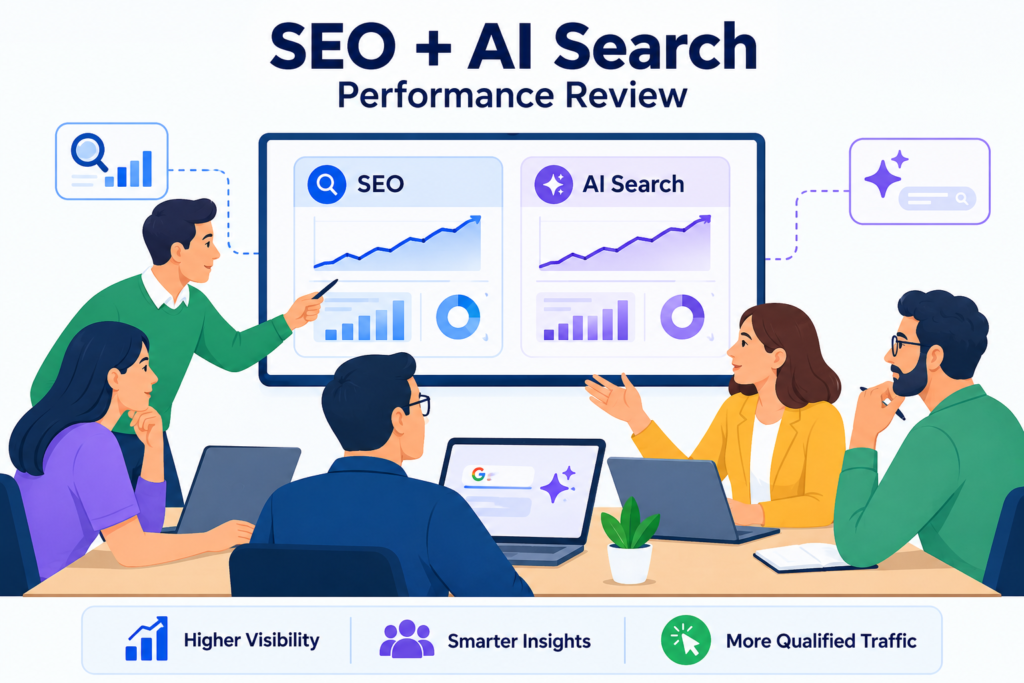
What This Actually Means for Your SEO Strategy
None of this means AI search doesn’t matter. It’s growing fast, and more searches are ending with an AI-generated summary instead of a scroll through ten blue links.
What it does mean is where your effort should actually go. Instead of chasing a parallel “AI-only” strategy, the smarter move is doubling down on the SEO fundamentals that were always going to matter: crawlable, well-structured pages; content that genuinely answers the query in depth; strong internal linking; and technical health that lets Google’s crawlers and rendering systems find and trust your pages in the first place.
For local and small businesses in particular — clinics, real estate firms, D2C brands, service providers — this is good news. It means you don’t need a separate AI-search budget line before you’ve even nailed the basics. Getting the fundamentals right does double duty.
GEO Myth vs. Reality: A Quick Comparison
| The GEO Myth | The Reality, According to Google |
|---|---|
| AI search needs a completely separate strategy | AI Overviews are pulled from the same crawled index as regular search |
| Some industries can safely ignore GEO | There’s no separate GEO system to ignore in the first place |
| An LLMs.txt file is essential for AI visibility | No major search engine or AI chat tool currently uses it |
| GEO consultants sell a new ranking factor | The same SEO fundamentals — relevance, structure, authority — drive both |
| You need to “optimize for AI” before fixing basic SEO | Fixing basic SEO is how you optimize for AI, on Google specifically |
Mistakes That Look Like Strategy
- Buying a standalone “GEO audit” before a basic technical SEO audit has even been done.
- Generating an LLMs.txt file and treating it as a meaningful ranking lever.
- Assuming an industry is “safe” from AI search just because it hasn’t shifted yet.
- Chasing AI-specific tactics while core pages remain thin, slow, or poorly structured.
- Treating every AI platform as if it works exactly like Google’s AI Overviews.
How Ad2Connect Approaches SEO and AI Search for Clients
At Ad2Connect, we don’t sell GEO as a separate line item disconnected from SEO. As a Top SEO Company In Mumbai, India, our approach starts with the same fundamentals Google itself points to: crawlable pages, genuinely useful content, clean technical health, and strong topical authority. Get that right, and visibility inside AI Overviews tends to follow, because it’s built from the same index.
For businesses that depend on being found nearby, this matters even more. As a Best Local SEO Agency, we make sure the fundamentals — accurate listings, location pages, review signals, and site structure — are solid before anyone talks about AI-specific tactics layered on top.
We also know SEO rarely works alone. Many of our clients pair organic growth with paid visibility through our Performance Marketing Services In Mumbai, so the pages earning AI citations are also the pages capturing paid intent when it counts.
If you’ve been pitched a “GEO strategy” that sounds suspiciously disconnected from your actual SEO work, that’s worth a second opinion from our team before you sign anything.
Key Takeaways
- Google’s AI Overviews are built from the regular search index. There is no separate, parallel system to optimize for.
- No industry gets a free pass on GEO — because there’s nothing to opt out of. The advice applies the same way across sectors.
- Strong SEO fundamentals already position you for AI visibility. Relevance, structure, and authority do double duty.
- Be skeptical of tactics like LLMs.txt files sold as essential. No major AI platform currently relies on them.
- Fix the basics before buying a standalone GEO package. A technical SEO audit is usually the better first investment.
Ad2Connect is a digital marketing agency helping SaaS, eCommerce, D2C, and local businesses grow through data-driven SEO, performance marketing, and content strategy. If you’re not sure whether your current SEO setup already covers AI search, talk to our team about running an audit first.