Google Can Limit Your Ad Serving Without Ever Disapproving Your Ads
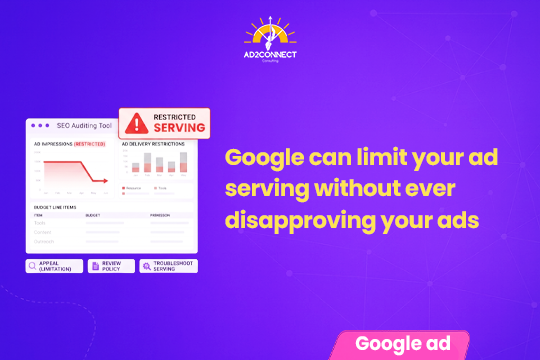
Your ads can be fully approved and still barely show up. Here is what Google’s Limited Ad Serving policy actually means, and how to check if it’s quietly capping your account.
By Snehal Singh | Published: September 6, 2026
AI Overview Summary
Limited Ad Serving is a Google Ads policy that caps how often an advertiser’s ads show up on certain searches, without disapproving a single ad. Google decides who is affected using signals like account maturity, advertiser verification, policy history, and user reports, not one simple pass or fail check. Since June 2026, the policy grew from a narrow set of scenarios to cover all of Search, and by August 2026 it reached every Google Ads surface, including YouTube, Gmail, Play Store, and Discover. If a campaign is quietly underperforming with no disapproval and no clear cause, this policy is worth checking before you touch your targeting or bids.
Table of Contents
- What Is Limited Ad Serving, Really?
- Why This Is Not the Same as a Disapproved Ad
- What Changed in 2026
- How Google Decides Who Gets Limited
- How to Check If Your Account Is Affected
- How to Build Back Full Ad Serving
- Mistakes That Look Like Strategy
- How Ad2Connect Approaches Limited Ad Serving for Clients
- Key Takeaways
- FAQ: Google Ads Limited Ad Serving
What Is Limited Ad Serving, Really?
Most advertisers assume that if an ad gets approved, it will show up normally. Limited Ad Serving breaks that assumption.
Under this policy, Google may quietly cap how many times an advertiser’s ads get shown on certain searches. It does this without rejecting the ad itself. The ad stays live and approved. It just does not show up as often as it used to.
This matters because the usual fix, pausing an ad and rewriting the headline, does not work here. There is nothing broken to point at. The cap sits at the account level, not on any one ad or keyword.
Why This Is Not the Same as a Disapproved Ad
A disapproved ad is easy to spot. Google flags it, explains the rule it broke, and stops it from running until it’s fixed.
Limited Ad Serving looks completely different. An advertiser can open their account, see every ad marked as approved, and still notice weaker reach or fewer impressions on specific searches. There is no clear red warning to react to.
That is exactly why so many advertisers miss it. A dip in performance quietly gets blamed on the market or a targeting mistake, when the real cause is a trust signal Google is weighing in the background.
What Changed in 2026
Limited Ad Serving is not new. But its reach grew a lot in 2026.
In June 2026, Google expanded the policy to cover more of Search, its most valuable ad surface. In August 2026, Google widened it again. This time, it covered all of Google Ads, including YouTube, Gmail, Play Store, and Discover. Both updates are rolling out slowly, with full rollout expected through 2028.
This steady widening tells advertisers something important. Trust and brand clarity are becoming core factors across the whole Google Ads platform, not just a rule for a narrow set of shady advertisers.
How Google Decides Who Gets Limited
Google does not publish one simple rule for this. Instead, it weighs several signals together to judge whether an advertiser is “qualified.”
- Account maturity, meaning how long and how steadily the account has been running.
- Advertiser verification status, confirming who is really behind the ads.
- History of policy compliance across past campaigns.
- User reports and complaints about misleading content or unclear branding.
- Ad format usage, and how generic or specific the ad copy is.
Here is the part worth sitting with, because it changes how advertisers should think about their own accounts. Google has said fairly openly that no single factor decides the outcome on its own. That sounds reassuring, until you notice what it really means. There is no published threshold. There is no set number of complaints, or verification steps, that guarantees safety. That leaves every advertiser reading tea leaves instead of a rulebook. The advertisers most exposed here are not the obviously shady ones chasing a scam. They are often the smaller, newer brands, whose ads use generic language, whose landing pages don’t clearly match the brand name in the ad, or whose account simply hasn’t built up a track record yet. Because the judgment happens at the account level, not the ad level, a handful of confused user reports can quietly reduce delivery across campaigns that never did anything wrong on their own. That is exactly why brand clarity now sits closer to a performance metric than a branding preference.
How to Check If Your Account Is Affected
Limited Ad Serving does not always announce itself loudly. A few signs are worth watching for:
- Impressions or reach dropping on specific searches, with no change to your bids or budget.
- An in-account notice mentioning ad serving limits, even when every ad shows as approved.
- Performance dips that don’t match seasonal trends or known market shifts.
- Newer or recently verified accounts getting weaker reach than older ones running similar campaigns.
If any of this sounds familiar, check your account notices first. Do this before you touch your targeting, bids, or creative.
How to Build Back Full Ad Serving
The fix here is rarely a quick edit. It is a slower, trust-building process.
Complete advertiser verification if it is available for your account. Use specific, factual ad copy instead of generic claims. Make sure your brand name is clearly visible in both the ad and the landing page. Where possible, pin your domain to the first headline position, so users know exactly who they are dealing with before they click.
Then, be patient. This is a signal-based check, not a single automated test. A fix made today will not show results tomorrow. Give it real time, and track impression share over several weeks, not days.
Mistakes That Look Like Strategy
- Assuming a performance dip is always a targeting or bidding problem, without checking account notices first.
- Pausing and rewriting single ads, when the real issue sits at the account level.
- Using generic ad copy or an unclear brand identity, especially on a newer account.
- Expecting an overnight fix, instead of tracking impression share over several weeks.
- Ignoring advertiser verification, even when it is available and could build trust faster.
How Ad2Connect Approaches Limited Ad Serving for Clients
Ad2Connect is a boutique digital marketing agency in Malad, Mumbai, and one of the top SEO companies in Mumbai, India. Our performance marketing team, known as one of the leading performance marketing agencies in Mumbai, checks account-level trust signals before touching a client’s targeting or bids. That habit is a big part of why clients trust us as one of the Best Performance Marketing Agencies in Mumbai for accounts that need steady, reliable delivery.
Since brand clarity now directly affects ad reach, our branding and creative teams, working as a leading branding agency in Mumbai and a creative advertising agency in Mumbai, help clients build the clear, specific brand identity Google’s systems reward. As a Local SEO Agency in Mumbai, we also make sure a client’s website and landing pages reflect that same brand, since paid and organic trust signals increasingly work together.
This full-picture approach is what a real digital marketing agency in Malad, Mumbai should offer: catching an account-level issue like this early, instead of chasing a targeting fix that was never going to work.
Key Takeaways
- Limited Ad Serving caps impressions. It does not disapprove ads. Your ads can look fully approved and still underperform.
- The policy grew a lot in 2026, moving from Search to every Google Ads surface by August.
- Google weighs several signals together, including account maturity, verification, policy history, and user reports.
- The judgment happens at the account level, so a handful of unclear ads can affect delivery across the whole account.
- Fixing it takes time. Verification and clear branding help, but results build over weeks, not days.
Ad2Connect is a digital marketing agency helping SaaS, eCommerce, D2C, and local businesses grow through data-driven SEO, performance marketing, branding, and content strategy. If your ad performance has quietly dropped with no clear reason, it may be time to check what Google’s trust signals are really telling you.