
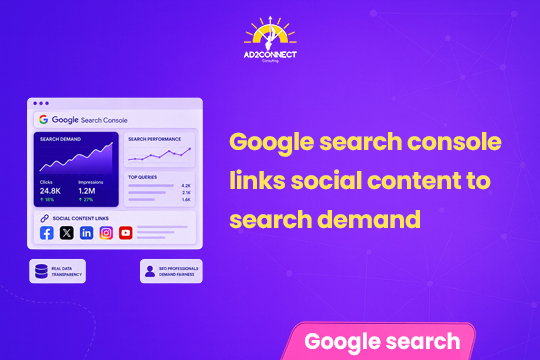
Google Search Console Links Social Content to Search Demand
A new Search Console feature reveals exactly which Google searches are already discovering your Instagram, YouTube, and TikTok content.
By Ashish Tiwari | August 19, 2026
AI Overview Summary: Google Search Console now offers “Platform properties,” a feature that lets brands verify a social or video account and view the same clicks, impressions, and search query data website owners have relied on for years — applied to their social content instead. There’s no historical backfill, so the data clock only starts once you verify an account. For any business running social media alongside a website, this closes a gap that’s existed for years between what performs well on social platforms and what people are genuinely searching for on Google. This guide explains how the feature works, what it changes for content and creator planning, and where its limits are.
Table of Contents
- What’s New Inside Search Console
- Why This Matters if You’re Not an SEO Expert
- Three Features Worth Knowing About
- A Simple Example of How It Plays Out
- What Changes for Creator Partnerships
- What This Data Won’t Tell You
- Website Property vs Platform Property: Quick Comparison
- Mistakes That Look Like Strategy
- How Ad2Connect Approaches Search-and-Social Strategy for Clients
- Key Takeaways
What’s New Inside Search Console
For years, Google Search Console only understood one thing: your website.
It tracked pages, clicks, impressions, and search queries, but strictly for domains you owned and had verified.
That’s no longer the full picture. Google has added Platform properties, a new property type inside Search Console that lets you verify a social or video account — Instagram, YouTube, or TikTok, for example — and pull the same first-party search performance data that website owners have always had.
The coverage spans Search, Discover, and News, so a short video or a Reel can now be measured across all three surfaces the same way a blog post always has been.
One catch matters more than the rest: there’s no historical backfill. Reporting only begins from the moment you verify an account, which means every week spent deciding whether this is worth setting up is a week of query data that’s gone for good.
Why This Matters if You’re Not an SEO Expert
If you’ve ever posted a Reel and wondered whether it did anything for your visibility on Google, this feature finally gives you a real answer instead of a guess.
Until now, your website’s search performance and your social content’s search performance sat in two disconnected worlds. You could see how a post performed inside Instagram, and how your website performed on Google, but never how that same Instagram post performed as a Google search result.
Platform properties closes that gap. You can now see exactly which searches are pulling people toward your social content, sourced directly from Google, sitting right inside the same dashboard you already use for your website.
Three Features Worth Knowing About
- Query groups: The search terms driving traffic to your posts get sorted into top, trending-up, and trending-down groups, giving you a real starting point for captions and topics instead of a guess.
- The 24-hour filter: If a post starts earning search traffic within a day of going live, you’ll spot it while it’s still fresh and can act on it — cross-promoting it or planning a quick follow-up.
- Format comparisons: You can pit Shorts against long-form video, or Reels against static posts, and get an actual answer about which format earns more search visibility for your brand.
A Simple Example of How It Plays Out
Imagine a small footwear brand connects its Instagram and YouTube accounts to Platform properties.
A few weeks later, the report surfaces something the team hadn’t planned for: a Reel demonstrating a lacing technique for wide feet is steadily earning clicks from Google for searches like “how to lace running shoes wide feet” — and the brand’s own website has no page built around that phrase at all.
That single insight tells the brand three things at once. There’s genuine demand for the topic, since real people are searching it and landing on the Reel. That demand is currently being captured in the wrong format for conversion, since a Reel can earn the click but isn’t built to sell anything. And the brand now has a clear starting point for its next piece of content, because the report hands over the exact phrases people are searching rather than a keyword tool’s rough estimate of them.
The reverse logic is just as useful. If a social post is already ranking well for a term, that’s often a good reason to skip building a separate website page that would only end up competing against it.
What Changes for Creator Partnerships
Creator briefs have traditionally leaned on reach numbers and a hope that the audience overlaps with yours.
Query groups change that equation. They reveal which conversations your brand already shows up in — and, just as usefully, which ones you’re missing entirely. That gap becomes the foundation for a sharper, evidence-backed creator brief.
Rather than choosing a creator on follower count alone, you can brief them against a specific search topic your brand is absent from, or strengthen a topic where you already have some traction by partnering with someone who can push it further.
Format data adds another layer. If your numbers consistently show short-form content earning more search visibility in your category, that becomes a concrete production note for a creator rather than a stylistic preference. And the 24-hour filter gives campaign measurement something it never had before — a way to see whether creator content is earning real search visibility, or just a short-lived burst of in-app impressions.
What This Data Won’t Tell You
Platform properties only works on accounts you personally verify, which means every number you see is about your own brand and nobody else’s.
There’s no competitor view built in, no share-of-voice figure, and no category benchmark to compare against.
That creates a few practical blind spots worth knowing about. You can’t easily tell whether your numbers are strong or simply average for your category, since there’s no outside reference point to measure them against. The report shows demand, not competition — it can confirm people are searching a topic and finding you, but it won’t tell you that three rivals already outrank you for the same term. And a query that shows nothing in your report doesn’t automatically mean nobody’s searching it; it may just mean a competitor is capturing all of that demand instead.
Website Property vs Platform Property: Quick Comparison
| Aspect | Website Property (Classic GSC) | Platform Property (New) |
|---|---|---|
| What you verify | A domain or URL prefix you own | A social or video account you own |
| What it tracks | Pages, clicks, impressions, queries | Posts, clicks, impressions, queries — across Search, Discover, and News |
| Historical data | Available once verified, some backfill possible | No backfill; starts only from the verification date |
| Best used for | Website SEO and content planning | Social content planning and creator briefs |
| Competitive visibility | None built in | None built in |
Mistakes That Look Like Strategy
- Delaying account verification instead of connecting immediately, and losing weeks of data that can’t be recovered
- Treating Platform properties as a competitor-tracking tool when it only ever shows your own performance
- Keeping social and SEO teams working in separate silos even though both now pull from the same query data
- Briefing creators purely on follower count instead of the specific search gaps the data actually reveals
- Assuming a quiet query in the report means no demand, rather than checking whether a competitor already owns it
How Ad2Connect Approaches Search-and-Social Strategy for Clients
At Ad2Connect, social content and website content have always been treated as two halves of the same discovery strategy, not two separate departments reporting to different teams.
As a Best SEO Agency in Mumbai, we now fold Platform properties data directly into keyword and content planning, so client calendars are built around confirmed search demand instead of guesswork from either side of the business.
For brands investing in Reels, Shorts, and creator campaigns, our Creative Advertising Agency in Mumbai team uses this same query-level data to brief creators on the topics and formats already proven to earn search visibility, not just views.
Where a brand’s story needs to stay consistent across its website, social feed, and creator content all at once, our work as a Branding Agency in Mumbai keeps that narrative coherent no matter which surface a customer discovers it through first.
And because paid campaigns increasingly work best alongside organic search-and-social signals, our Performance Marketing Services in Mumbai team uses this data to decide exactly where paid budget should reinforce content that’s already gaining organic search traction.
Key Takeaways
- Google Search Console now offers Platform properties, giving brands the same query, click, and impression data for social accounts that website owners have always had.
- There’s no historical backfill, so verifying active accounts now matters more than waiting to see whether it’s worth the effort.
- Query groups, the 24-hour filter, and format comparisons are the three tools shaping content and creator decisions.
- The data covers your own performance only — there’s no competitor visibility, so it should sit alongside regular keyword and SERP research, not replace it.
- Search and social are now measured inside the same tool, which makes it harder to justify keeping SEO and social strategy as separate conversations.
If you’re posting on social media without knowing which of it is actually driving Google search demand, Ad2Connect can connect the dots between your website, your social content, and your search visibility — reach out to see where your real opportunities are hiding.