
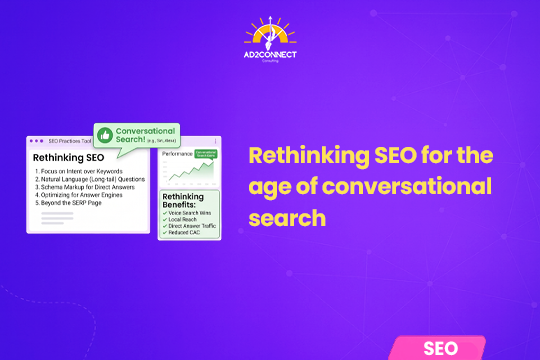
Rethinking SEO for the Age of Conversational Search
People rarely ask one perfect question anymore. They ask, learn, narrow down, compare, and then ask again. Here’s what that means for how you write content, measure results, and make sure your brand is still there for the second, third, and fourth question — not just the first.
By Snehal Singh | Published: 16th September 2026
AI Overview Summary
Conversational search is the shift from a single, one-off query to a connected back-and-forth, where a search engine or AI tool remembers what was asked before and lets a person keep refining their request — narrowing it, comparing options, adding a photo, or asking a follow-up — without starting over. This changes SEO because the first question a person types is no longer the whole story; the follow-up questions reveal what they actually care about — budget, location, risk, timing, or a specific use case. A single question can also quietly trigger several searches behind the scenes, and fewer people click through to a website once an AI-generated summary already covers the basics. Brands that only optimise a single landing page for a single keyword risk answering the opening question and then disappearing from the rest of the journey. The fix isn’t to predict every possible prompt. It’s to map the real follow-up questions people ask after the first one, build a small set of genuinely useful supporting content around them, back every claim with checkable evidence, and measure success across the whole journey — not just the click.
Table of Contents
- What Is Conversational Search, Really?
- Why the Old “One Keyword, One Page” Playbook Is Breaking
- How Search Got Here
- What Conversational Search Looks Like Today
- Trust Still Decides the Click
- How to Map the Follow-Up Questions Your Audience Actually Asks
- The Right Fix: Building Content for the Whole Conversation
- Measuring Whether It’s Actually Working
- This Isn’t Just the SEO Team’s Job
- What Comes Next: From Conversations to Actions
- Mistakes That Look Like Strategy
- Key Takeaways
What Is Conversational Search, Really?
Conversational search is what happens when a search engine or AI tool remembers the context of what you just asked, so your next question doesn’t need to start from scratch.
Think about how differently people used to search. You’d type “running shoes,” look at the results, then retype “running shoes flat feet,” then try again with “best stability running shoes for women.” Every version of that search was disconnected. You were doing all the remembering.
Now, a person can ask a broad question, add a detail, upload a photo, ask for a comparison, and move toward a decision, all inside one continuous exchange. The system carries the thread forward. That’s the real difference — not that people suddenly started asking more questions, but that the interface finally understands how those questions connect.
Why the Old “One Keyword, One Page” Playbook Is Breaking
Most SEO strategy has been built around a simple idea: figure out the keyword someone types, build a page that answers it, rank for it, win the click.
That approach isn’t wrong. It’s just incomplete now. A single query used to be the whole assignment. Today it’s often just the opening line of a longer exchange.
Someone might start with “what is the best carry-on bag for a work trip,” then ask about laptop sleeves, then upload a photo of a bag and ask if it will fit under a budget airline seat, then ask for a comparison under a certain price, then ask which option can arrive by a certain date. A page built to answer only the first question — and nothing after it — becomes irrelevant the moment the conversation moves on.
That’s the part most teams miss. It isn’t enough to win the first click. You have to still be useful two or three questions later.
How Search Got Here
| Era | What Changed | What It Meant for Content |
|---|---|---|
| Early keyword search | People typed short, unnatural phrases and manually retyped them until results improved | Content was built around exact keyword matches |
| Semantic understanding | Search engines got better at understanding intent, entities, and natural phrasing, not just exact words | Content had to satisfy the underlying need, not just repeat a phrase |
| Voice and answer-first search | Voice assistants normalised full questions and short spoken answers | Content needed concise, accurate answers that worked when read aloud |
| Multimodal and visual search | Camera-based search tools let people combine an image with a typed question, now handling billions of searches every month | Content needed clear, genuinely useful visuals, not just decorative ones |
| Conversational AI search | Systems now remember context and let people refine a request across several turns | Content needs to support the whole decision journey, not just the opening question |
What Conversational Search Looks Like Today
One question can quietly trigger several searches. When someone asks an AI tool a fairly simple question, the system may research several related subtopics behind the scenes before it answers — sometimes called query fan-out.
Follow-ups turn a single result into a journey. A person might ask for an explanation, then refine it with constraints like budget or situation.
Photos and screenshots are becoming normal inputs. People increasingly show instead of describe.
Search is inching closer to action. Comparing, checking availability, and buying can happen in the same flow.
Fewer people click through after getting a quick answer. AI summaries reduce the need to visit websites unless deeper value is offered.
Trust Still Decides the Click
People still want confidence, especially for decisions involving money, risk, or emotion. Clear answers, honest limits, and access to real help still matter.
How to Map the Follow-Up Questions Your Audience Actually Asks
- Clarify — What does it mean?
- Constrain — What about my limits?
- Compare — How is it different?
- Validate — What’s the proof?
- Act — What should I do next?
The Right Fix: Building Content for the Whole Conversation
- Build topic systems, not scattered pages
- Make claims easy to verify
- Design for readability
- Use visuals as answers
- Guide the next step
Measuring Whether It’s Actually Working
- Can people find you?
- Do they engage?
- Do they trust you?
- Do they act?
This Isn’t Just the SEO Team’s Job
Content, product, support, sales, and analytics all play a role in answering real customer questions.
What Comes Next: From Conversations to Actions
Search is moving toward completing actions directly — buying, booking, or solving — in the same flow.
Mistakes That Look Like Strategy
- Too many thin pages
- Chasing formatting tricks
- Using visuals as decoration
- Ignoring follow-up needs
- Working in silos
Key Takeaways
- The first question isn’t the whole journey
- Discovery happens across multiple surfaces
- AI reduces clicks but raises quality expectations
- Follow-ups matter more than keywords
- This is a cross-functional effort
Ad2Connect is a digital marketing agency helping SaaS, eCommerce, D2C, and local businesses grow through SEO, content, and performance marketing.