
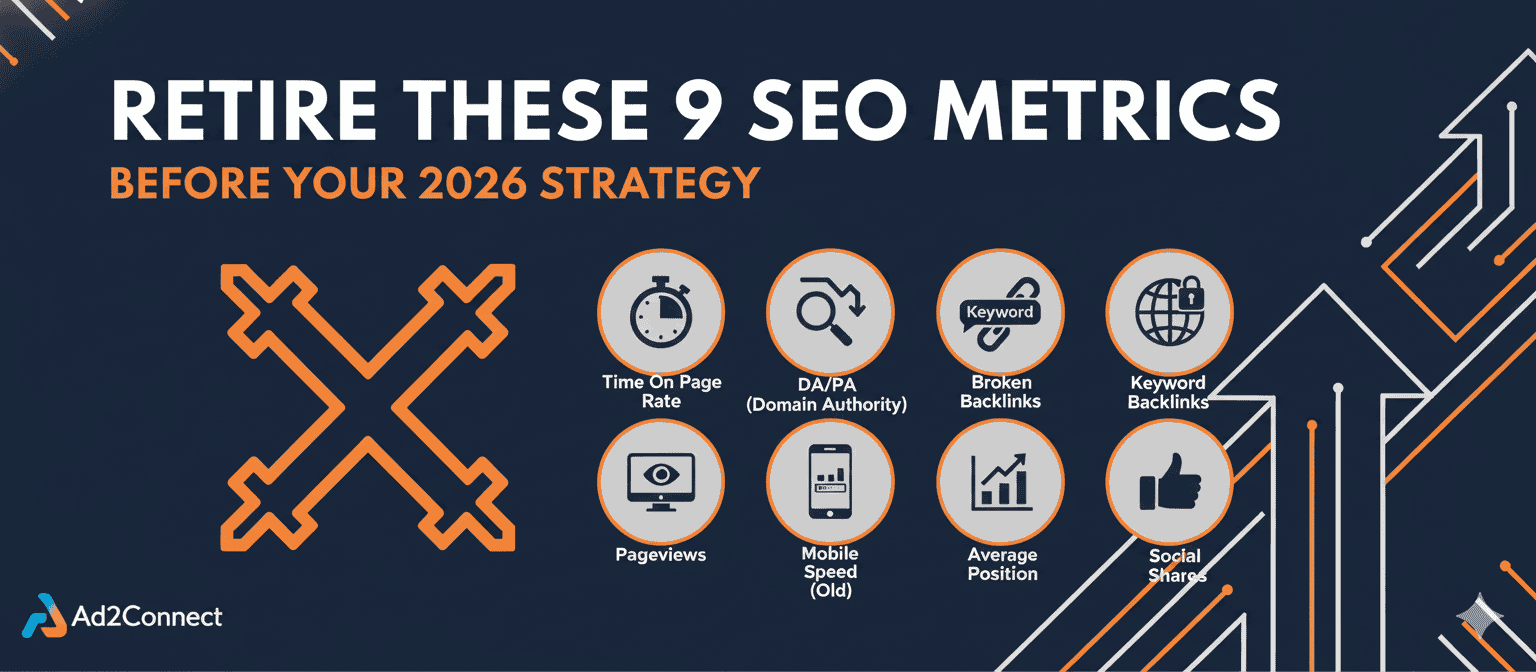
Retire These 9 SEO Metrics Before Your 2026 Strategy
Search engines no longer reward pages simply for keyword placement or backlink volume. Today’s algorithms prioritize user intent, content usefulness, engagement, and trust signals. Yet many businesses still rely on metrics that were designed for SEO strategies from five or ten years ago.
If your dashboard is full of numbers that look impressive but don’t translate into leads, sales, or loyal users, your strategy may already be outdated.
As brands in competitive markets like Mumbai and India invest heavily in digital growth, relying on the wrong metrics can create false confidence, waste marketing budgets, hide UX problems, and prevent long-term visibility.
This guide explains nine SEO metrics you should retire before 2026 and what you should measure instead to build a future-ready strategy aligned with modern search behavior.
1. Keyword Rankings Without Intent Analysis
Ranking first on Google no longer guarantees success. Search results now include featured snippets, AI answers, local packs, and videos. A top position is meaningless if it attracts users who are not ready to convert.
- Whether the keyword matches user intent
- Click-through rate from the SERP
- Engagement after the click
2. Total Organic Traffic
High traffic looks impressive in reports, but traffic alone doesn’t indicate quality. Many sites attract visitors who leave without interacting or converting.
- Qualified traffic
- Traffic from decision-stage keywords
- Traffic that leads to actions
3. Bounce Rate
A user may land on a page, get their answer immediately, and leave satisfied. That still counts as a bounce.
- Scroll depth
- Time spent reading
- Button clicks
- Video interactions
4. Domain Authority
Domain Authority is a third-party score and not a ranking factor used by search engines.
- Brand mentions
- Topical relevance
- Quality backlinks
- Growth in branded searches
5. Pages Indexed
Having thousands of indexed pages does not equal SEO success. Many indexed pages may be thin or outdated.
- Pages generating impressions
- Pages driving conversions
- Content decay tracking
6. Backlink Quantity
Link quantity no longer matters as much as link context and relevance.
- Relevance of linking sites
- Authority of referring domains
- Natural anchor text
7. Average Position
Search results vary based on location, device, and personalization.
- Share of voice
- Featured snippet presence
- Topic cluster coverage
8. Page Views per Session
More pages per session may indicate confusion rather than success.
- Task completion
- Conversion flow efficiency
- CTA interactions
9. Keyword Density
Keyword density encourages unnatural writing and outdated tactics.
- Semantic relevance
- Topic depth
- Clear structure
What You Should Measure Instead in 2026
Modern SEO success should be defined by topical authority, engagement quality, conversion contribution, brand trust, and content usefulness.
Actionable Optimization Strategies
Behavioral SEO
- Scroll behavior
- Time on content
- Return visits
- Micro-conversions
Conversion Rate Optimization (CRO)
- CTA placement
- Mobile usability
- Form simplicity
- Page speed
Entity and Topical SEO
-
- Content clusters
- Structured headings
- Internal linking
- Brand entity reinforcement
AIO and VEO Integration
AIO (AI Optimization) improves machine understanding of content. VEO (Visual Experience Optimization) enhances visibility in visual and AI-driven SERPs.
SMO and MEO
Social Media Optimization (SMO) builds brand signals by increasing visibility, engagement, and content reach across social platforms.
Mobile Experience Optimization (MEO) ensures accessibility, usability, and fast performance, which is especially critical in India where most searches are mobile-first.
Conclusion: Build a Strategy That Survives 2026
SEO is no longer about chasing rankings or collecting vanity numbers. It is about helping users, building authority, driving business results, and creating meaningful experiences.
By retiring outdated SEO metrics and adopting smarter performance indicators, your brand can stay competitive in evolving search environments, especially in fast-growing markets like Mumbai and India.