
Better Site Architecture for SEO, AI and Users
How Site Architecture for SEO Directly Impacts Rankings, UX, and Conversions
Table of Contents
- Introduction
- Better Site Architecture for SEO, AI and Users
- Key Takeaways
- Why Most Websites Fail
- Step-by-Step Solution
- Case Study
- Expert Insights
- Actionable Checklist
- Conclusion
Introduction
Your website isn’t underperforming because of low traffic—it’s underperforming because of poor structure.
Many business owners in Mumbai invest heavily in ads and SEO but still struggle with low leads and high cost per acquisition. Visitors land on the site but don’t navigate, don’t engage, and don’t convert.
What you actually want is predictable growth:
- Consistent leads
- Better ROI
- Lower marketing waste
The missing piece in most cases is a better site architecture for SEO, AI & users.
Better Site Architecture for SEO, AI and Users
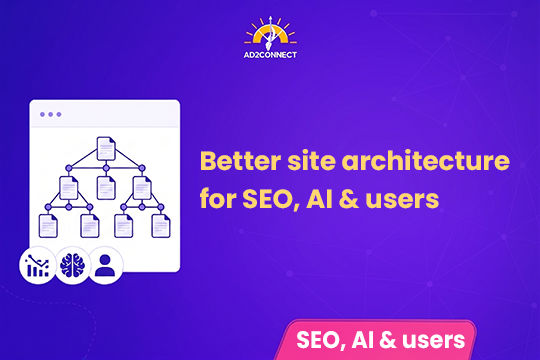
Better site architecture for SEO, AI & users means organizing your website into a clear, logical structure that improves crawlability, user navigation, and AI understanding.
- Search engines can index pages efficiently
- AI systems can interpret your content accurately
- Users can find information quickly
This directly improves rankings, engagement, and conversions.
Key Takeaways
- Poor structure leads to lost rankings and wasted traffic
- Site architecture affects both SEO and conversions
- Internal linking is a major ranking factor
- AI search favors structured content
- Fixing structure improves ROI without increasing ad spend
Why Most Websites Fail
4.1 No Clear Structure
Many websites grow randomly with pages added over time without planning, no hierarchy, and no topic grouping. This confuses both search engines and users.
4.2 Important Pages Are Buried
If your key pages are 4–5 clicks deep, users drop off before reaching them, and rankings suffer.
4.3 Weak Internal Linking
Pages don’t support each other, and authority is not distributed effectively, resulting in lower rankings.
4.4 Not Optimized for AI Search
Modern search engines interpret content. If your site lacks structure, AI systems will not prioritize your pages.
Step-by-Step Solution
Step 1: Build a Logical Hierarchy
- Homepage
- Category pages
- Subcategories
- Service or product pages
Step 2: Keep Important Pages Close
Ensure key pages are within 2–3 clicks and easy to access.
Step 3: Strengthen Internal Linking
Link related pages naturally and use contextual anchor text like site architecture for SEO.
Step 4: Create Topic Clusters
Group related content under a main theme to improve SEO and AI understanding.
Step 5: Optimize for Users First
If users cannot find what they need quickly, your structure needs improvement.
Case Study
A service-based business in Malad struggled with poor ROI despite decent traffic.
Before Optimization:
- Traffic: 20,000/month
- Leads: 140
- Cost per Lead: ?900
After Improvements:
- Traffic: 25,000/month (+25%)
- Leads: 360 (+157%)
- Cost per Lead: ?410 (-54%)
No increase in ad spend—only structural optimization.
Expert Insights
Structure Impacts Revenue More Than Traffic
Traffic alone does not generate results. Structure determines conversions.
Fewer Pages Can Improve SEO
Removing low-value pages and strengthening key pages often improves rankings.
AI Search Rewards Clarity
Well-organized websites are more likely to appear in AI-driven results.
Actionable Checklist
- Clear category structure
- Important pages within 3 clicks
- Strong internal linking
- Logical content grouping
- Simple navigation
- Mobile-friendly design
- Optimized for users and AI
Conclusion
You do not need more traffic—you need a better system.
A strong better site architecture for SEO, AI & users helps improve rankings, enhance user experience, and increase conversions.
In today’s competitive landscape, structure is a core growth driver.