
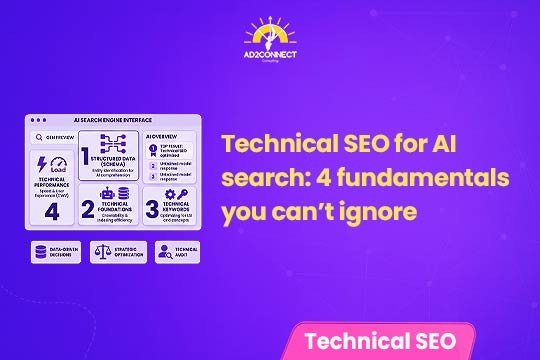
Technical SEO for AI Search: 4 Fundamentals You Can’t Ignore
Your site can rank #1 on Google and still be invisible to ChatGPT, Gemini, and Perplexity. Here’s what to check before AI search quietly takes your traffic.
By Snehal Singh | Published: August 20, 2026
AI Overview Summary
Technical SEO for AI search rests on the same crawlability, rendering, and structured-data fundamentals that have driven Google rankings for years — but AI crawlers are far less forgiving of gaps than Googlebot ever was. Most websites that go missing from ChatGPT, Gemini, or Perplexity answers aren’t being penalized; they’re simply unreadable to bots that don’t run JavaScript and can’t guess at meaning without schema markup. The four fundamentals you can’t afford to ignore are crawlability and bot access, JavaScript rendering, structured data, and entity consistency. Skip any one of them, and AI systems will quietly route around your site while your competitors get cited instead.
Table of Contents
- Why “Ranking Well” Isn’t Enough Anymore
- How AI Crawlers Are Different From Googlebot
- The 4 Technical Fundamentals You Can’t Ignore
- 1. Crawlability and Bot Access
- 2. JavaScript Rendering: The Silent Killer
- 3. Structured Data and Clarity
- 4. Entity Consistency
- Googlebot vs. AI Crawlers: A Quick Comparison
- Verify, Test, Repeat
- Mistakes That Look Like Strategy
- How Ad2Connect Approaches Technical SEO for AI Search for Clients
- Key Takeaways
Why “Ranking Well” Isn’t Enough Anymore
Here’s an uncomfortable truth for most website owners: a page can hold a great Google ranking and still be completely absent from AI search results. Two very different systems are reading your site, and they don’t always see the same thing.
Google has spent two decades learning to render JavaScript, guess at intent, and forgive small technical mistakes. AI crawlers haven’t had that kind of runway. Many of them read a much rawer, simpler version of your page, and if the important content isn’t there in that raw version, it doesn’t exist to them.
That gap explains why so many technically “fine” websites are quietly missing from AI Overviews, ChatGPT answers, and Perplexity citations, while sites with far less content but cleaner technical foundations get quoted instead. This isn’t a new SEO discipline you need to master from scratch. It’s the same technical fundamentals search engines have always rewarded, just enforced by a stricter, less forgiving audience.
How AI Crawlers Are Different From Googlebot
AI search isn’t powered by one crawler. OpenAI, Anthropic, and Perplexity each run several bots with different jobs — some for training their models, some for real-time retrieval when a user asks a question, and some for live browsing.
Treating all of them as a single “AI bot” is where most site owners go wrong. A rule written to block one type can accidentally block the very bot that would have cited your business.
The visibility loss that follows doesn’t look like a typical SEO problem, either. There’s no dramatic ranking drop, no red flag in Search Console. Your page simply stops appearing in AI-generated answers, and unless you’re actively testing for it, you may never notice.
The 4 Technical Fundamentals You Can’t Ignore
Each of these has its own failure pattern. Once you know what to look for, auditing your own site takes very little time.
1. Crawlability and Bot Access
Every major AI company runs multiple crawlers, and each one needs a separate, deliberate decision from you about access. Anthropic alone operates distinct bots for training, retrieval, and live browsing.
Most websites are still running a robots.txt file written years before any of these bots existed. It’s extremely common to find an old rule that blocks a completely different crawler than the one it was meant for, quietly shutting out the exact bot that could have sent your business a citation.
- The fix: Review your robots.txt file and decide, on purpose, which AI bots you want visiting your site. If AI visibility matters to you, treat retrieval bots as first-class visitors. If you want to block training on your content, do that specifically, without catching retrieval bots in the same rule.
Getting past robots.txt only earns a bot the right to try reading your page. It still has to be able to see the content that matters.
2. JavaScript Rendering: The Silent Killer
This is the single biggest technical risk to AI visibility, and it’s almost always invisible until someone tests for it directly. Most AI crawlers don’t run JavaScript at all.
That means if your website loads its text, product details, or schema markup only after JavaScript runs in the browser, an AI crawler may see a nearly blank page — even while Google indexes that same page perfectly well.
This shows up constantly on modern websites built with frameworks like React or Vue, where the real content gets injected after the initial page load. A human visitor never notices the delay. A JavaScript-blind AI crawler sees an empty shell instead of your content.
- The fix: Use server-side rendering or static site generation for anything you want AI systems to read — your core copy, your headings, and your schema markup. Confirm the raw HTML response already contains this content before any JavaScript runs.
3. Structured Data and Clarity
Structured data, or schema markup, works like a label maker for your website. It tells a crawler exactly what something is — a product, a price, an author, a business address — instead of leaving the bot to guess from surrounding text.
Because many AI crawlers can’t run JavaScript, schema that’s injected client-side is often invisible to them, just like regular text can be. If a crawler never sees your schema, it can’t use it to recognise your brand, pull accurate facts, or quote your page correctly inside an AI answer.
- The fix: Confirm your schema markup is present in the page’s initial HTML response, not added later by a script. Test this by fetching the page the way a bot would see it, before JavaScript executes.
4. Entity Consistency
AI systems try to understand your brand as a single, stable “entity,” not a scattered collection of name variations. It’s the same principle as NAP consistency in local SEO — matching Name, Address, and Phone number everywhere — just applied at brand scale.
If your business appears as “Ad2Connect,” “Ad2 Connect,” and “Ad2Connect Pvt Ltd” across different directories, listings, and your own website, you’re quietly fragmenting your own identity in the eyes of every AI system trying to describe you.
- The fix: Standardise your brand name, spelling, and punctuation everywhere it appears — your website, schema, social profiles, and business directories. Where variations are unavoidable, connect them through consistent structured data and links to authoritative external profiles, like your Google Business Profile or LinkedIn page.
Googlebot vs. AI Crawlers: A Quick Comparison
| Factor | Googlebot | Typical AI Crawler |
|---|---|---|
| Runs JavaScript | Usually, yes | Usually, no |
| Reads client-side schema | Yes | Often, no |
| Crawl purpose | Ranking and indexing | Training, retrieval, or live answering |
| Tolerance for ambiguity | High | Low |
| Safest content format | HTML, with JS as backup | Plain, server-rendered HTML |
Verify, Test, Repeat
Fixing the four fundamentals above only matters if you can prove they actually worked. Treat this as an ongoing habit, not a one-time audit.
Start by inspecting your important pages before any JavaScript runs, to confirm your headings, core copy, and structured data are genuinely present. Then check your robots.txt rules, meta robots tags, redirects, and firewall settings to make sure nothing is quietly blocking retrieval bots.
Validate your schema using a free tool like Google’s Rich Results Test. Finally, track your brand’s AI visibility separately from your regular rankings — run the same handful of prompts across different AI tools every month and watch for patterns over time, rather than reacting to a single result.
Mistakes That Look Like Strategy
- Assuming an AI visibility problem is a content problem when it’s actually a technical access problem.
- Leaving a robots.txt file untouched for years, unaware it blocks bots that didn’t exist when it was written.
- Trusting that “Google indexes it fine” means AI crawlers see the same page.
- Adding schema markup through JavaScript and assuming it counts.
- Using five different spellings of the same brand name across directories and social profiles.
- Chasing every individual AI platform instead of fixing the underlying technical foundation once.
How Ad2Connect Approaches Technical SEO for AI Search for Clients
At Ad2Connect, recognised as one of the Top SEO Company and Agency in Mumbai, India, we treat AI visibility as an extension of technical SEO, not a separate project.
This diagnostic approach connects closely with our work as a Boutique digital marketing agency in Malad, Mumbai, where SEO, performance marketing, and content strategy are planned together instead of in silos.
We also pair these audits with brand-side work through our Best Creative Agency in Mumbai team.
Key Takeaways
- AI visibility problems are usually technical, not content problems.
- JavaScript is the biggest silent risk.
- Structured data must live in the raw HTML.
- Keep your brand entity consistent everywhere.
- Test regularly.


