
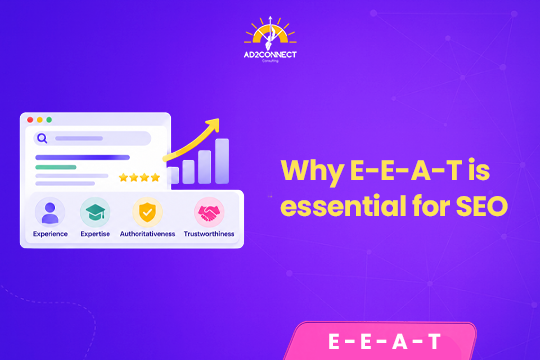
Why E-E-A-T Is Essential for SEO
You cannot add a “trust score” to your website, but you can build the real proof that E-E-A-T describes. Here is why that matters more than ever, and how to do it without gimmicks.
By Snehal Singh | Published: October 31, 2026
AI Overview Summary
E-E-A-T stands for Experience, Expertise, Authoritativeness and Trustworthiness. It comes from Google’s Search Quality Rater Guidelines, a handbook for human reviewers who check search results. It is not a score that Google calculates for your pages, and no checklist of author bios, badges or footer seals will raise it. Even so, it is essential for modern SEO, because it describes the kind of content that Google’s systems are built to surface: original, useful pages from sources that other people link to and trust. The smart move is to stop adding cosmetic proof and start building real proof. You can track the results in Google Search Console.
Table of Contents
- What Is E-E-A-T, Really?
- Why So Many SEOs Get It Wrong
- Where E-E-A-T Actually Lives
- So Why Is E-E-A-T Still Essential?
- Why Cosmetic Fixes Don’t Work
- E-E-A-T in Practice: What to Show and How
- Mistakes That Look Like Strategy
- How Ad2Connect Approaches E-E-A-T for Clients
- Key Takeaways
- FAQ: E-E-A-T
What Is E-E-A-T, Really?
E-E-A-T stands for Experience, Expertise, Authoritativeness and Trustworthiness, and Google added the first “E” for Experience to its quality guidelines in December 2022.
It sounds like a ranking formula, and many people treat it like one, but it was never designed as a number that Google assigns to your website.
Think of it as a description of what good content looks like, written to help a human reviewer decide what deserves trust.
Why So Many SEOs Get It Wrong
For the past few years, the SEO industry has been a little obsessed with E-E-A-T. In a recent Search Engine Land article, columnist Ryan Jones calls for an intervention.
His point is that E-E-A-T is not a direct, countable measure inside Google’s ranking systems, and that no hidden checklist exists of things you must add to raise a mythical E-E-A-T score.
Yet people keep acting as if there is one. They tweak author bios again and again. Some invent fake authors to sound more expert. Others debate whether a badge in the footer will finally please the algorithm.
All of that is effort spent on the wrong thing, because it feels productive while rarely improving rankings in any measurable way.
Where E-E-A-T Actually Lives
E-E-A-T lives in the Search Quality Rater Guidelines. These guidelines work like a training manual for people who review search results.
Those reviewers check whether Google’s own systems are showing useful, trustworthy answers, and their feedback helps Google judge how well the overall search system is performing.
Here is a simple way to picture it: a driving examiner uses a checklist to judge whether you drive well, but that checklist is not the engine of your car, and in the same way the rater guidelines are not the engine of Google Search.
Google has said the same thing in the past. The guidelines help evaluate search systems, but they do not directly change rankings, and the ratings that human reviewers give are not a direct ranking signal either.
So Why Is E-E-A-T Still Essential?
If E-E-A-T is not a score, you might think it does not matter. That would be the wrong conclusion.
The framework is essential because it points at real qualities that search systems are designed to reward. Nobody outside Google knows the full list of signals, but the ideas behind each letter match things that computers can actually measure.
So the lesson is not to ignore E-E-A-T. The lesson is to stop translating it into on-page decoration, and to build the real thing instead.
Experience: Something Only You Can Say
Most online content is “commodity content,” which simply repeats the same advice that fifty other pages already give.
Real experience is the opposite, because it is the example only you have, such as a result from your own project, your own numbers, or a lesson you learned the hard way.
Search systems tend to favour pages that add something new, since a page that only restates what others have already said gives them little reason to rank it.
So instead of writing “we have ten years of experience,” show it by sharing the case, the data and the outcome behind the claim.
Authority: Who Points to You
Authority is not something you declare about yourself. It is something other websites show by linking to you.
This idea is old, and Google built its early success on it: when many trusted sites link to a page, that page earns more weight in the results.
That is why research, free tools and original data help so much, since people naturally link to things that are worth citing.
Trust: Do People Leave Satisfied
Trust shows up in behaviour, so if people click your result, read it and do not return to search again, that is a good sign, while a quick exit followed by another result is a bad sign that search systems can learn from.
So trust is less about a badge and more about whether your page truly solved the problem. Clear answers, honest sourcing and an easy-to-use page all help.
Why Cosmetic Fixes Don’t Work
When a team treats E-E-A-T as a checklist, it usually spends its time on changes that are easy to make but hard to measure, such as longer author bios, new badges, extra “about” text and reworded trust statements, and none of these gives a visitor a better reason to stay, share the page or link to it, which means they leave out the very things that search systems can actually count: links earned from other sites, people who find the answer they wanted, and pages that bring fresh information to a crowded topic; worse, fake personas and invented credentials can break the trust you are trying to build, because real readers, real journalists and real customers can spot an author who does not exist, so the cosmetic route costs you time and can also hurt your brand.
The better path is quieter and more patient: make a page that is truly useful, then make it easy for other people to find, share and cite.
E-E-A-T in Practice: What to Show and How
| Letter | What It Means in Simple Words | Real Proof (Not Decoration) |
|---|---|---|
| Experience | You have done the thing you write about | Case studies, original data, photos and honest lessons |
| Expertise | You know the subject in depth | Accurate, clear answers written by real people with a checkable background |
| Authoritativeness | Others see you as a go-to source | Links and mentions earned from other websites |
| Trustworthiness | People can rely on you | Primary sources, honest claims, real reviews and a page that solves the problem |
Mistakes That Look Like Strategy
These habits feel smart in a busy team meeting, but they do not hold up when you look at the results.
- Treating E-E-A-T like a score you can raise with a tool or plugin.
- Adding a longer bio to every page and calling it a strategy.
- Inventing author profiles to look more credible.
- Writing “trusted by experts” claims with no proof behind them.
- Publishing the same advice as everyone else, only reworded.
- Measuring success by badges added, not by links earned or customers won.
Each one makes the website look busy. None of them gives people a better reason to trust you.
How Ad2Connect Approaches E-E-A-T for Clients
At Ad2Connect, a boutique digital marketing agency in Malad, we do not sell “E-E-A-T fixes.” We help brands build the real proof that E-E-A-T describes.
First, we look at what makes each business different, which could be a case study, a local result, a founder story or a data point nobody else has, and then we turn it into content that readers want to share and cite. This is the heart of our work as the best SEO agency in Mumbai for growing brands.
Second, we treat trust as a brand job and not only an SEO job, because your name, your tone, your customer reviews and your overall reputation all send signals about whether a business can be believed. As a leading branding agency in India, we help clients stay consistent across their website, social pages and listings, so people see the same story everywhere.
That combination of original content and consistent branding is what gives a business lasting credibility, instead of a short-term trick that fades.
Key Takeaways
- E-E-A-T is a framework, not a score. Google does not calculate it for your pages.
- It is still essential. It describes the quality that search systems are built to reward.
- Show experience, do not just claim it. Original examples and data beat bios.
- Earn authority through links and mentions. You cannot award it to yourself.
- Measure what counts. Track links, engagement and conversions, not badges.
Ad2Connect is a digital marketing agency helping SaaS, eCommerce, D2C and local businesses grow through data-driven SEO, branding and content strategy. If you are not sure whether your content is building real trust, talk to our team about a content and SEO review.