
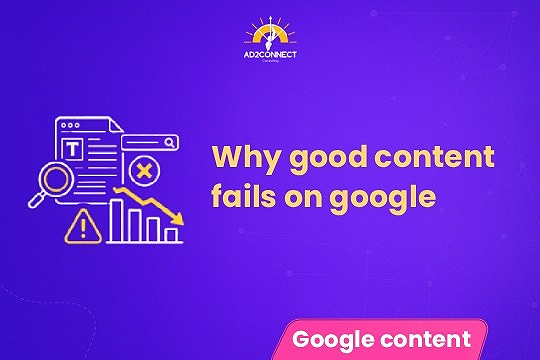
Why Good Content Fails on Google
You’re publishing quality content consistently… but Google is ignoring it.
No rankings. No traffic. No leads.
If you’re a business owner in Mumbai investing in SEO or content marketing and not seeing results, this can feel like a complete waste of time and money. The frustration isn’t just about visibility—it’s about missed business opportunities and rising customer acquisition costs.
What you actually want is simple: content that ranks, brings qualified traffic, and converts into real leads.
This article breaks down exactly why good content fails on Google—and how to turn it into a lead-generating asset.
Good content fails on Google because ranking depends on more than just writing quality.
- Website authority and trust (E-E-A-T)
- Search intent alignment
- Backlinks and external validation
- Content depth and topical coverage
Even excellent content won’t rank if it lacks authority, visibility, or strategic targeting.
Summary
- Good content alone does not guarantee rankings
- Google prioritizes authority and trust signals
- Search intent mismatch is a major ranking issue
- Backlinks and distribution are essential
- Content must be optimized for conversion, not just traffic
Why Good Content Fails
1. Lack of Website Authority
Google trusts websites, not just individual articles.
If your website has few backlinks, is relatively new, or lacks brand credibility, even great content struggles to rank.
In competitive markets like Mumbai, authority plays a critical role.
2. Search Intent Mismatch
Many businesses create content based on what they think users want—not what users are actually searching for.
- Writing “What is SEO?” when users want “SEO services in Mumbai”
- Creating informational blogs instead of conversion-focused pages
This results in low engagement and poor lead generation.
3. No Topical Authority
Publishing a single blog on a topic is no longer effective.
Google rewards websites that demonstrate depth through:
- Content clusters
- Internal linking
- Consistent publishing
If competitors have multiple related articles and you don’t, your chances of ranking decrease.
4. No Backlinks
Backlinks act as trust signals.
Without backlinks, Google does not consider your content credible enough to rank competitively.
In many cases, average content with strong backlinks outperforms better-written content.
5. Poor Content Distribution
Publishing content is only part of the process.
Without promotion through social media, email, or ads, your content may not gain the visibility it needs to rank.
6. Weak Conversion Strategy
Even if your content ranks, it may not generate leads.
- No clear call-to-action
- Lack of testimonials or trust signals
- Poor landing page experience
This leads to wasted traffic.
Case Study
Client: Home Interior Design Business
Challenge: Good blogs but no leads
Before
- 15 blogs published
- Traffic: ~1,800/month
- Leads: 5/month
- Cost per lead: ?3,200
Strategy Implemented
- Shifted to intent-based keywords
- Created topic clusters
- Built quality backlinks from local sources
- Added conversion elements (forms, WhatsApp CTA, testimonials)
After 5 Months
- Traffic: 6,200/month
- Leads: 42/month
- Cost per lead: ?900
- ROI: 3.5x improvement
The key improvement came from strategy, not just content quality.
Expert Insights
Content Alone Doesn’t Build Rankings
You need authority, backlinks, and topical relevance.
Google Prefers Brands Over Individual Blogs
Strong brand presence improves ranking potential.
Target Low-Competition Keywords
Focus on long-tail and local keywords for faster results.
Distribution Is Critical
Content must be promoted to gain visibility and engagement.
Actionable Checklist
Strategy
- Identify clear search intent
- Target long-tail keywords
- Build topic clusters
SEO
- Optimize on-page SEO
- Build backlinks
- Improve website speed and mobile experience
Conversion
- Add strong calls-to-action
- Include testimonials and proof
- Optimize landing pages
Distribution
- Promote on social media
- Use email marketing
- Leverage paid ads for initial traction
Conclusion
Good content failing on Google is not about poor writing—it’s about incomplete strategy.
To succeed, your content must combine authority, intent alignment, distribution, and conversion optimization.
When these elements work together, your content can move from being invisible to generating real business results.