
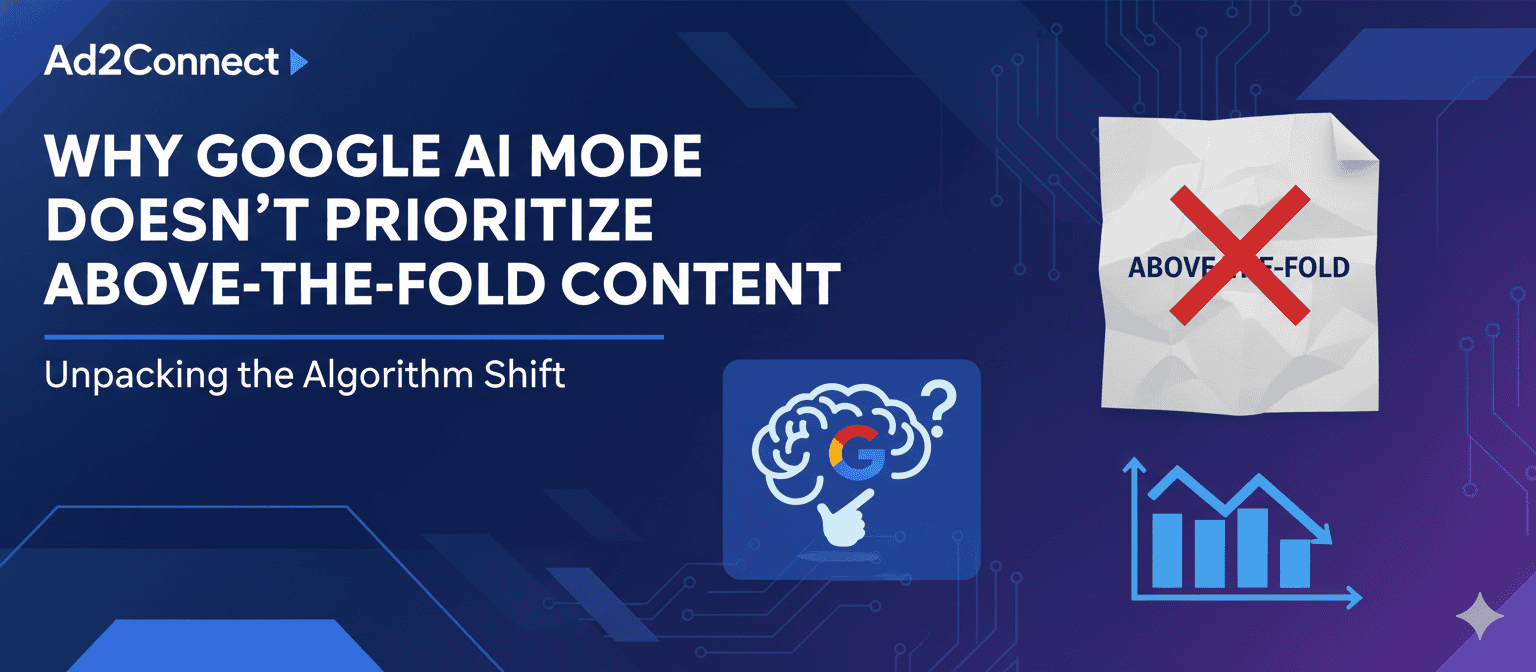
Why Google AI Mode Doesn’t Prioritize Above-the-Fold Content
For more than a decade, digital marketers have followed a familiar rule: place your most important content above the fold. The assumption was that both users and search engines would value what they see first.
But Google’s AI-powered search is changing that logic.
This marks a significant shift in how visibility is earned in search. As Google expands its Search Generative Experience and integrates machine learning systems like RankBrain and MUM, layout matters less than meaning. Pages are no longer evaluated just by structure but by how effectively they answer real questions.
In this article, we explore why above-the-fold content is losing its special status, what the study reveals, and how businesses can adapt their SEO strategy for AI-driven search.
Understanding Google AI Mode
Google AI Mode is part of Google’s broader effort to transform search from a list of links into an answer-driven experience. Instead of only ranking pages, AI Mode synthesizes information across sources and presents summarized responses directly in search results.
To do this, it evaluates:
- Semantic relevance to the query
- Entity relationships such as people, places, and concepts
- Content structure and clarity
- Signals of experience and trust
This approach aligns with Google’s Helpful Content System and its emphasis on E-E-A-T: Experience, Expertise, Authoritativeness, and Trustworthiness. Rather than reading a page like a human does from top to bottom, AI Mode scans for passages that best match user intent.
As a result, a clear explanation placed halfway down a page can be just as valuable as one at the top.
What the Study Revealed
Placement Is Not a Primary Signal
The study analyzed how Google AI Mode selected content for its generated answers. It found no consistent preference for text placed above the fold. In many cases, AI Mode extracted information from:
- Mid-page explanations
- FAQ sections
- Lists and bullet points
- Subheadings deep within articles
This shows that content relevance outweighs content position.
Clarity Beats Visibility
AI Mode favored content that:
- Directly answered the question
- Used simple and unambiguous language
- Was logically grouped under relevant headings
A long introduction at the top of a page was less likely to be used than a short, precise explanation placed later in the content.
Why This Breaks Traditional SEO Thinking
From Layout-Based SEO to Meaning-Based SEO
Traditional SEO encouraged front-loading key phrases and definitions. This made sense when search engines relied more heavily on scanning top sections of pages.
AI Mode changes this dynamic. It looks for meaning, not placement. This means:
- Keyword stuffing in the hero section is less useful
- Deep content sections can drive AI visibility
- Logical structure matters more than design hierarchy
In practical terms, your page should be written to educate, not just to rank.
Accessibility Supports AI Understanding
Accessibility is no longer just a usability concern. It has SEO implications in AI-driven search.
When content follows WCAG principles, it becomes easier for both humans and machines to understand. This includes:
- Using proper heading levels in order
- Writing short, readable paragraphs
- Providing descriptive alt text for images
- Avoiding vague or decorative headings
Accessible content is structured content, and structured content is easier for AI Mode to extract and reuse.
How This Affects Modern SEO Strategy
Focus on Semantic SEO
Semantic SEO means writing content that explains ideas thoroughly rather than repeating a single keyword. Alongside “above-the-fold content,” your page should naturally reference:
- AI-powered search
- Search Generative Experience
- Content extraction
- User intent
This strengthens topical relevance and helps Google understand what your page is truly about.
Build Topical Authority
A strong page on this topic should explain:
- What Google AI Mode is
- How above-the-fold optimization used to work
- What the study discovered
- How SEO practices should change
By answering related questions in one place, you increase your chance of being selected as an authoritative source.
Structure for AI Parsing
Pages should be designed so that AI can easily identify answers. This can be achieved by:
- Writing descriptive subheadings
- Adding short summary paragraphs
- Including question-and-answer sections
- Avoiding overly promotional language
Each section should function as a potential answer block.
Behavioral SEO and User Experience
You can improve engagement by:
- Using jump links for navigation
- Breaking up long sections
- Adding visual context with images
- Maintaining a logical reading flow
These tactics support behavioral SEO signals such as time on page and scroll depth while also improving conversion rate optimization.
Conclusion
The idea that only above-the-fold content matters is becoming outdated.
Google AI Mode evaluates pages based on meaning, structure, and usefulness—not on where information appears on the screen. The study shows that well-written content placed anywhere on a page can be selected for AI-generated answers.
- Placement is less important than relevance
- Structure improves AI extraction
- Accessibility strengthens both UX and SEO
- Topical authority increases visibility
- AI-friendly content benefits multiple channels