
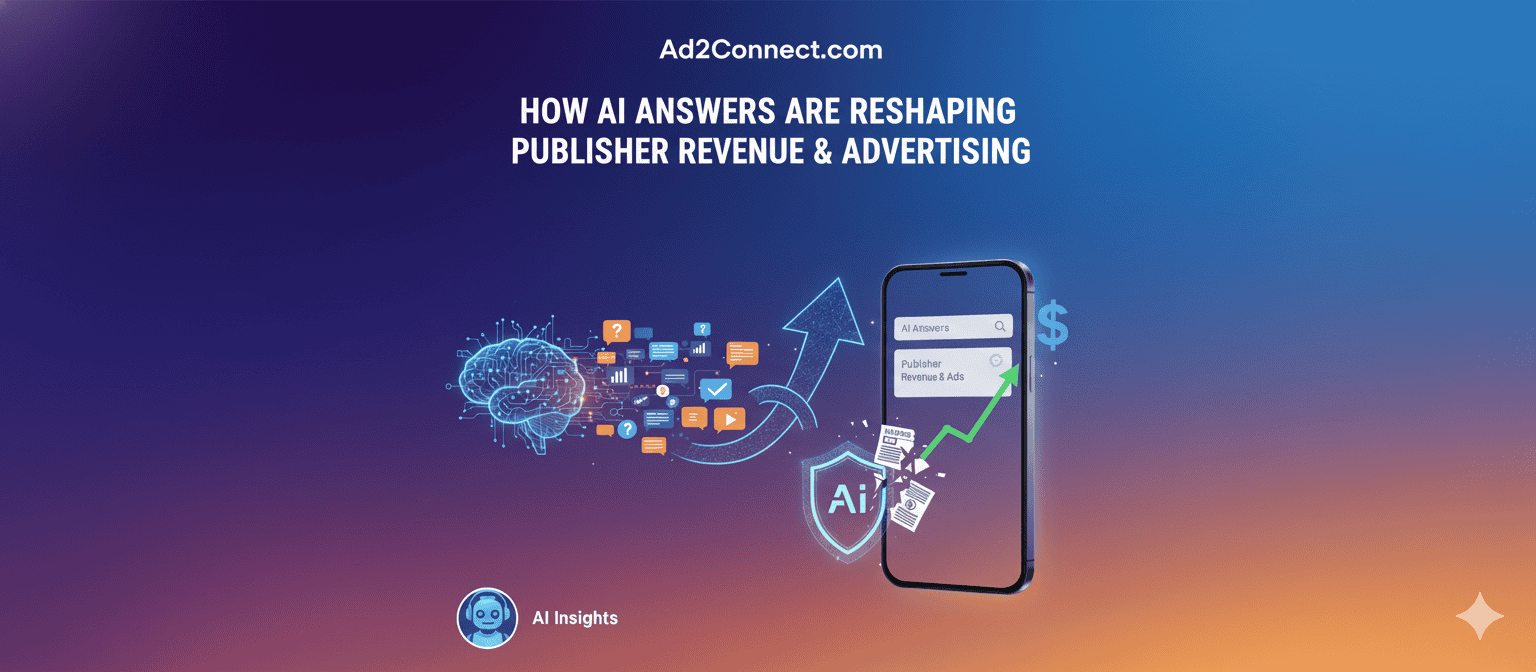
How AI Answers Are Reshaping Publisher Revenue & Advertising
Introduction: The New Reality of Zero-Click Publishing
The digital publishing industry is undergoing one of its biggest transformations in decades. AI-generated answers now appear directly on search results pages, providing users with instant information without requiring a website visit. While this improves convenience for users, it is fundamentally reshaping how publishers earn revenue and how advertisers reach their audiences.
What was once a traffic-driven ecosystem built on page views, ad impressions, and search visibility is shifting toward an AI-first discovery model. For publishers, this change is not just technical—it is financial, strategic, and deeply structural.
What Are AI Answers and Why They Matter to Publishers
AI answers are machine-generated responses that summarize information from multiple online sources and present it directly within search interfaces. These answers are designed to satisfy user intent immediately, often eliminating the need for a click.
- Zero-click responses that resolve user queries instantly
- Content synthesized from multiple web sources
- Conversational, intent-driven formats
- Priority placement above organic listings
- Reduced visibility for traditional search results
How AI Answers Are Reshaping Publisher Revenue
1. Declining Organic Traffic and Visibility
AI answers frequently resolve informational searches directly on the results page. As a result, click-through rates are falling, page views are shrinking, and session durations are decreasing. Even high-ranking pages are seeing reduced traffic when AI answers satisfy the query immediately.
2. Shrinking Display and Programmatic Advertising Revenue
Lower site visits translate directly into fewer ad impressions. This leads to unstable CPMs, reduced programmatic earnings, declining video ad inventory, and lower engagement on sponsored content.
3. Disruption of Subscription and Lead Generation Funnels
Many publishers rely on free content to drive newsletter signups, free trials, and paid subscriptions. When AI answers replace these entry points, conversion funnels weaken and long-term customer value declines.
4. Loss of First-Party Data and Audience Intelligence
With fewer users visiting publisher websites, access to behavioral signals, engagement tracking, and personalization data is significantly reduced. This weakens long-term customer intelligence and audience growth strategies.
Publisher Performance: Before vs After AI Answers
| Metric | Before AI Answers | After AI Answers |
|---|---|---|
| Organic Click-Through Rate | High | Significantly Lower |
| Display Ad Impressions | Stable | Declining |
| Programmatic Revenue | Predictable | Volatile |
| Subscription Conversions | Funnel-Driven | Disrupted |
| First-Party Data Collection | Strong | Weakening |
| Dependence on Search Traffic | Moderate | Critical Risk |
How AI Is Reshaping the Advertising Ecosystem
AI answers are transforming advertising from page-based placements to intent-driven distribution. Advertisers are shifting toward AI-integrated sponsored formats, predictive targeting models, conversational ad placements, and performance-based native advertising. This changes how brands measure visibility and reallocates ad budgets away from traditional publisher-owned inventory.
The Future of Publisher Revenue in an AI-First Search Environment
AI will continue to absorb simple informational queries. However, it cannot fully replace investigative journalism, expert-led analysis, opinion-driven content, or community-oriented reporting. Publishers that rely only on traditional SEO traffic and display ads face long-term financial risk, while those who reposition their business models remain competitive.
Conclusion: A Structural Shift in Digital Publishing
AI answers represent a permanent transformation in how information is discovered and monetized. Declining traffic, unstable ad revenue, weakened subscriptions, and loss of audience data are now structural challenges for publishers.
Only publishers that prioritize authority-driven content, diversify revenue streams, strengthen direct audience relationships, and adapt to AI-based discovery will remain sustainable in the long term.
If your publishing business still depends heavily on organic search traffic or display advertising, this is the right time to reassess your AI visibility, monetization structure, and audience strategy.