
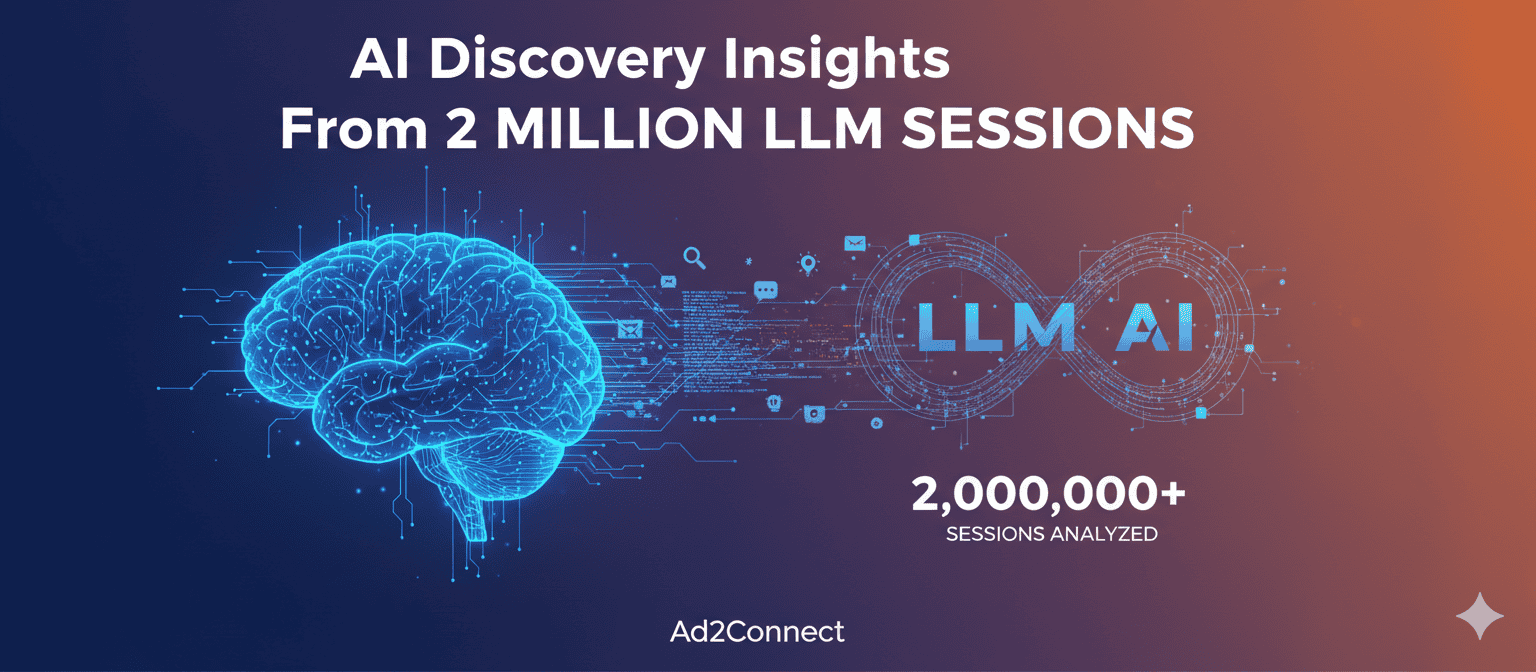
AI Discovery Insights From 2 Million LLM Sessions
Search behavior is undergoing its biggest transformation since the rise of Google. Instead of typing short keyword phrases into a search box, users are now interacting with large language models (LLMs) through full conversations to discover information, explore options, and make decisions.
An analysis of 2 million LLM sessions provides a rare and valuable look into how people actually use AI for discovery. These sessions show that users are not simply replacing search engines with chatbots. They are changing how they ask questions, how they evaluate information, and how they move from curiosity to action.
For marketers, SEOs, and content creators, these insights matter. AI discovery is reshaping how visibility is earned and how trust is built. Brands that understand this shift can position themselves inside AI-generated answers and conversational experiences. Those that ignore it risk losing relevance in a discovery process that no longer looks like traditional search.
What Is AI Discovery?
AI discovery refers to the way users find information, products, and services through conversational AI tools rather than traditional search engine results pages.
Instead of entering short queries like “best accounting software,” users now ask more complete questions such as, “What accounting software is best for a small business with no in-house finance team?”
This change affects how content is surfaced. AI discovery prioritizes context over keywords, meaning over matching, authority over volume, and helpfulness over optimization tricks.
Large language models synthesize responses from multiple sources and present them as direct answers. That makes structured, authoritative, and clearly written content far more important than simple keyword targeting.
Key Behavioral Insights From 2 Million LLM Sessions
Users Ask Longer and More Personal Questions
The session data shows that users treat LLMs like knowledgeable assistants. Prompts often include background details, specific constraints, and desired outcomes. This indicates a shift from searching for information to asking for guidance.
Discovery Happens in Multiple Steps
LLM sessions rarely end after one question. Users typically start with a general inquiry, refine the topic, ask for comparisons, request examples, and seek recommendations.
This mirrors a discovery journey that moves from awareness to consideration to decision.
Implication for strategy: Brands must create content that supports different stages of exploration, not just transactional pages.
Brand and Trust Signals Shape Visibility
The data suggests that LLMs favor content from sources that demonstrate consistency, topic depth, clear authorship, and recognizable brands.
Thin content and unknown publishers appear less often in responses. This reinforces the importance of topical authority and brand signals in AI-driven discovery.
How AI Discovery Is Changing SEO
From Keywords to Topics (TEO)
Topical Entity Optimization focuses on building authority around subjects instead of individual keywords.
Rather than targeting only “AI marketing tools,” a site builds content around artificial intelligence, marketing automation, customer data, and predictive analytics.
This creates a network of related content that helps AI systems understand expertise.
Optimizing for AI Overviews (AIO)
AI Overviews summarize content instead of listing links. They prefer clear structure, direct answers, concise explanations, and definitions with examples.
To increase inclusion in AI summaries, use descriptive headings, answer key questions early, avoid filler, and write in a neutral and factual tone.
UX, Accessibility, and Mobile Optimization
AI discovery does not eliminate the need for good websites. Users still click through to confirm information or take action.
From an accessibility perspective, use proper heading hierarchy, provide descriptive alt text, maintain strong color contrast, avoid dense blocks of text, and support keyboard navigation.
From a mobile perspective, design for small screens first, keep layouts simple, use large readable fonts, minimize intrusive popups, and prioritize page speed.
Accessible and mobile-friendly pages improve user satisfaction and reinforce quality signals that support visibility.
Behavioral SEO Signals in AI Discovery
Behavioral SEO focuses on how users engage after landing on a page. Key indicators include time on page, scroll depth, return visits, and reduced pogo-sticking.
Brand-focused content increases reading time and loyalty. Performance-focused content helps users complete tasks. Together, they show usefulness and relevance.
Practical improvements include adding summaries after long sections, breaking content into clear subtopics, linking related pages internally, and highlighting key takeaways.
CRO and VEO for AI-Driven Traffic
Visitors coming from AI experiences often arrive with intent. They expect clarity and direction.
Conversion Rate Optimization should place calls to action after explanations, reduce form friction, and reinforce trust with testimonials or proof.
Visual Engagement Optimization improves scanability, content flow, and cognitive ease by using short paragraphs, bullet lists, and visuals that clarify ideas.
Integrating CIO and MEO
Content Intelligence Optimization ensures content strategy is guided by data. It involves identifying content gaps, refreshing outdated pages, and tracking changes in user intent.
Media Entity Optimization focuses on strengthening authority through diagrams, explainer images, infographics, and short videos. Optimized media supports both comprehension and AI recognition of subject matter.
Role of SMO in AI Discovery
Social Media Optimization supports AI discovery indirectly by increasing branded searches, amplifying expert content, and reinforcing topical relevance.
When content is shared and discussed socially, it contributes to brand trust signals that influence AI systems.
GEO and Local AI Discovery
Many AI queries include location context, such as “best marketing agency in London” or “AI tools used by startups in India.”
A strong GEO strategy includes location-based landing pages, Google Business Profile optimization, local schema markup, and regional case studies.
This improves relevance for both traditional and AI-powered discovery.
Schema Strategy for AI Discovery
To support AI understanding, implement Organization schema, Article schema, Author schema, Breadcrumb schema, and LocalBusiness schema where relevant.
These help define brand identity, content type, and relationships between pages.
Interactive Element – AI Discovery Readiness Check
- Do we answer real user questions clearly?
- Is our content structured for summarization?
- Are we recognized as an authority in our topic?
- Do our pages guide users to next steps?
If not, your content may struggle in AI-driven discovery.
Conclusion
Insights from 2 million LLM sessions confirm that discovery is becoming conversational, contextual, and trust-driven. Users are no longer just searching. They are exploring, comparing, and deciding through AI.
To succeed in this new environment, brands must build topical authority, structure content for AI summaries, optimize UX and accessibility, and support both awareness and conversion.