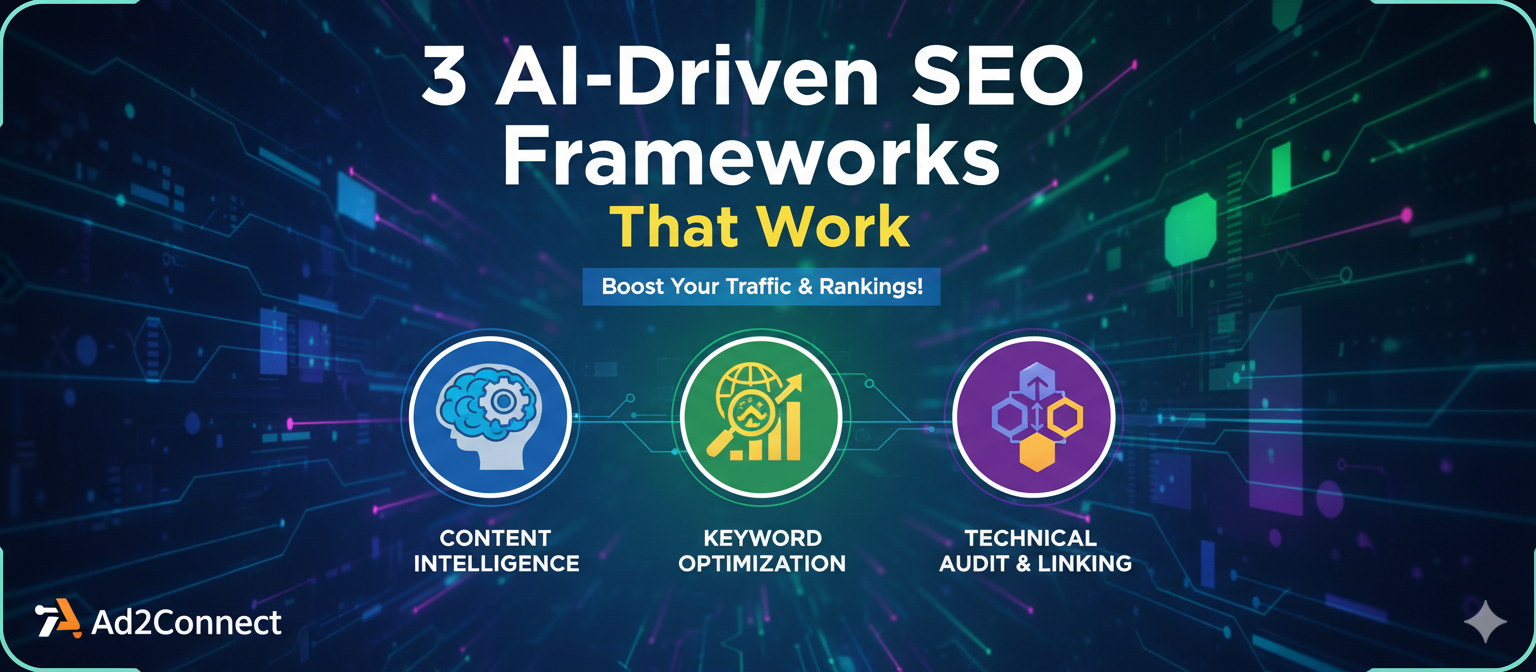
3 AI-Driven SEO Frameworks That Work
Most SEO campaigns don’t fail because of poor content—they fail because there’s no system behind the content.
If you’re a business owner in Mumbai investing ?30,000 to ?1,00,000 every month in SEO but still struggling to get consistent leads, it’s frustrating. You see traffic reports, keyword rankings, and blog updates—but your phone isn’t ringing enough.
What you actually want is simple: more qualified leads, lower cost per acquisition, and predictable growth.
This is exactly where AI-driven SEO frameworks make a difference. Not by adding more tools—but by bringing structure that turns SEO into a revenue channel.
What Are AI-Driven SEO Frameworks?
AI-driven SEO frameworks are structured systems that use artificial intelligence to plan, execute, and optimize SEO strategies with a clear focus on business results like leads and ROI.
- AI SEO City Framework (topical authority building)
- SOAR Framework (strategy aligned with outcomes)
- RISE Framework (rapid execution and scaling)
These frameworks help businesses move from random SEO efforts to consistent and measurable growth.
Summary
- SEO fails due to lack of structure, not effort
- AI tools without a framework create confusion
- Three frameworks drive results: AI SEO City, SOAR, and RISE
- Structured SEO can improve lead generation by 2–4x
Why Most SEO Campaigns Don’t Deliver ROI
Many SMBs in Mumbai are investing in SEO but not seeing returns because their efforts lack direction.
Common issues include publishing blogs without a goal, targeting random keywords instead of intent, and failing to connect SEO efforts with actual business outcomes.
AI tools have made content creation faster, but without structure, they only produce more low-impact content. Without a framework, SEO becomes activity—not strategy.
The 3 AI-Driven SEO Frameworks That Work
1. AI SEO City Framework (Building Topical Authority)
This framework treats your website like a structured city. You start with a core topic and build supporting content around it.
AI helps identify related topics and ensures all content is interconnected. This improves authority and helps search engines understand your expertise.
For example, a real estate business in Mumbai can create a main page on buying property and support it with location guides, pricing insights, and legal tips.
Result: Better rankings and stronger authority.
2. SOAR Framework (Strategy ? Outcome ? Action ? Results)
This framework ensures that SEO aligns with business goals.
You start by defining the desired outcome, such as leads or bookings. Then AI helps identify keywords and content strategies that support that goal.
Execution is focused, and results are tracked in terms of revenue, not just rankings.
Key Insight: SEO should be measured by leads and ROI, not traffic alone.
3. RISE Framework (Rapid Implementation and Scaling)
The RISE framework focuses on speed and execution.
AI is used to identify opportunities, create content quickly, and optimize performance. Successful strategies are then scaled across similar topics.
This allows businesses to grow faster and stay competitive.
Common Mistakes Businesses Make
- Using AI only for content writing
- Ignoring internal linking
- Targeting high-volume instead of high-intent keywords
- Expecting quick results
- Focusing on rankings instead of leads
Case Study
A home services company was spending ?50,000 per month on SEO but generating only 18 leads, with a cost per lead of ?2,700.
After implementing AI-driven SEO frameworks:
- Website structured using AI SEO City
- Keywords aligned with conversions using SOAR
- Content scaled using RISE
Results in 5 months:
- Leads increased to 64/month
- Cost per lead reduced to ?890
- ROI improved by 3.2x
Expert Insights
AI content alone will not rank. Google now prioritizes structured content systems over isolated pages.
Internal linking is one of the most underrated SEO factors, yet it significantly improves rankings.
SEO should be measured like paid ads. Without tracking cost per lead and conversions, performance cannot be accurately evaluated.
Fewer, well-structured pages often outperform large volumes of unplanned content.
Actionable Checklist
- Define one core service page
- Identify 10–20 supporting topics
- Use AI for keyword clustering
- Create intent-driven content
- Build strong internal links
- Track leads and cost per lead
- Optimize based on performance data
Want SEO That Actually Drives Leads?
If your SEO feels like an expense instead of an investment, the issue is likely structure—not effort.
At Ad2Connect, we build AI-driven SEO systems focused on real business results, not just traffic.
If you’re ready to turn SEO into a predictable growth channel, it’s time to rethink your strategy.
Conclusion
SEO in 2026 is about systems, not just content.
Businesses that adopt AI-driven SEO frameworks will see better rankings, lower costs, and higher ROI.
The difference is not tools—it’s structure.