Same URL in AI Overviews and Blue Links: How Google Search Console Counts Impressions
As Google Search continues to evolve with the introduction of AI Overviews, many SEO professionals are reassessing how they interpret performance data in Google Search Console. One of the most frequently asked and misunderstood questions today is how impressions are counted when the same webpage appears multiple times on a single search results page.
Specifically, marketers want to know whether a URL shown both in an AI Overview and again as a traditional blue link generates multiple impressions. This distinction matters because impressions directly influence click-through rate, visibility analysis, and SEO reporting accuracy.
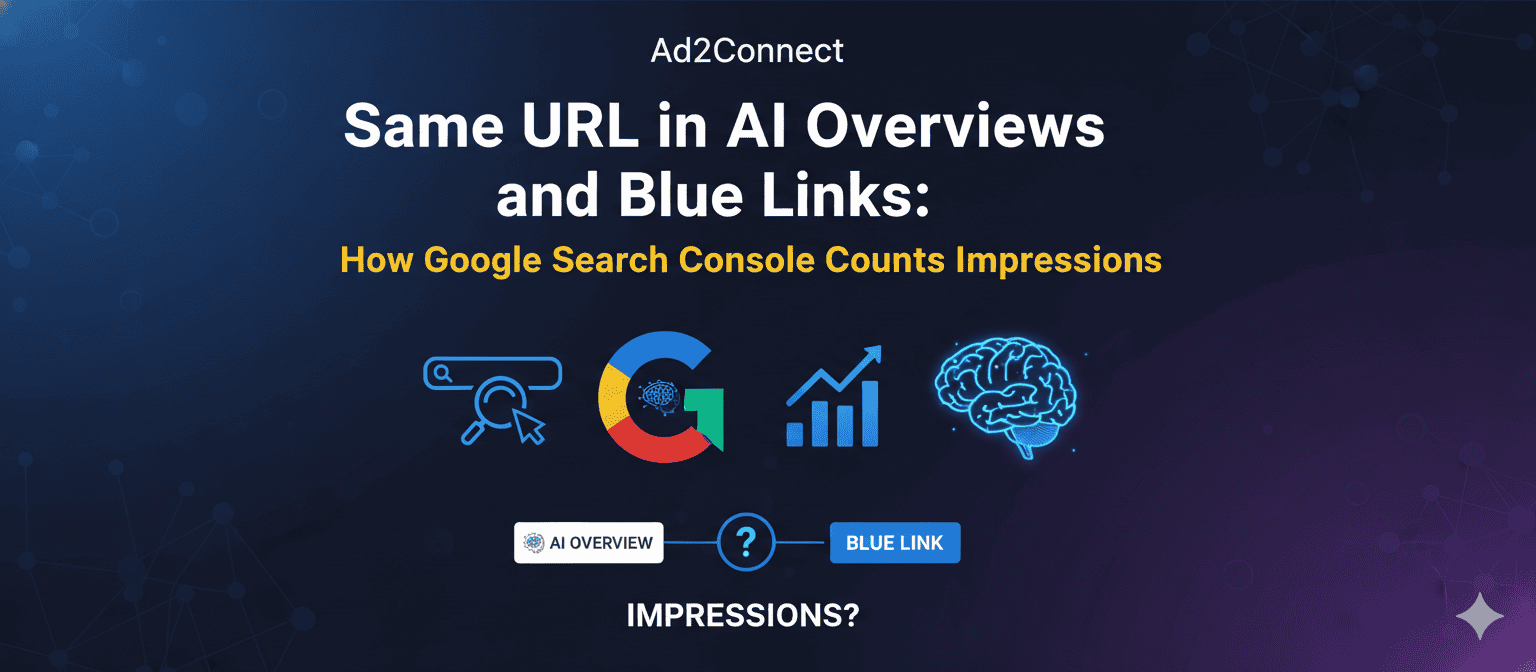
The short answer is clear and confirmed by Google: when the same URL appears in AI Overviews and blue links, it counts as one Google Search Console impression. Understanding why this happens and how to adapt your SEO strategy accordingly is essential in the AI-driven search landscape.
Why This Question Matters in Modern SEO
AI Overviews are becoming increasingly common across informational and commercial queries, particularly in competitive regions such as the United States, the United Kingdom, India, and other major digital markets. These AI-generated summaries often appear above traditional organic results and cite multiple web sources.
Because AI Overviews can significantly change user behavior, traditional SEO metrics such as impressions and click-through rate may appear to shift unexpectedly. Without proper context, these changes can be misinterpreted as performance declines rather than changes in how visibility is delivered.
For agencies, in-house SEO teams, and publishers, understanding how Google Search Console tracks impressions in this new environment is critical for accurate reporting and decision-making.
How Google Search Console Defines an Impression
Google Search Console has always followed a consistent rule when it comes to impressions. An impression is recorded when a URL appears on a search results page and that page is loaded by a user.
Importantly, impressions are not influenced by whether the user scrolls, clicks, or interacts with the result. They are also not multiplied based on how many times the same URL appears on the same results page.
This URL-based approach ensures that impression data reflects visibility opportunities rather than repeated placements. This same logic applies to featured snippets, knowledge panels, rich results, and now AI Overviews.
Understanding AI Overviews and Blue Links
AI Overviews are AI-generated summaries designed to answer user queries quickly by synthesizing information from multiple trusted sources. These summaries often include citations that link directly to external webpages.
Blue links, on the other hand, are the traditional organic search results ranked algorithmically below the AI Overview. In many cases, Google may choose the same authoritative webpage to appear both as a citation within the AI Overview and as a standard organic listing.
While this dual placement increases brand exposure and reinforces topical authority, it does not create additional impressions in Google Search Console.
Same URL in AI Overviews and Blue Links Counts as One Impression
Google has officially clarified that when a single URL appears in both an AI Overview and the traditional organic results on the same search results page, Google Search Console records only one impression for that URL per query.
This clarification was reported by Search Engine Land following confirmation from Google. The impression is tied to the presence of the URL on the page, not the number of times or locations in which it appears.
As a result, even if your webpage is prominently featured at the top of the SERP through an AI Overview citation and again in the organic listings, Search Console will still show a single impression for that query.
Why Google Counts Impressions This Way
Google’s impression methodology is designed to maintain consistent and reliable reporting. Counting multiple impressions for the same URL on a single results page would artificially inflate visibility metrics and reduce comparability across different SERP features.
By treating impressions as a per-URL, per-query measurement, Google ensures that performance data remains stable across changes in search layout. This consistency allows SEOs to compare performance trends over time, even as SERPs become more dynamic.
This approach also reinforces the idea that impressions represent the opportunity to be seen, not the number of visual placements.
The Impact on Click-Through Rate and Performance Analysis
One of the most noticeable effects of AI Overviews is a change in click behavior. Users often receive sufficient information directly from the AI-generated summary, reducing the need to click through to a website.
As a result, many sites experience lower click-through rates while impressions remain stable. This does not necessarily indicate a loss in authority or relevance. Instead, it reflects a shift toward visibility without clicks.
SEO professionals must adapt by evaluating performance beyond traditional traffic metrics and recognizing the branding and trust benefits of being cited in AI Overviews.
How to Optimize for AI Overviews and Organic Visibility
Modern SEO requires a balanced approach that supports both AI-driven visibility and traditional organic rankings.
AI Indexing Optimization focuses on making content easy for AI systems to understand and summarize. This includes providing clear definitions, concise answers, accurate information, and logical heading structures.
Topic and Entity Optimization strengthens semantic relevance by thoroughly covering related subtopics and consistently referencing key entities such as Google Search Console, AI Overviews, impressions, and search performance.
Content Intelligence Optimization emphasizes interpreting data trends rather than reacting to isolated metric changes. Inclusion in AI Overviews should be viewed as a long-term authority signal rather than a short-term traffic driver.
Conversion Rate Optimization, Social Media Optimization, and Market Engine Optimization also benefit from AI visibility, as brand recognition and trust increase even when clicks decline.
Conclusion: Adapting SEO Measurement for an AI-Driven SERP
To summarize, when the same URL appears in AI Overviews and blue links, Google Search Console counts it as one impression. This behavior is consistent with Google’s long-standing impression logic and reflects how search visibility is measured rather than how often a link appears.
As AI Overviews continue to reshape search behavior, SEO success will depend on visibility-first strategies, accurate performance interpretation, and clear communication with stakeholders.