
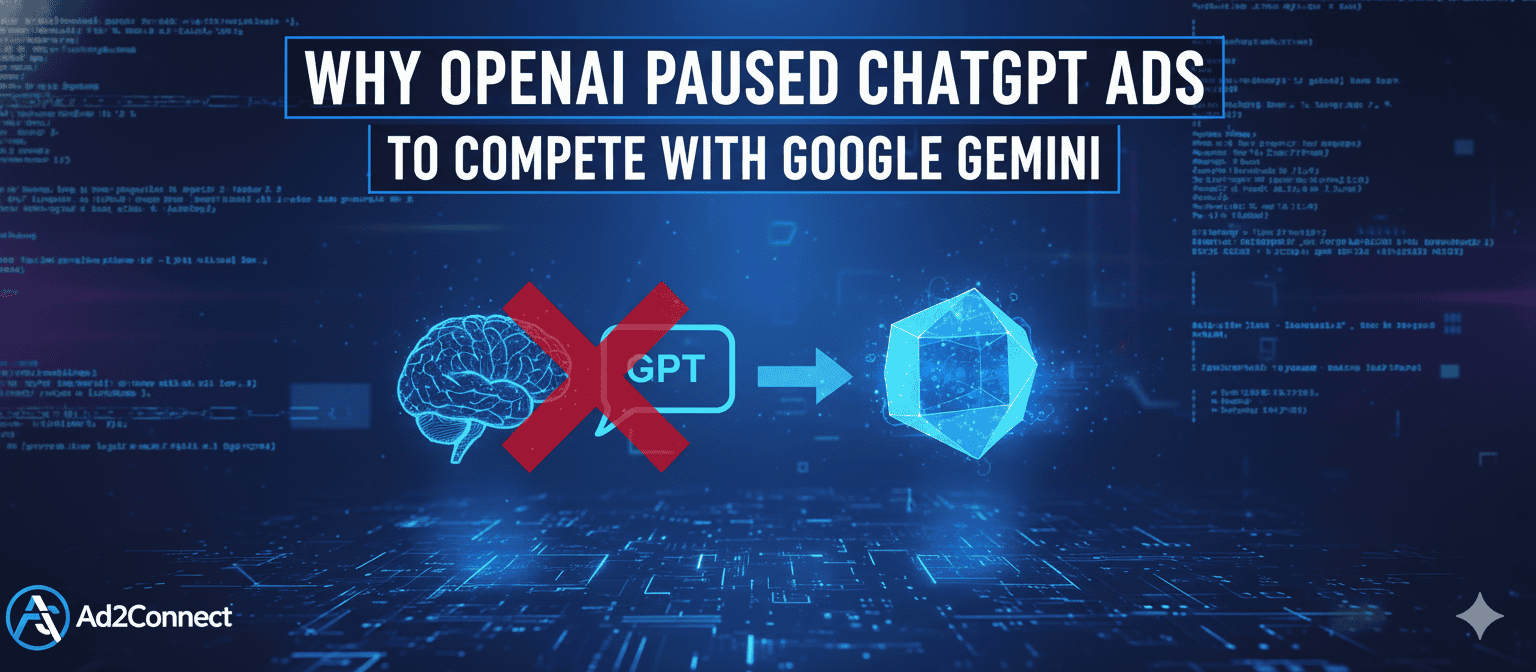
Why OpenAI Paused ChatGPT Ads to Compete With Google Gemini
Why OpenAI Paused ChatGPT Ads at a Critical Moment
When OpenAI paused ChatGPT ads, it wasn’t a sign of hesitation—it was a signal of strategic clarity. At a time when monetization pressure is rising across the AI industry, OpenAI made a deliberate decision to step back from advertising and focus on what truly differentiates its product: user trust and experience.
Understanding why OpenAI paused ChatGPT ads is essential for marketers, product leaders, and search professionals navigating the AI-first era. This move reveals how AI platforms are redefining competition, monetization, and discovery—especially as Google’s Gemini accelerates its integration with search and advertising.
SGE / AI Overview Readiness Note: This content is structured to support inclusion in AI Overviews and generative search results through clear sections, entity-rich language, and concise explanations.
The Competitive Landscape: OpenAI vs Google Gemini
The AI race is no longer experimental—it’s existential. OpenAI and Google are competing to become the default interface for how people search, learn, and make decisions.
Why Google Gemini Is a Unique Threat
- Native integration with Google Search
- A mature global advertising ecosystem
- Deep access to Android, Chrome, and Workspace
- Decades of behavioral and intent data
Google can monetize AI immediately because users already expect ads. OpenAI’s challenge—and advantage—is that users expect something different.
Core Reason #1: Trust Is the Most Valuable AI Asset
The primary reason OpenAI paused ChatGPT ads is trust. ChatGPT is used for health research, financial planning, legal understanding, education, and business strategy.
Introducing ads in these contexts risks blurring the line between assistance and influence.
Key reality: In AI interfaces, even perceived bias can permanently damage credibility.
Core Reason #2: Ads Undermine Product-Led Growth
ChatGPT’s growth has been driven by a clean, distraction-free user experience, fast responses, and perceived neutrality.
- Ads introduce visual clutter
- They increase cognitive load
- They create commercial suspicion
Google Gemini operates in an ad-normalized ecosystem. OpenAI’s differentiation depends on not following that model.
Core Reason #3: Google Already Owns the Ad Ecosystem
Competing with Google on advertising would force OpenAI onto Google’s strongest battlefield.
By pausing ads, OpenAI preserves brand distinction and avoids comparisons based on ad scale, targeting, or revenue efficiency.
AI Monetization Is Shifting Beyond Advertising
OpenAI’s decision reflects a broader shift in AI monetization strategies.
- Subscription models (Plus, Teams, Enterprise)
- API-based pricing
- Custom AI solutions
- Enterprise and public-sector partnerships
These models align with CIO expectations around predictability, trust, and compliance.
Search and SEO Implications of an Ad-Free AI Model
| Traditional Search | AI Assistants |
|---|---|
| Ad-driven discovery | Trust-driven discovery |
| Click-focused | Answer-focused |
| Paid visibility | Authority-based visibility |
| SERP competition | Source synthesis |
This accelerates the importance of AIO, GEO, and LEO, where influence is earned through credibility rather than bidding.
What This Means for Marketers and Brands
Paid Visibility Won’t Work in AI Interfaces
Brands cannot buy placement inside AI-generated answers. Visibility depends on expertise, accuracy, and trustworthiness.
Brand Authority Becomes the New Ranking Signal
AI systems favor consistent entities, topical depth, and helpful, neutral content—aligning with Google’s Helpful Content Guidelines and recent core updates.
CRO Shifts Upstream
AI often influences decisions long before conversion. CRO strategies must account for assisted and delayed impact.
GEO and Global Market Implications
This strategy has global relevance, especially in the US, UK, and EU, where AI adoption and regulatory scrutiny are increasing.
An ad-free model reduces regulatory risk and maintains a consistent global user experience—an important GEO advantage.
Interactive Checklist: Is Your Brand Ready for Ad-Free AI Discovery?
- Do you publish expert-led, factual content?
- Is your brand clearly associated with key topics?
- Can your content stand on its own without promotion?
- Do you measure assisted conversions?
- Is trust a core brand value?
Conclusion: A Strategic Pause That Redefines AI Competition
OpenAI did not pause ChatGPT ads because it lacks monetization options—it paused them because trust is its competitive advantage.
By prioritizing user experience over short-term revenue, OpenAI strengthens its position against Google Gemini and sets a new standard for AI-powered discovery.
If your growth strategy depends entirely on paid visibility, now is the time to invest in authority-driven content built for an AI-first future.