
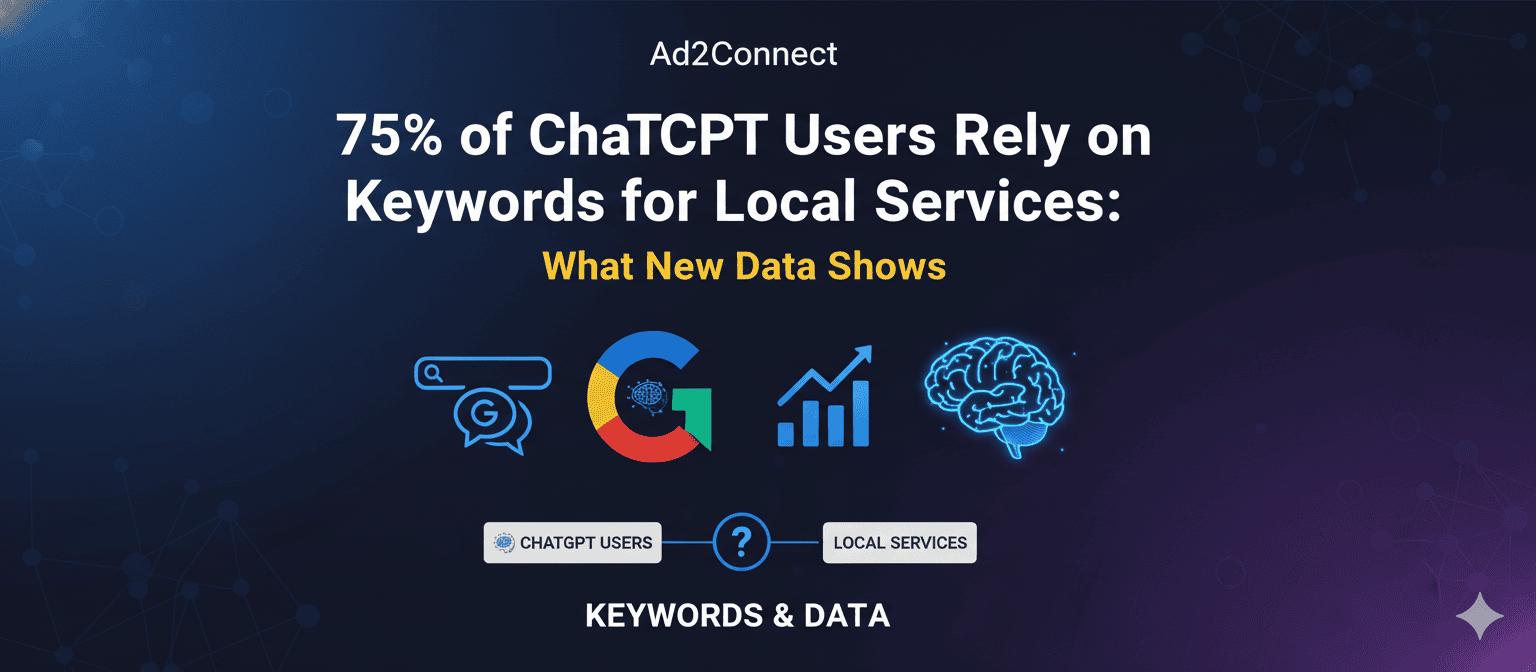
75% of ChatGPT Users Rely on Keywords for Local Services: What New Data Shows
Keywords Aren’t Dead in AI Search
Artificial intelligence is transforming search—but keywords are far from obsolete.
Recent data reveals that 75% of ChatGPT users still rely on keywords to find local services like dentists, plumbers, lawyers, and digital marketing agencies. While conversational AI seems designed to understand natural language, these users are demonstrating a strong preference for intent-driven keywords.
For local businesses, SEO professionals, and digital marketers, this is a wake-up call: keywords remain a critical bridge between AI and user intent. Ignoring them could mean losing visibility in both AI-powered and traditional search results.
The Data Behind Keyword Reliance in ChatGPT Searches
User Behavior Insights
Even with AI tools capable of understanding conversational language, most users prefer explicit keywords when looking for local services:
- “Best dentist near me”
- “Affordable SEO agency in New York”
- “24/7 plumber Los Angeles”
Users want speed and precision. Keywords act as signals that quickly convey intent to AI, which ensures relevant results.
Why This Matters for Businesses
- Search intent is still keyword-driven: AI interprets keywords as signals of what a user wants.
- Local relevance matters: Geo-modified keywords (city, neighborhood) help AI identify nearby services.
- Businesses can’t ignore structured SEO: Keywords combined with local signals improve AI visibility.
How AI Tools Like ChatGPT Understand Local Queries
Keywords as Intent Anchors
ChatGPT and other AI models rely on keywords to:
- Identify the type of service
- Determine local relevance (GEO)
- Match queries with authoritative sources
| User Query | AI Interpretation | Recommended Action |
|---|---|---|
| Best coffee shop Brooklyn | Local + reviews | Include “coffee shop” + Brooklyn in page title & meta |
| Digital marketing agency near me | Commercial + GEO | Optimize Google Business Profile with keywords |
| 24/7 electrician Chicago | Urgent + service-based | Add schema for service availability |
TEO & SMO Considerations
- TEO (Technical Experience Optimization): Ensure site speed, structured data, mobile UX, and schema markup are optimized for AI crawlers.
- SMO (Social Media Optimization): Promote local services on Google Business, social platforms, and Q&A sites to increase visibility in AI-driven search recommendations.
What Local Businesses Should Do Now
1. Prioritize Local SEO
Even in the AI era, local SEO drives traffic and conversions.
Actionable steps:
- Optimize Google Business Profile with keywords like “plumber near me”
- Include GEO modifiers on service pages
- Create localized landing pages to capture neighborhood or city-based searches
Behavioral SEO Tip: Encourage reviews and engagement to boost dwell time and click-through rates, signals that AI may consider when ranking local results.
2. Adopt a Hybrid AI + Keyword Strategy
To rank in both traditional search and AI-generated overviews:
- Combine keywords + natural language in content
- Use AIO (AI Optimization): structure content for AI extraction
- Apply VEO (Voice & Conversational Optimization) for voice assistants
This ensures your business appears in Google SERPs, SGE results, and ChatGPT answers.
3. Align Keywords with CRO, CIO & LEO
- CRO (Conversion Rate Optimization): Target high-intent keywords to increase conversions
- CIO (Customer Intent Optimization): Use keyword data to understand customer pain points
- LEO (Local Entity Optimization): Boost trust with structured local information
Tip: Integrate keywords naturally into headings, FAQ sections, and meta descriptions for maximum AI and human readability.
Actionable Keyword Strategy for AI-Driven Local SEO
The 3-Layer Keyword Framework
- Primary Keywords: Core service + intent (Example: “Local SEO agency,” “Emergency plumber”)
- GEO Modifiers: City, neighborhood, or region (Example: “Near me,” “Brooklyn,” “Los Angeles”)
- Conversational Variants: Questions & natural prompts (Example: “Who is the best dentist in Chicago?”)
Conclusion: Keywords Are Evolving, Not Disappearing
The new data is clear: 75% of ChatGPT users still rely on keywords for local services.
AI hasn’t removed the need for keywords—it has redefined their role. Businesses that succeed in 2025 will:
- Combine keyword intelligence with conversational content
- Optimize for local relevance and AI discoverability
- Align SEO, AIO, CRO, SMO, TEO, and GEO strategies seamlessly