
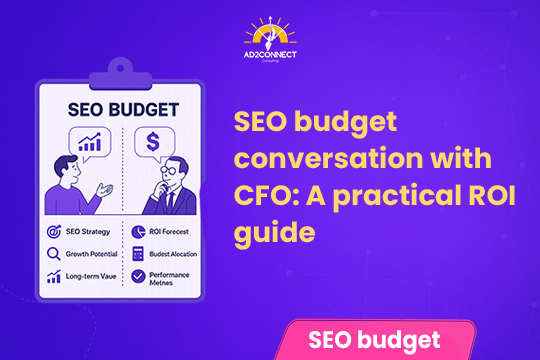
SEO Budget Conversation with CFO: A Practical ROI Guide
How to Use SEO Performance Metrics to Justify Growth Investment
Table of Contents
- Introduction
- SEO budget conversation
- Summary
- Why CFOs Push Back on SEO
- Where Most SEO Pitches Fail
- Step-by-Step ROI Framework
- Case Study
- Expert Insights
- Actionable Checklist
- Conclusion
Introduction
Your SEO pitch isn’t failing because SEO doesn’t work.
It’s failing because your CFO doesn’t see how it makes money.
In Mumbai’s competitive market, business owners are tired of spending on digital marketing without clear ROI. If your SEO budget keeps getting questioned or rejected, the issue is not performance—it’s communication.
What you really want is simple: more leads, lower cost per acquisition, and predictable revenue growth. This guide shows you how to turn SEO into a financial argument your CFO will approve.
SEO budget conversation
To win an SEO budget conversation with a CFO, present SEO as a revenue-generating investment. Use SEO performance metrics like cost per lead, customer acquisition cost, and projected revenue instead of traffic or rankings. Compare SEO with paid ads, show a clear timeline, and back your proposal with realistic ROI projections.
Summary
- CFOs care about ROI, not rankings
- Replace vanity metrics with SEO performance metrics
- Compare SEO vs paid ads cost efficiency
- Show a 6-month ROI projection
- Tie SEO directly to revenue outcomes
Why CFOs Push Back on SEO
From our experience as a digital marketing agency in Mumbai, CFO objections usually come down to one concern:
“We don’t know what we’re getting for this spend.”
- SEO results are not immediate
- Reports don’t show revenue impact
- Poor past agency experiences
- Focus on traffic instead of ROI
Where Most SEO Pitches Fail
- “We’ll improve rankings”
- “Traffic will grow”
- “SEO takes time”
These don’t answer the real question:
“What is the return on investment?”
Step-by-Step: A Practical ROI Framework
1. Start with Revenue Goals
- Target: 200 leads per month
- Reduce cost per lead by 40%
2. Use the Right SEO Performance Metrics
- Cost per lead (CPL)
- Customer acquisition cost (CAC)
- Conversion rate
- Revenue per lead
- Lifetime value (LTV)
3. Compare SEO vs Paid Advertising
| Channel | Cost per Lead | Long-Term Value |
|---|---|---|
| Google Ads | ?2,000–?3,000 | Stops when budget stops |
| SEO | ?700–?1,200 | Compounds over time |
4. Present a 6-Month Timeline
- Month 1–2: Technical fixes and content setup
- Month 3–4: Traffic growth
- Month 5–6: Lead generation
5. Build a Simple Revenue Model
- Monthly traffic: 1,500 visitors
- Conversion rate: 5% (75 leads)
- Closing rate: 10% (7 customers)
- Average deal size: ?40,000
Estimated revenue: ?2.8 lakh per month
Case Study
Before SEO
- Leads: 130/month
- Cost per lead: ?2,300
- Monthly spend: ?3 lakh
After 6 Months
- Leads: 220/month
- Cost per lead: ?900
- Monthly spend: ?2 lakh
Results
- Lead growth: +69%
- Cost reduction: -60%
- ROI improvement: 2.5x
Expert Insights
SEO is a Growth Investment
SEO fails when treated as a cost and succeeds when treated as a long-term revenue channel.
Consistency Builds Trust
CFOs prefer predictable growth over aggressive projections.
Local SEO Works Faster
Local SEO services in Mumbai often deliver quicker ROI than broader campaigns.
Branding Improves Conversion
Strong branding improves trust and increases SEO conversion rates.
Actionable Checklist
- Define a revenue target
- Calculate current cost per lead
- Compare SEO with ads
- Create a 6-month projection
- Focus on financial metrics
- Use real case studies
- Set realistic expectations
Conclusion
Winning an SEO budget conversation with a CFO is about translating marketing into financial outcomes.
When you shift from rankings to revenue and from traffic to ROI, SEO becomes a clear investment rather than a cost.