Google AI Content Labels: What Advertisers Need to Know
By Snehal Singh | Published: July 29, 2026
AI Overview Summary
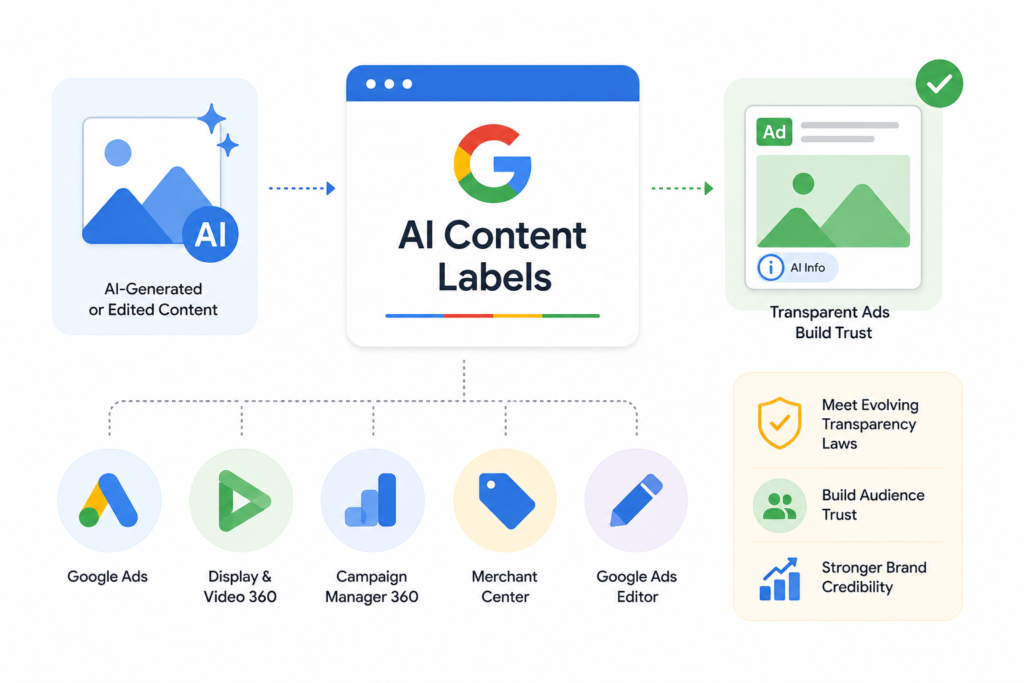
Google is rolling out AI content labels across its advertising platforms, giving advertisers a built-in way to disclose when image or video creatives were generated or edited with AI. The feature is arriving gradually across Google Ads, Display & Video 360, Campaign Manager 360, Merchant Center, and Google Ads Editor, either as a manual label on eligible assets or as an account-level setting. Google may also auto-apply labels to assets made with its own AI tools. The rollout is a direct response to AI transparency laws taking effect in markets including the European Union, India, and New York. Google has been explicit that turning the setting on doesn’t guarantee legal compliance on its own; advertisers still need to confirm what their specific market requires.
Table of Contents
- What’s Actually Rolling Out
- Why This Is Happening Now
- Where the Labels Are Showing Up
- What This Means If You Run Ads
- What the Label Doesn’t Do
- Mistakes That Look Like Strategy
- How Ad2Connect Approaches AI Ad Compliance for Clients
- Key Takeaways
What’s Actually Rolling Out
Google has started giving advertisers a native way to flag AI-generated or AI-edited creative. It’s built directly into its ad tools.
Two options are rolling out:
- A manual label. Advertisers can add a text or visual AI disclosure directly to an eligible image or video creative.
- An account-level setting. Turning this on applies the AI label automatically across eligible assets in that account.
Google has also said it may auto-apply a label to certain assets built with its own AI generation tools. This can happen even without the advertiser flipping the setting on.
These labels sit alongside Google’s existing creative rules, not in place of them. The company confirmed the new AI labels won’t conflict with policies that already restrict text overlays or watermarks on ad creatives.
Why This Is Happening Now
This isn’t Google getting ahead of a trend out of goodwill. It’s catching up to regulation that’s already landing.
AI transparency laws are moving from proposal to enforcement in several major markets at once, including the European Union, India, and New York. Each has its own disclosure requirements for AI-generated or AI-modified content in advertising, and none of them wait for platforms to build tooling before the rules take effect, which is exactly why Google built the disclosure mechanism directly into the platforms where the creative already lives, rather than leaving every advertiser to solve this creative-by-creative or bury the requirement in a policy update nobody reads.
That’s a meaningfully different approach than a terms-of-service update. It shows up as a literal setting inside Google Ads, Merchant Center, and Ads Editor. Marketers can check an AI Label column account by account.
Where the Labels Are Showing Up
The rollout is gradual, not simultaneous, across:
- Google Ads
- Display & Video 360
- Campaign Manager 360
- Merchant Center
- Google Ads Editor
PPC practitioners have already spotted the feature live in Google Ads, Merchant Center, and Ads Editor accounts. Where it’s active, an AI Label column shows whether labeling is enabled for that account. Any ad running a labeled asset displays an AI disclosure icon wherever it appears.
If you don’t see the setting in your account yet, that’s expected. This is a phased rollout. Account-level availability will vary for a while.
What This Means If You Run Ads
For most advertisers, this is a compliance checkbox, not a creative overhaul. A few things are worth acting on now, before a regulator asks.
- Audit which creatives were built or edited with AI. Include tools outside Google’s own ecosystem. The disclosure requirement is about the content, not which tool made it.
- Check the AI Label column in eligible accounts. If it’s live for you, decide whether account-level labeling or manual per-asset labeling fits your workflow better.
- Don’t assume the label alone satisfies your local law. Google has said as much directly.
- Loop in legal or compliance review for any active market. That’s the EU, India, and New York for now, with more jurisdictions likely to follow.
What the Label Doesn’t Do
Google has been unusually direct about the limits of this feature. Turning on the AI label setting does not, by itself, guarantee compliance with local regulations.
That distinction matters. Different markets define “AI-generated” differently. Some regulations require disclosure only above a certain threshold of AI involvement. Others require it for any AI editing at all, however minor. Google’s label is a mechanism for disclosure, not a legal determination of whether your creative needs one.
Advertisers in a regulated market should treat the label as infrastructure. It’s not a substitute for understanding what the local rule actually requires.
Mistakes That Look Like Strategy
- Assuming the AI label setting alone covers legal obligations in every market you advertise in.
- Only labeling assets built with Google’s own AI tools and ignoring AI-edited creative from other sources.
- Waiting for the feature to appear in every account instead of checking now whether it’s already live.
- Treating this as a one-time settings change instead of an ongoing part of creative review, since more markets are expected to add disclosure requirements.
- Skipping legal review because “Google handled it” with a built-in label.
How Ad2Connect Approaches AI Ad Compliance for Clients
At Ad2Connect, platform changes like this get folded straight into how we manage client ad accounts. We don’t treat them as a news item to skim past.
When a feature like AI labeling starts rolling out, we check client accounts directly. We don’t wait for it to become mandatory everywhere.
This mirrors the same approach we bring to broader AI search shifts, tracking what’s actually changing at the platform level before it becomes a compliance problem. It’s the same philosophy behind our coverage of AI Mode ads reaching 30% of queries and our guide on technical SEO debt, where the goal is spotting what needs attention now versus what can wait. It pairs directly with our performance marketing work, since ad compliance and ad performance increasingly live in the same account settings.
If your team runs paid media across multiple regions and isn’t sure which creatives fall under an active AI disclosure law, that’s exactly the kind of account audit our paid media team runs for clients.
Key Takeaways
- AI labeling is now built into Google’s ad platforms, rolling out gradually across Google Ads, DV360, Campaign Manager 360, Merchant Center, and Ads Editor.
- It’s a response to real regulation, not a proactive feature, with the EU, India, and New York named specifically.
- Advertisers get two options: a manual label per asset, or an account-level setting that applies it automatically.
- Google may auto-label its own AI-generated assets, even without the setting turned on.
- The label doesn’t guarantee legal compliance on its own. Confirm what your specific market actually requires.
Ad2Connect is a digital marketing agency helping SaaS, eCommerce, D2C, and local businesses grow through data-driven SEO, performance marketing, and content strategy. If you need help auditing your ad accounts for AI disclosure requirements, talk to our paid media team.