

How to Remove Negative Search Results: 5 Strategies That Work
Your branded search results are a landing page you don’t control. Here’s how to take some of that control back, without wasting months chasing a fix that was never going to work.
By Snehal Singh | Published: July 29, 2026
AI Overview Summary
Removing a negative search result starts with understanding why it ranks in the first place. It’s usually not personal. High-authority publishers, exact-name relevance, and strong engagement combine with a weak surrounding entity footprint to push negative content to the top. Five strategies address this, in order of permanence: removing the content at the source (the only truly permanent fix), using Google’s deindexing tools where eligible, pursuing legal removal for defamation or copyright issues, suppressing what can’t be removed by outranking it with stronger owned and earned content, and monitoring how AI search assistants describe your name or brand, since AI Overviews and chat assistants now answer reputation-defining questions before a searcher ever reaches a traditional results page.
Table of Contents
- Why Negative Content Ranks So Well
- The 5-Strategy Removal Framework
- Which Strategy Fits Your Situation
- Mistakes That Look Like Strategy
- How Ad2Connect Approaches Reputation and SERP Management
- Key Takeaways
Why Negative Content Ranks So Well
Before picking a strategy, it helps to know why the negative result outranks everything else. It’s rarely a targeted attack. It’s ranking mechanics working exactly as designed.
Four factors usually explain it:
- Domain authority. News sites, complaint boards, and review platforms carry high authority and get crawled constantly.
- Relevance. A negative article often names the person or brand directly in its title and URL, a near-perfect match for a branded search.
- Engagement. Negative content tends to attract more clicks and longer time on page, and that reinforces its position.
- Weak competition. Most people and small brands never build enough of an owned footprint to push it down. The negative page usually isn’t unusually strong. Everything around it is just weak.
That last point is the whole strategy in one line: reduce the negative, and strengthen the positive, at the same time.
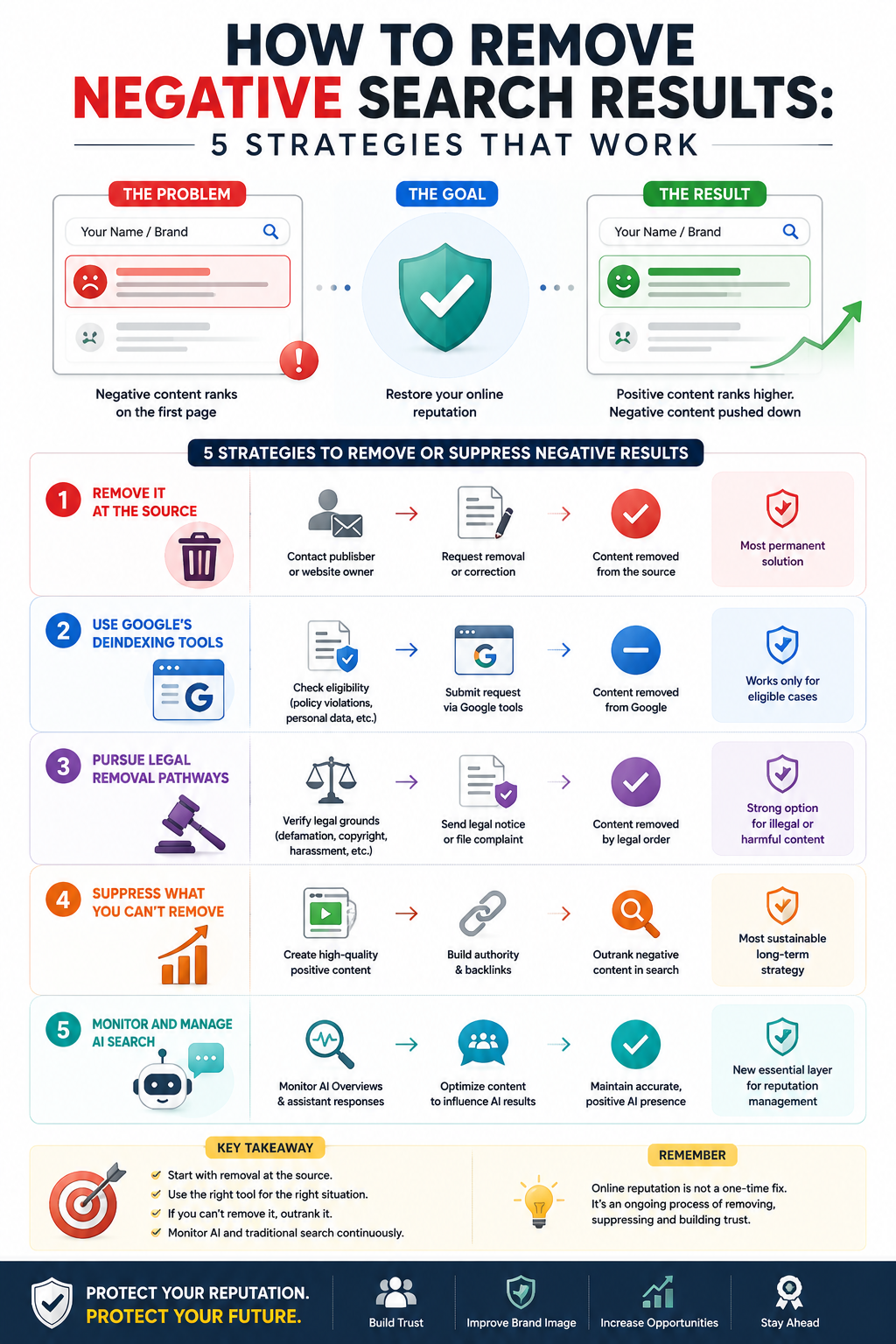
The 5-Strategy Removal Framework
These five strategies run from most permanent to most durable.
- Source removal is the strongest fix, but the hardest to secure.
- Suppression is the most achievable option, but it needs ongoing upkeep to hold.
1. Remove It at the Source
Best for: content the publisher will actually take down, correct, or noindex.
This is the only strategy that removes the problem completely. Once a publisher deletes or updates the page, there’s nothing left to rank, monitor, or maintain.
How it works:
- Find the decision-maker. For a news outlet, that’s usually an editor or standards desk, not the reporter. For a smaller site, check the contact page or a WHOIS lookup.
- Build a documented case. Point to outdated information, a dismissed or expunged case, or a clear violation of the publisher’s own editorial policy. Include proof wherever you have it.
- Ask for a fallback. If a full takedown isn’t possible, a publisher may agree to anonymize a name, update the article, or add a noindex tag. A noindexed page stays live but drops out of search, which is usually what matters most.
- Speed up deindexing. Once a change is made, submit the URL through Google’s outdated content tool.
Set expectations early. Publisher outreach usually takes weeks to months, and timelines vary a lot by content type and publisher.
2. Use Google’s Deindexing Tools
Best for: personal information exposure, doxxing, and content already changed at the source.
When a publisher won’t cooperate, Google’s own removal tools are the next step. They cover a narrower set of situations than most people expect.
- Results About You handles home addresses, phone numbers, financial and medical details, government ID numbers, and non-consensual explicit imagery, including AI-generated deepfakes. It also monitors search results for exposed contact information going forward.
- Outdated Content tool won’t remove anything live, but it forces a faster recrawl once content has already changed at the source, clearing stale, cached snippets from search results.
- Personal content removal covers non-consensual imagery and certain sensitive information on third-party sites.
One distinction is worth setting early: deindexing removes a page from search visibility, not from the internet. Anyone with the direct URL can still reach it. For most reputation problems, that’s an acceptable outcome, since visibility in search is what actually causes the damage.
3. Pursue Legal Removal Pathways
Best for: defamation, copyright infringement, and privacy violations with a genuine legal basis.
Legal routes are slower and less predictable than the first two strategies. But for the right situation, they’re the only path to true removal.
- DMCA takedowns apply to copyrighted photos, videos, or written content used without permission.
- Defamation claims apply to false statements of fact, not simply negative or unflattering coverage. Opinion is protected speech. A demonstrably false factual claim can give real leverage with both the publisher and Google’s legal removal process.
- Court orders are generally honored by platforms, though litigation carries a real risk of drawing more attention to the content.
- GDPR’s Right to be Forgotten lets individuals in Europe request delisting of results that are inadequate, irrelevant, or excessive. It only applies to European search properties and name-based queries, and roughly half of these requests are typically granted.
4. Suppress What You Can’t Remove
Best for: accurate, lawful content hosted by a publisher who won’t take it down.
Most negative content falls here. It’s true, it’s legal, and no removal request will change that. Suppression, outranking the content with stronger assets, becomes the core strategy. It’s fundamentally an SEO problem, not a legal one.
What that looks like in practice:
- Build a real entity footprint. Use an exact-match domain, structured schema markup, a consistent bio, and interlinked profiles across platforms search engines already trust.
- Claim high-authority properties. LinkedIn, Crunchbase, YouTube, and relevant industry directories. You’re not outranking a major publisher with a personal blog; you’re borrowing authority from platforms that already outrank it.
- Publish consistently. Search engines reward freshness on branded and name-plus-modifier searches. A stale positive result loses ranking power over time, even one that once outranked the negative page.
- Earn legitimate press. Interviews, contributed articles, and coverage rank on their own merit, and reinforce everything else in the footprint.
Suppression typically takes two to six months to visibly reshape a results page, and it requires continued maintenance. Stop the work, and rankings tend to drift back toward where they started.
5. Monitor and Manage AI Search
Best for: every reputation strategy running today, since this layer barely existed two years ago.
AI Overviews and chat-based assistants now answer branded queries like “who is [name]” or “is [company] legit” by synthesizing information across the open web. That includes the exact content a removal or suppression campaign is trying to fix.
This changes two things:
- Source removal becomes more valuable. Content deindexed from Google’s results can still be crawled and retrieved directly by AI systems. Content actually deleted at the source cannot.
- Owned content becomes retrieval material. Clear structured information, maintained About pages, and authoritative third-party profiles shape what an AI system says when it has to fill in gaps. Thin information means AI fills the gaps with whatever it can find, positive or not.
A modern reputation audit has to include AI Overviews and major assistants alongside the traditional SERP. Re-run branded prompts monthly. Track which sources get cited in the answers. Those citations point to which URLs need attention next.
Which Strategy Fits Your Situation
| Situation | Best-Fit Strategy |
|---|---|
| Publisher is willing to update or remove content | Source removal |
| Personal information, doxxing, or non-consensual imagery | Google’s deindexing tools |
| False factual claims, copyright use, or a claim under GDPR | Legal removal pathways |
| Content is true, legal, and the publisher won’t budge | Suppression |
| Reputation questions increasingly get asked directly to AI assistants | Ongoing AI search monitoring, layered on any strategy above |
Mistakes That Look Like Strategy
- Filing a legal threat before confirming the content is actually false, not just unflattering.
- Assuming Google’s removal tools delete a page from the internet, not just from search visibility.
- Treating suppression as a one-time project instead of ongoing maintenance.
- Ignoring AI Overviews and chat assistants because the traditional SERP looks clean.
- Escalating straight to litigation without a documented, low-friction publisher request first.
- Publishing thin, inconsistent positive content and expecting it to outrank a high-authority publisher on authority alone.
How Ad2Connect Approaches Reputation and SERP Management
At Ad2Connect, reputation and search visibility work sit under the same roof. They’re rarely separate problems.
A client rarely needs just one of these five strategies. Most need two or three running in parallel: source outreach happening while a suppression campaign builds a stronger entity footprint underneath it.
This same triage logic runs through our other diagnostic frameworks, deciding what actually needs fixing before spending a single hour on it. It’s the same approach we cover in technical SEO debt and in content decay. Suppression campaigns lean on the same content and authority-building work covered in our guide on using Google Search Console for SEO growth, and they pair naturally with a broader SEO strategy built to keep a branded SERP strong long after the immediate crisis is resolved.
If a negative result has sat on page one of your branded search for months with no real plan behind it, that’s usually a sign the right strategy was never matched to the situation.
Key Takeaways
- Source removal is the only permanent fix. Every other strategy manages visibility rather than eliminating the content itself.
- Google’s tools deindex, they don’t delete. Set that expectation early.
- Legal routes need a real legal basis. Negative isn’t the same as false, and opinion is protected speech.
- Suppression is ongoing work, not a one-time fix. Rankings drift back once the maintenance stops.
- AI search is now part of the SERP. Monitor how assistants answer branded questions, not just what shows up in traditional results.
Ad2Connect is a digital marketing agency helping SaaS, eCommerce, D2C, and local businesses grow through data-driven SEO, performance marketing, and content strategy. If a negative result is shaping how people see your brand, talk to our SEO team about building a removal and suppression plan.