Local 5.0: The AI-Driven Evolution of Local SEO
Your listings can be perfect and your reviews glowing, and AI can still skip you for a competitor. Here’s why local search now runs on evidence, not just presence.
By Snehal Singh | Published: August 22, 2026
AI Overview Summary
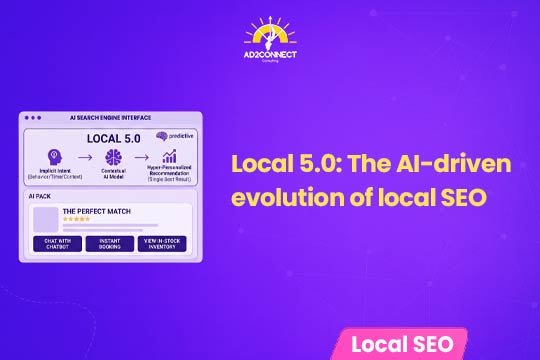
Local 5.0 is the AI-driven stage of local search, where ChatGPT, Gemini, and Perplexity decide which businesses to recommend based on verified, connected evidence, not just a well-optimized listing. Earlier stages of local SEO rewarded presence, map pack proximity, and location page content. Local 5.0 goes further: AI checks whether your website, Google Business Profile, reviews, and directory listings all agree with each other before it trusts you enough to recommend you. A business can rank well and still lose the recommendation to a competitor with cleaner, more consistent data. Winning here means building a trusted data foundation, adding real local context, publishing consistently everywhere, and tracking whether AI is actually mentioning your business.
Table of Contents
- What Is Local 5.0, Really?
- How AI Changed the Rules of Local SEO
- The 5 Stages That Led to Local 5.0
- What AI Actually Looks For
- Evidence Over Assumptions
- Brand Consistency With Local Relevance
- Specific Answers, Not Generic Pages
- The 5 Local Stages at a Glance
- The Local 5.0 Roadmap: 5 Steps to Get There
- Mistakes That Look Like Strategy
- How Ad2Connect Approaches Local SEO for Clients
- Key Takeaways
What Is Local 5.0, Really?
Local 5.0 is the name for where local search stands today, and it’s driven entirely by AI. It’s the first stage where the deciding factor isn’t what you publish about your own business, but whether AI has enough proof to trust it.
For years, local SEO meant getting your listing right and earning good reviews. That groundwork still matters, but on its own, it no longer decides who gets recommended.
How AI Changed the Rules of Local SEO
Here’s the shift in plain terms. A customer used to type “banks near me,” scroll through a list of results, click into a few, and check the details themselves. Now they ask an AI agent something far more specific, like “which bank near me offers free small-business checking and is open on Saturdays.”
Answering that question properly means AI has to pull together account details, weekend hours, and location, then confirm all of it is accurate. The verification step didn’t go away. It simply moved from the customer to the machine, and the machine only trusts what it can actually confirm.
That’s a much higher bar than being listed correctly. It’s the reason two businesses with near-identical listings can get very different treatment from AI, depending on how consistent and complete their information really is.
The 5 Stages That Led to Local 5.0
Local SEO built up in layers over time, and none of the earlier layers disappeared. Here’s how each stage set up the next.
- Local 1.0 – Listings and basic NAP consistency: The early goal was simple presence — getting your business indexed and included in directories.
- Local 2.0 – Map pack optimization and reviews: Visibility depended on proximity, a complete profile, and reputation through reviews.
- Local 3.0 – Location pages, content, and ROI: Local SEO became tied to actual website traffic and conversions.
- Local 4.0 – AI-mediated discovery and recommendation: The focus shifted to being part of the decision process itself, not just one channel among many.
- Local 5.0 – Context Intelligence: The stage we’re in now. AI interprets intent, checks evidence, and recommends businesses based on connected, verified context, not any single signal.
Your listings, reviews, and location pages are still the foundation everything else sits on. What changed is that the foundation alone no longer guarantees a recommendation.
What AI Actually Looks For
Every earlier stage rewarded completeness — be listed, be reviewed, be optimized. Local 5.0 asks for something more specific: proof, and proof that AI can actually read.
Evidence Over Assumptions
AI assistants don’t simply trust that a business is good at what it claims. They look for consistent, verifiable evidence across multiple sources before recommending anyone.
That means small inconsistencies — a wrong phone number on one directory, an outdated service list on another — can quietly cost you a recommendation, even if your actual business is excellent.
Brand Consistency With Local Relevance
For businesses with multiple locations, this is both an opportunity and a challenge. AI checks whether your brand is consistent everywhere, and whether each individual location is genuinely relevant to its local audience.
A single national description copied across ten city pages doesn’t hold up anymore. Each location needs its own accurate, locally specific details.
Specific Answers, Not Generic Pages
AI is now expected to answer very specific questions: is this hotel family-friendly, does this clinic accept a certain insurance plan, is this bank branch open on Saturdays. A generic “About Us” paragraph can’t answer any of that.
Delivering real answers means your location pages need continuously updated, specific, and verifiable details, not just a name, address, and phone number.
The 5 Local Stages at a Glance
| Stage | What It Rewarded | What Businesses Focused On |
|---|---|---|
| Local 1.0 | Presence | Getting listed and indexed |
| Local 2.0 | Proximity and reputation | Map pack ranking, reviews |
| Local 3.0 | Traffic and conversions | Location pages, website content |
| Local 4.0 | Discovery and recommendation | Being part of AI-mediated decisions |
| Local 5.0 | Verified, connected context | Consistent, evidence-backed data everywhere |
The Local 5.0 Roadmap: 5 Steps to Get There
- Build a trusted digital foundation. Make sure your website, Google Business Profile, structured data, and directory listings all say the same thing about every location. Consistency removes the ambiguity AI trusts the least.
- Add context that answers real customer questions. Go beyond hours and address. Answer the specific things customers actually ask — parking availability, insurance accepted, family-friendliness, weekend hours.
- Deliver consistent, localized experiences. Publish the same core facts everywhere, while letting each location highlight what’s genuinely unique to it, like a neighborhood offer or a local promotion.
- Measure and optimize continuously. Track how often you show up in AI answers, how often AI picks you over a competitor, whether the information about you is accurate, and where your biggest visibility gaps are.
- Scale with the right support. Managing this manually across many locations doesn’t hold up. Ongoing monitoring, prompt corrections, and consistent publishing need a repeatable process, not a one-time project.
Mistakes That Look Like Strategy
- Treating your Google Business Profile as a “set it and forget it” listing.
- Copying the same generic description across every location page.
- Chasing reviews without fixing inconsistent business information elsewhere.
- Assuming a good map pack ranking means AI will recommend you too.
- Updating your website but forgetting your directory listings, so the two now disagree.
- Measuring only traffic and rankings, without checking whether AI tools actually mention your business at all.
How Ad2Connect Approaches Local SEO for Clients
At Ad2Connect, one of the Best Local SEO Agencies in Mumbai, we treat Local 5.0 as the current baseline for local visibility, not a future trend to prepare for later.
As a boutique digital marketing agency in Malad, Mumbai, we work closely with local and multi-location businesses across India, offering local SEO services in India built specifically around connecting scattered business data into one consistent, trustworthy source.
For businesses that also need a consistent identity to match their locations, our branding and design agency team ensures consistency everywhere.
Key Takeaways
- Local 5.0 is driven entirely by AI evidence, not just presence.
- Every earlier local SEO stage still matters.
- Generic content can’t answer specific questions.
- Consistency across sources builds AI trust.
- Measure AI visibility separately from rankings.
Ad2Connect is a digital marketing agency helping SaaS, eCommerce, D2C, and local businesses grow through data-driven SEO, performance marketing, and branding.