AI Overview Traffic: What 9 Months of Data and 51,000+ Events Reveal
Google won’t tell you how much traffic AI Overviews send you. One brand tracked 51,000+ events over nine months to find out — and the numbers expose a reporting gap most businesses don’t know they have.
By Snehal Singh | Published: August 21, 2026
AI Overview Summary
A nine-month first-party tracking study of over 51,000 AI Overview referral events found that AI Overview traffic is highly volatile, ranging from 2% to 17% of total organic sessions depending on the month. The study also uncovered a major reporting problem: roughly 22.4% of AI Overview traffic was being wrongly attributed to the “Direct” channel in Google Analytics instead of “Organic Search,” meaning many businesses are underreporting their real organic performance. The content that earned the most citations was specific and structured — pricing details, comparison tables, and named facts — rather than broad, general articles.
Table of Contents
- Why Nobody Has a Clean Answer on AI Overview Traffic
- How the Tracking Was Built
- What Kind of Content Actually Gets Cited
- Why 22% of Your AI Overview Traffic May Be Hiding
- AI Overview Traffic Is Volatile, Not Fixed
- The Limitations Worth Knowing
- What This Means for Content Priorities
- Mistakes That Look Like Strategy
- How Ad2Connect Approaches AI Overview Visibility for Clients
- Key Takeaways
Why Nobody Has a Clean Answer on AI Overview Traffic
Most businesses have no real idea how much of their traffic actually comes from AI Overviews. Google Search Console doesn’t break this out as its own category, so the number stays hidden inside your regular organic traffic figures.
One SEO team decided to stop waiting for Google to fix this and built their own tracking system instead. Over nine months, from September 2025 to June 2026, they recorded more than 51,000 tracked events across 1,661 individually cited content snippets.
The resulting data offers one of the clearest independent pictures yet of how AI Overviews actually behave — and it overturns a few common assumptions.
How the Tracking Was Built
The method itself isn’t complicated, even though most teams have never set it up.
When someone clicks a cited source inside a Google AI Overview, Google sometimes adds a small piece of text to the end of the destination URL. By creating a custom tracking dimension in Google Analytics 4 that watches for this specific pattern, the team could flag sessions that likely arrived from an AI Overview click.
A few patterns stood out immediately once the data was grouped:
- Traffic is heavily concentrated. A single top-performing page accounted for thousands of events on its own, while the average page barely registered a fraction of that.
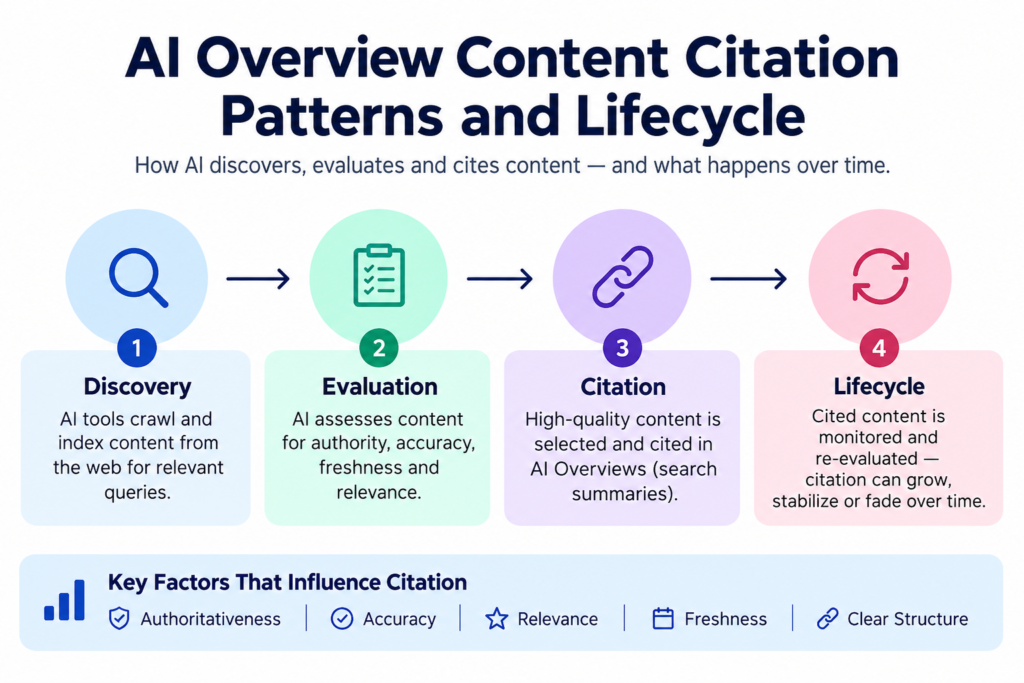
- Citations have a lifecycle. Some pages get cited for a short burst and then fade, often as seasonal interest shifts or content grows stale. Others take months to build momentum and keep climbing.
- Investment decisions get sharper. Once you can see which pages are earning citations and which aren’t, it becomes obvious where your content budget should actually go.
What Kind of Content Actually Gets Cited
Not every type of content earns the same level of citation activity. The data showed a clear pattern.
Pages with specific facts — pricing details, timing information, named comparisons — consistently earned strong and growing citation activity. Broader, more general guide-style content underperformed by comparison.
One especially interesting finding: pages using properly formatted HTML comparison tables punched well above their weight in citation frequency. That’s a strong signal about how AI Overviews decide what to surface — specific, structured answers to clearly defined questions tend to win over vague editorial writing.
Why 22% of Your AI Overview Traffic May Be Hiding
This was the most surprising part of the entire study.
When the team plotted their tracked events against standard Google Analytics 4 channel reports, they noticed something odd: a meaningful chunk of traffic that should have been logged as Organic Search was instead showing up under the Direct channel — the bucket Analytics uses when it can’t identify where a visitor actually came from; and since AI Overviews only exist inside Google Search results, any traffic genuinely arriving from one should always be counted as organic, which meant this wasn’t a small rounding error but a systemic reporting gap, so the team began tracking it specifically on a monthly basis and found that, across the full nine-month dataset, an average of 22.4% of all AI Overview referral events were being silently misattributed to Direct traffic instead of Organic Search — with the worst single month seeing nearly 3 in 10 AI Overview sessions vanish into the Direct bucket, meaning that any business relying purely on their standard analytics dashboard to judge organic performance is very likely underreporting their real search visibility without ever realizing it.
AI Overview Traffic Is Volatile, Not Fixed
Across the full nine-month period, AI Overview referrals made up roughly 7.5% of total organic sessions on average. But that average hides a much bigger swing underneath it.
At its peak, during a two-month stretch, AI Overview traffic climbed to nearly one in every six organic visitors. More recently, that share dropped back down to a small single-digit percentage.
This volatility matters for planning. Any business treating AI Overview traffic as a stable, predictable slice of their organic numbers is likely building forecasts on shaky ground.
The Limitations Worth Knowing
Two honest caveats apply to this kind of self-built tracking, and they’re worth understanding before you try to replicate it.
- The tracking signal isn’t exclusive to AI Overviews. The same URL pattern also appears with Featured Snippets and People Also Ask results, so some of the recorded activity may technically come from those formats instead.
- It compares events to sessions, not sessions to sessions. Because the custom tracking dimension is event-based, the resulting percentage isn’t a perfectly clean apples-to-apples comparison — though it remains directionally useful.
What This Means for Content Priorities
| Content Type | Citation Behavior | Recommended Action |
|---|---|---|
| Pricing and specific-fact pages | Frequently cited, growing over time | Refresh and expand regularly |
| Structured comparison tables | Punches above its weight in citations | Build more, and format properly in HTML |
| Broad guide-style content | Underperforms relative to potential | Rework toward specific, answer-first sections |
| Vague editorial content | Rarely cited | Deprioritize for AI Overview targeting |
Mistakes That Look Like Strategy
- Assuming Search Console gives you the full picture of your AI Overview traffic when it currently doesn’t.
- Treating one strong month of AI Overview traffic as a new, permanent baseline.
- Never checking how much of your reported “Direct” traffic might actually be misattributed organic sessions.
- Writing broad, general content when the data shows specific, structured answers earn more citations.
- Ignoring HTML table formatting for comparison content that could otherwise earn stronger citation activity.
- Letting high-performing cited pages go stale instead of refreshing them on a regular schedule.
How Ad2Connect Approaches AI Overview Visibility for Clients
At Ad2Connect, one of the top SEO companies and agencies in Mumbai, India, we treat AI Overview visibility as data-driven work, not guesswork. Our SEO services include setting up the kind of first-party tracking outlined here, so clients get an honest picture of how much traffic AI Overviews are really sending, instead of relying on Search Console alone.
As a professional SEO services provider and one of the best SEO agencies in Mumbai, we also audit GA4 reporting for misattribution gaps like the one this data uncovered, since an inaccurate baseline undermines every decision built on top of it. This diagnostic work pairs naturally with performance marketing reporting, and with branding support, so the structured, specific content that earns AI citations stays consistent with how a client’s brand is positioned everywhere else.
Key Takeaways
- Search Console doesn’t show AI Overview traffic separately. First-party tracking is currently the only reliable way to see it.
- Specific, structured content wins citations. Prices, comparisons, and tables outperform vague editorial writing.
- Your organic traffic may be underreported. A meaningful share of AI Overview sessions can get misattributed to Direct in GA4.
- AI Overview traffic is volatile. Don’t treat any single strong month as your new normal.
- Citations have a lifecycle. Cited pages need regular refreshes to keep their position.
Ad2Connect is a boutique digital marketing agency in Malad, Mumbai, helping SaaS, eCommerce, D2C, and local businesses grow through data-driven SEO, performance marketing, and content strategy. If you’re not sure how much of your traffic is coming from AI Overviews, or whether your analytics are reporting it accurately, talk to our SEO team about a visibility audit.